Think your kid is not “sexting”? Think again. Sexting — sharing sexually explicit photos, videos and chat by cell phone or online — is fairly commonplace among young people, despite sometimes grim consequences for those who do it.
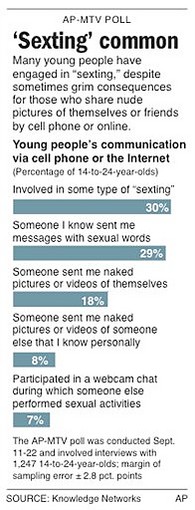
More than a quarter of young people have been involved in sexting in some form, an Associated Press-MTV poll found. That includes Sammy, a 16-year-old from the San Francisco Bay Area who asked that his last name not be used.
Sammy said he had shared naked pictures of himself with girlfriends. He also shared naked pictures of someone else that a friend had sent him.
What he didn’t realize at the time was that young people across the country — in Florida, Indiana, Ohio and Pennsylvania — have faced charges, in some cases felony charges, for sending nude pictures.
“That’s why I probably wouldn’t do it again,” Sammy said.
Yet, “I just don’t see it as that big of a problem, personally.”
That was the view of nearly half of those surveyed who have been involved in sexting. The other half said it’s a serious problem — and did it anyway. Knowing there might be consequences hasn’t stopped them.
 “There’s definitely the invincibility factor that young people feel,” said Kathleen Bogle, a sociology professor at La Salle University in Philadelphia and author of the book “Hooking Up: Sex, Dating and Relationships on Campus.”
“That’s part of the reason why they have a high rate of car accidents and things like that, is they think, `Oh, well, that will never happen to me,'” Bogle said.
Research shows teenage brains are not quite mature enough to make good decisions consistently. By the mid-teens, the brain’s reward centers, the parts involved in emotional arousal, are well-developed, making teens more vulnerable to peer pressure.
But it is not until the early 20s that the brain’s frontal cortex, where reasoning connects with emotion, enabling people to weigh consequences, has finished forming.
Beyond feeling invincible, young people also have a much different view of sexual photos that might be posted online, Bogle said. They don’t think about the idea that those photos might wind up in the hands of potential employers or college admissions officers, she said.
“Sometimes they think of it as a joke; they have a laugh about it,” Bogle said. “In some cases, it’s seen as flirtation. They’re thinking of it as something far less serious and aren’t thinking of it as consequences down the road or who can get hold of this information. They’re also not thinking about worst-case scenarios that parents might worry about.”
Sexting doesn’t stop with teenagers. Young adults are even more likely to have sexted; one-third of them said they had been involved in sexting, compared with about one-quarter of teenagers.
Thelma, a 25-year-old from Natchitoches, La., who didn’t want her last name used, said she’s been asked more than once to send naked pictures of herself to a man.
“It’s just when you’re talking to a guy who’s interested in you, and you might have a sexual relationship, so they just want to see you naked,” she said, adding that she never complied with those requests.
“But with my current boyfriend, I did it on my own; he didn’t ask me,” she said, adding that she was confident he would keep the image to himself.
Those who sent nude pictures of themselves mostly said they went to a boyfriend, girlfriend or romantic interest. But 14 percent said they suspect the pictures were shared without permission, and they may be right: Seventeen percent of those who received naked pictures said they passed them along to someone else, often to more than just one person.
Boys were a little more likely than girls to say they received naked pictures or video of someone that had been passed around without the person’s consent. Common reasons were that they thought other people would want to see, that they were showing off and that they were bored. Girls were a little more likely to send pictures of themselves. Yet boys were more likely to say that sexting is “hot,” while most girls called it “slutty.” Altogether, 10 percent said they had sent naked pictures of themselves on their cell phone or online.
Criminal charges aren’t the worst consequences. In at least two cases, sexting has been linked to suicide. Last year in Cincinnati, 18-year-old Jessica Logan hanged herself after weeks of ridicule at school; she had sent a nude cell phone picture to her boyfriend, and after they broke up, he forwarded the picture to other girls.
And three months ago, 13-year-old Hope Witsell hanged herself, after relentless taunting at her school near Tampa, Fla. She had sent a nude photo of herself to a boy she liked, and another girl used his phone to send the picture to other students who forwarded it along. The St. Petersburg Times first reported on Hope’s death this week.
Other teenage suicides have been linked to online bullying, also a subject of the AP-MTV poll. Half of all young people said they have been targets of digital bullying.
That can mean someone wrote something about them on the Internet that was mean or a lie, or someone shared an e-mail or instant message that was supposed to be private. Less often, it can be more serious, such as taking pictures or video of someone in a sexual situation and sharing it with others.
The AP-MTV poll was conducted Sept. 11-22, and involved online interviews with 1,247 teenagers and adults ages 14-24. It has a margin of sampling error of plus or minus 2.8 percentage points. The poll is part of an MTV campaign, “A Thin Line,” aiming to stop the spread of digital abuse.
The survey was conducted by Knowledge Networks, which initially contacted people using traditional telephone and mail polling methods and followed with online interviews. People chosen for the study who had no Internet access were given it for free.