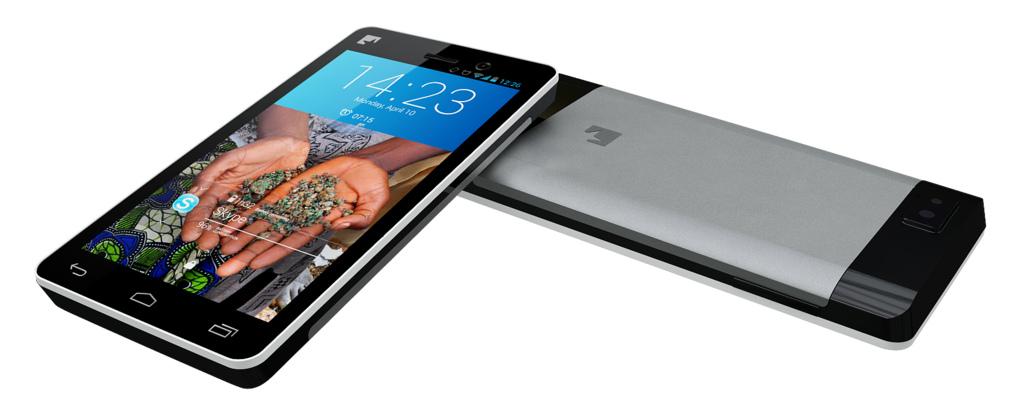
If you read this site, you likely own a number of mobile gadgets. But do you know where they come from? Do you know where they are made, or how workers are treated at those factories? The answers may shock and surprise you. It takes dozens of minerals to build a smartphone, and they often come from areas full of conflict. Yes, sometimes people die obtaining the minerals to build your device. And the workers in Chinese factories that build them are often underpaid and mistreated. If this bothers you, there is a company trying to change things. It’s called Fairphone.
The Fairphone story begins back in 2010 as an awareness campaign designed to educate people about the fact that the sourcing of the minerals going into our electronics is fueling war, specifically in the DR Congo. It grew out of the Waag Society research institute in the Netherlands and developed into a social enterprise. Through fact-finding missions and research, it soon became clear that the best way forward would be to form a company and actually make a fair phone.
“As a designer, it disturbed me that no one in the world truly understands how a mobile phone is made and when you don’t understand how something is made, you can’t change it,” said Bas van Abel, Fairphone’s founder and CEO. “Consuming is a political act … if you have a choice. With Fairphone, I want to offer buyers this choice, while raising the bar for the industry. By buying this phone, you join a movement to change the way things are made.”
The Fairphone proposition
Thus far Fairphone has run on non-profit funding from NGOs (non-government organizations) and seed investors with a social conscience. They have sourced some conflict-free tin and tantalum, and have committed to ensuring good working conditions for their suppliers, environmental protection, and safe recycling practices. Transparency is at the core of this, and so Fairphone will provide customers with a complete price breakdown, a Bill of Materials, and a list of suppliers.
“We’ve joined a supply chain in the Democratic Republic of Congo (DRC) that guarantees these minerals don’t fund illegal armed forces,” said Bas van Abel in a blog post. “The soldering paste we will use contains conflict-free tin from mines located in the South Kivu province. The conflict-free tantalum in our capacitors is extracted from coltan sourced from the Mai Baridi, Kisengo, and Luba mines, located in the northern part of the Katanga province. By focusing on a single region, we can formalize the mining sector, increase employment for small-scale miners, and contribute to regional stability.”
In order to get production up and running, without having to accept investment that may compromise the small team of seven’s control over the project, it decided to crowdfund. They need 5,000 pre-orders to enter production. As I write this Fairphone has already received 3,096 orders and there are 16 days left.
What is the Fairphone?
If you’ve been wondering about the specs, we can tell you the Fairphone sounds like a solid mid-to-upper range Android phone. It will have a 4.3-inch display with a 960×540 pixel resolution, a 1.2GHz quad-core processor, 1GB of RAM, an 8-megapixel main camera, a 1.3-megapixel front-facing camera, 16GB of storage, and a 2,000mAh battery. It will run on GSM and WCDMA networks. LTE was not included in order to keep costs down.
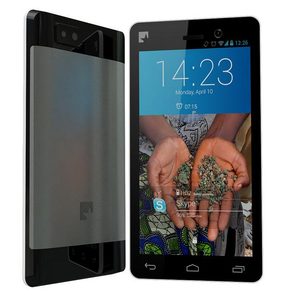
It will ship with Android 4.2 and there will be a Fairphone overlay, developed by Kwame, and designed to be intuitive and accessible. The focus is on making the phone as usable as possible. It will also be an unlockable bootloader, and when I spoke to Joe Mier, Community Manager at Fairphone, he told us that it’s fully rootable and they’re “in the process of talking with open source developer communities like Firefox and Ubuntu.”
The Fairphone will also have a replaceable battery, a microSD card slot, and it won’t ship with headphones or a charger by default, because it’s wasteful if you don’t need them. Interestingly, the Fairphone will also be a dual-SIM device, which is great for frequent travelers, and will also help to extend its life in secondary markets.
What about the price and availability?
It is on sale for 325 euros which is around $420. If we compare that with the 16GB Nexus 4 at $350 direct from Google (without sales tax), then you can see that you’re obviously paying a small premium for those ethical credentials, but it’s a reasonable proposition. It’s also worth remembering that Google charges more for the Nexus 4 in Europe.
Now comes the bad news – the Fairphone is only on sale in Europe right now. The GSM support means that it would work on AT&T and T-Mobile in the States, but Fairphone is a small company and this is only the beginning. Joe told us that the problem is largely one of logistics, “we would have to have a service center there because right now any repair issues mean shipping to Amsterdam.” He also acknowledged that “we have to make partnerships with the carriers…it will likely be 2014 before we can launch in the States.”
How fair is it?
When we asked about the possibility of a Fairtablet and other electronics down the line, Joe told us that they have already had inquires, but he was at pains to point out that this is very much a work in progress: “Our Fairphone is not 100 percent fair. There is so much to be done. We want to be clear on managing expectations; there are 30 different minerals that go into a smartphone, but this year we’re tackling two with long term plans to handle a few more.”
We’ve highlighted the challenge of finding eco-friendly smartphones before. The trouble is there are so many ways to measure environmental and ethical issues, and a real lack of transparency in the average supply chain.
“Our end goal is to have transparent, long-term relationships with suppliers to ensure good working conditions, environmental protection, and safe recycling practices,” writes CEO Bas van Abel. “There are many challenges to overcome, so we’re taking a realistic approach, one step at a time. Besides undertaking assessments of working conditions with their known limitations, we are in talks to create a worker welfare fund. The fund will bring together workers and management and give them a say in how to resolve issues revealed by the audits, for example working on issues of living conditions, wages, and education.”
The future for Fairphone
The team at Fairphone may be idealistic, but they aren’t unrealistic. Their expectations for this are modest and they are not expecting an overnight revolution in the way our electronics are made. When we asked Joe about what the best outcome would be he said that “all these other people with best practices would come rushing to us and say hey check out our amazing sustainable box and please ship with this, or we’ve been working on fair trade services, let’s work together.”
The hope is that the growth of Fairphone will attract more partners, that it can continue to take advice from NGOs with similar goals, and that it can work together toward a truly fair phone in the short term. Ultimately would love to influence the wider industry and encourage more ethical sourcing and manufacturing in the long term, but the first step is to actually start selling those phones.
If you’re interested, you can pre-order the Fairphone and find out more at www.fairphone.com. It is expected to ship in October. If it doesn’t hit that initial 5,000 target, all pre-orders will be fully refunded, but we have a strong feeling it’ll make it.