  1. Home
  2. Space
  3. News

These are the suits space tourists will wear on Virgin Galactic flights

Add as a preferred source on Google

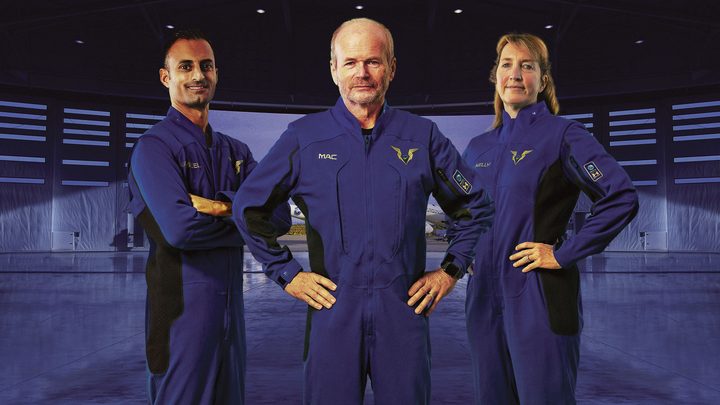
Virgin Galactic pilot spacesuits, modelled by Virgin Galactic Pilot Jameel Janjua, Virgin Galactic Chief Pilot Dave Mackay, and Virgin Galactic Pilot Kelly Latimer
Virgin Galactic pilot spacesuits, modeled by Virgin Galactic Pilot Jameel Janjua, Virgin Galactic Chief Pilot Dave Mackay, and Virgin Galactic Pilot Kelly Latimer. Virgin Galactic

Virgin Galactic has unveiled the spacesuits that will be worn by its pilots and customers for its upcoming sub-orbital space flights from Spaceport America.

Recommended Videos

The suits will be worn on the company’s upcoming test flight on December 11, which is to be the first crewed spaceflight from the new spaceport in New Mexico. The test flight had been planned for November but was pushed back due to coronavirus precautions at the spaceport. Eventually, this will be the location where space tourism flights take off from.

Virgin Galactic said its priorities when designing the suits were safety and comfort, so the designers chose materials that are lightweight but also strong. The suit weighs just over one kilogram (2.2 pounds) and is constructed of flight-grade fabrics that work for all the flight stages including takeoff and zero gravity.

During the launch phase, pilots experience strong gravity which presses them back into their seats, so fabrics need to be durable. And the suits have extra cushioning around the shoulders to protect wearers from the straps which hold them in their seats in the zero-gravity environment.

The knitted fabric of the suit is also designed to regulate body temperature, as pilots can expect to experience a range of temperatures including hot sunshine while on the ground at the spaceport in New Mexico.

When space tourists are allowed on flights in the future, they will wear very similar suits. But the suits for the pilots have black inserts to differentiate them from the customers’. The pilot suits have a distinguishing pilot wings logo on the chest as well.

One of the people who will be the first to test out the suits in a real flight is Dave Mackay, Virgin Galactic Chief Pilot, who will be on board the test flight next week. “It’s a real honor for all of us in the Virgin Galactic Pilot Corps to wear these spacesuits,” he said in a statement. “The thoughtfulness of the design ensures the suits are not only comfortable and practical, but also bespoke to each pilot.

“As soon as you step into the suit, you immediately get a sense of the significance of our mission. I’m very much looking forward to wearing my own spacesuit during New Mexico’s first human spaceflight later this month and then many times in the future as we share the wonder of space with our Future Astronauts.”

Georgina Torbet
Georgina has been the space writer at Digital Trends space writer for six years, covering human space exploration, planetary…
Dimming the sun sounds unhinged, but this new study on El Niño makes a surprisingly good case for it
A natural test case, Australia's worst-ever wildfire season, suggests the idea deserves serious consideration.
Nature, Outdoors, Sky

When I first saw "scientists propose dimming the sun," I rolled my eyes. It sounds like a science fiction movie cooked up after watching many climate documentaries. But a new study, published on July 8, 2026, in the journal Science Advances, seems to have a genuinely compelling argument.

A Super El Niño is currently forming in the Pacific, feared to be the most intense in decades. It could escalate floods, wildfires, and extreme heat events worldwide. However, Researchers at UC San Diego's Scripps Institution of Oceanography, led by climate scientists Kate Ricke and Jessica Wan, are now proposing one of the most interesting solutions I’ve come across.

Read more
You can now walk through space and gaze into a black hole at this VR exhibit
Smithsonian Starstruck lets you drift past dying stars and see the origin point of the universe for as little as $18 a person.
Smithsonian Starstruck featured

Most planetarium shows ask you to sit still and look up. The Smithsonian's new VR exhibit takes a different approach, letting visitors walk through the vast expanse of the universe, drifting past stars, planets, and a black hole to get a physical sense of its true scale.

A $29 ticket to the edge of the galaxy

Read more
Scientists warn Elon Musk’s orbital data centers could blind Earth’s biggest telescopes
A new ESO study suggests millions of satellites could make parts of the night sky effectively unusable for astronomy.
One hour of satellites over the northern Atacama Desert in Chile (October 2025)

The race to blanket Earth with satellite internet has unlocked faster connectivity for millions. But according to the European Southern Observatory (ESO), it could also make one of humanity's oldest hobbies, and one of its most important sciences, a whole lot harder. The organization warns that the rapid growth of satellite mega-constellations could severely disrupt observations made by some of the world's most powerful telescopes.

Astronomers say the night sky is reaching its limit

Read more