1. Home
  2. Phones
  3. Mobile
  4. News

Google’s Find My Device app is copying a helpful iPhone feature

Add as a preferred source on Google
Someone using Find My with an iPhone 15.
Apple

Google’s Find My Device network is still a work in progress, with features being added slowly. According to 9to5Google, an important feature that could arrive soon has proven crucial to its chief competitor, Apple, with the Find My app on the iPhone.

In the latest version of the Find My Device app for Android, v3.1.148, Google has set what’s being called a “foundation” for a compass feature — just like Apple’s Precision Finding tool.

Recommended Videos

Additionally, 9to5Google uncovered that “Strings show that the app will direct you to find a device using messages such as ‘Turn left,’ ‘Turn right,’ and ‘The device is behind you.’” It also believes the language “leave(s) the door open to this being an upgrade to existing functionality for finding trackers.”

Apple introduced something similar last year with its Precision Finding feature. If you have an iPhone 15 or iPhone 16 and are using Find My to locate an item that also has UWB, you get precise directions to your lost item (you can see it in the photo above). It’s extremely handy, and the prospect of something similar coming to Android is pretty exciting.
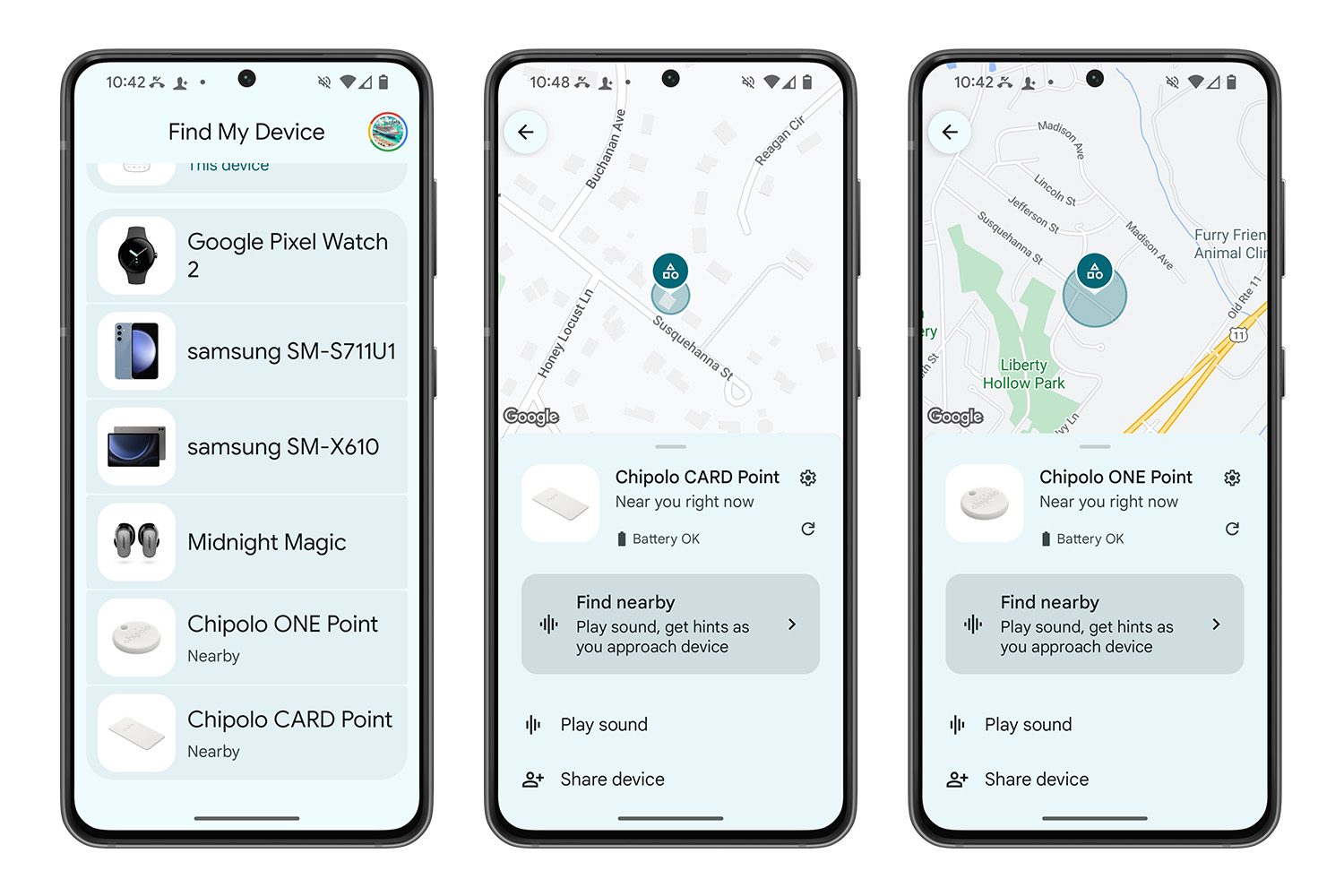
screenshots showing Google's Find My Device app on a Samsung device.
Google Find My Device Bryan M. Wolfe / Digital Trends

UWB trackers, or Ultra-Wideband trackers, utilize UWB technology for precise location tracking. They send and receive short pulses of radio waves over a wide frequency spectrum, allowing for highly accurate distance measurements and positioning. UWB technology is suitable for both indoor and outdoor use. It can provide real-time location updates and is noted for its low battery consumption.

In 2023, Google launched its Find My Device service, which enables users to remotely locate, secure, and manage their lost or misplaced Android devices. However, the service has faced criticism for providing inaccurate or outdated location information, limited offline tracking capabilities, and security concerns. Some users also need help verifying their identity when accessing Find My Device, particularly in emergencies.

One of the first third-party products to support Google’s Find My network is the Chipolo One Spot. It arrived earlier this year, and I think it’s a step in the right direction for both Chipolo and Google.

There’s no official word on when Google will release its more precise tracking feature, but we’ll keep our eye out for an announcement (hopefully) soon.

Bryan M. Wolfe
Former Mobile and A/V Freelancer
Bryan M. Wolfe has over a decade of experience as a technology writer. He writes about mobile.
A US state just approved an AI doctor. For now, it’ll only prescribe acne cures.
Aside from acne, Nolla's AI can also handle redness, fine lines and wrinkles, hyperpigmentation and dark spots, and under-eye bags.
Nolla Derm AI doctor app.

The first AI doctor is here. Despite all the skepticism and risks associated with AI models going haywire, the state of Utah just approved Nolla Health, a company that is providing an AI healthcare expert capable of writing prescriptions without any human in the chain. For now, it will only write acne prescriptions for Utah residents over 18 years of age, willing to pay a token monthly subscription fee that's lighter than your Spotify bill.

The big push here is that the Nolla Derm app will reduce the costs of medical consultation, save users the hassle of clinic visits, and take out the problem of waitlisting from the entire healthcare equation. “Unlike telehealth platforms that use AI only to collect information before handing patients off to clinicians, Nolla's AI system is designed to independently issue initial prescriptions within tightly defined, physician-approved treatment protocols,” writes the company. 

Read more
Google may be teaching Pixel Search to think one step ahead
Pixel Search could soon help finish the job after finding what you need
Electronics, Mobile Phone, Phone

Google ships its phones with Pixel Search that is built to save you from digging through your phone to find an app, email, photo, and more. Now, it appears to be taking this process even further by trying to figure out what you want to do with the results.

An APK teardown of Pixel Search version 1.0.983036833 by Android Authority has uncovered an unreleased feature called Gemini-powered suggestions. Strings inside the app describe it as a way to surface relevant information alongside Gemini-suggested actions that can help you “finish a task faster.”

Read more
Not sure if a Prime Day deal is legit? Malwarebytes has a free link checker to verify it
Scam Link Check analyzes URLs for phishing pages, redirects, and newly registered domains.
Online Scam Fraud MacBook

Amazon Prime Big Deal Days is about to kick off, which means shoppers are going to see plenty of emails, texts, ads, and social posts promising limited-time discounts. Scammers know the drill too. Fake shopping sites can now copy familiar brands, recreate convincing storefronts, and use AI-generated images or polished copy to make a bad link look legitimate at first glance.

Malwarebytes has launched Scam Link Check, a free tool for checking a questionable URL before opening it. Paste in an address and the service analyzes where it leads and looks for signs that something is wrong.

Read more