“LG’s V50 ThinQ is a boring but capable phone.”
- 5G-ready
- Beautiful, bright screen
- Flush camera design, versatile lenses
- Speedy performance
- Software needs polish, too much bloatware
- Concerning battery life on 4G LTE
- Expensive


“Why you can trust Digital Trends – We have a 20-year history of testing, reviewing, and rating products, services and apps to help you make a sound buying decision. Find out more about how we test and score products.“
You should not buy a 5G phone this year. Coverage is too spotty, with a lot of caveats, and it doesn’t help that 5G phones are overpriced. It’s fun to watch a nearly 2GB game download in 25 seconds, but the next-gen network technology is not worth the price of admission. Yet.
The LG V50 ThinQ doesn’t change that. It doesn’t offer much new over last year’s LG V40 ThinQ, which makes it dull, and the competition offers better features for less. It’s the first phone from LG to support 5G, which is why its $1,152 price (on Sprint) is so high. That’s why you should skip it.
5G on the V50
Ok. Let’s talk 5G.
The V50 ThinQ is a 5G phone, but it’s only available through Sprint and Verizon right now. There’s no unlocked version. It’s also not interoperable, so if you buy the V50 ThinQ from Sprint, it will not work on Verizon’s 5G network (and vice versa). That’s because Sprint’s V50 utilizes mid-band spectrum while Verizon’s model opts for millimeter wave (mmWave). Check out our guide explaining the different spectrum variants for 5G for more, and our in-depth explainer on 5G is worth a look.


You can only buy the V50 ThinQ in cities where 5G is available. That’s for the best, as there’s no reason to shell out over $1,000 for the V50 if you can’t access 5G. It works on 4G LTE, but 5G support is the phone’s killer feature.
I’ve tested the V50 ThinQ on Sprint’s 5G network in Dallas and saw download speeds hovering around 350Mbps. That’s not the quickest around. However, Sprint’s mid-band spectrum 5G works in a broader area. I haven’t tested the V50 on Verizon’s 5G network, but you should expect higher speeds thanks to mmWave (500Mbps-1Gbps), which should resemble my tests with the Galaxy S10 5G (also mmWave). However, mmWave has limited range. When I tested the Galaxy S10 5G, I noted that 5G dropped back to 4G LTE when I entered buildings, or even went more than a block away from the 5G node.
I’ll update this review when Sprint’s 5G comes to New York City, which will let me test 5G connectivity for prolonged use. This review is based on the V50 ThinQ connected to 4G LTE.
Same ol’ design
If it ain’t broke, don’t fix it. That’s what I presume LG’s design team thought when designing the V50, as it has (almost) the same look as the LG V40. What is new? There’s a gaudy 5G logo at the top of the rear that lights up yellow when the phone is connected to 5G (or when it feels like it). It’s tacky.
I do love the flush camera design. It rests under the Gorilla Glass 6 back, and the casing that surrounds it has been removed, which makes the triple-lens setup elegant and clean. An easy-to-access fingerprint sensor sits below.
Watching movies and playing games is a joy, and the screen is bright enough to see in sunny conditions. It’s excellent.
The V50 isn’t unwieldy for its size. The curved edges on the back and front make it feel comfortable to hold. You will need to adjust how you hold the phone to reach the top corners of the screen. It’s light, but that can make it feel less substantial than the Galaxy S10 5G.
The front is protected with Corning’s Gorilla Glass 5, and you’d be hard-pressed to find a difference with the design next to the V40. That’s disappointing, as other phone-makers like Samsung and OnePlus have managed to offer the latest styles on new phones instead of recycling the same look. There’s no hole-punch or pop-up camera here, just a notch — which is so 2018.
A button on the left edge of the phone accesses Google Assistant. I use Assistant a lot, but I didn’t use the button much — your mileage may vary. Sadly, you can’t remap it.
Excellent display and a focus on hi-res audio
The screen is a highlight. It’s a vast 6.4-inch OLED with sharp 3,120 x 1,440 resolution. It’s detailed, colorful, and delivers deep blacks. Watching movies and playing games is a joy, and the screen is bright enough to see in sunny conditions. It’s excellent.

The audio setup is great, too. You get stereo speakers, and LG’s “Boombox” feature from last year’s LG G7 makes a return. If you place the phone on certain surfaces (like a hollow box or a wood table), audio is amplified and room-filling. It doesn’t beat the Razer Phone 2, but it’s a good alternative if you don’t have a Bluetooth speaker.
The V50 also supports DTS:X 3D surround sound, has a 32-bit Quad DAC, supports hi-res audio files, and has a headphone jack to tie it all together. You’ll have a great time listening to music with this phone.
Speedy performance
Like most Android flagship phones of 2019, the V50 ThinQ is powered by Qualcomm’s Snapdragon 855 processor with 6GB of RAM. It’s a powerful chip, and I have yet to run into any issues.

Here are a few benchmark results:
- AnTuTu 3DBench: 338,438
- Geekbench 4 CPU: 3,326 single-core; 10,392 multi-core
- 3DMark Sling Shot Extreme: 4,469 (Vulkan)
It can’t match the OnePlus 7 Pro, a leader in our tests at the moment, but it comes close to other Snapdragon 855 chips like the Samsung Galaxy S10 Plus.
Games like Alto’s Odyssey, PUBG: Mobile, Harry Potter: Wizards Unite, and Pako: Forever ran without a hitch on the V50. You won’t have any problems running the latest apps on this phone for years to come.
The software could use some work
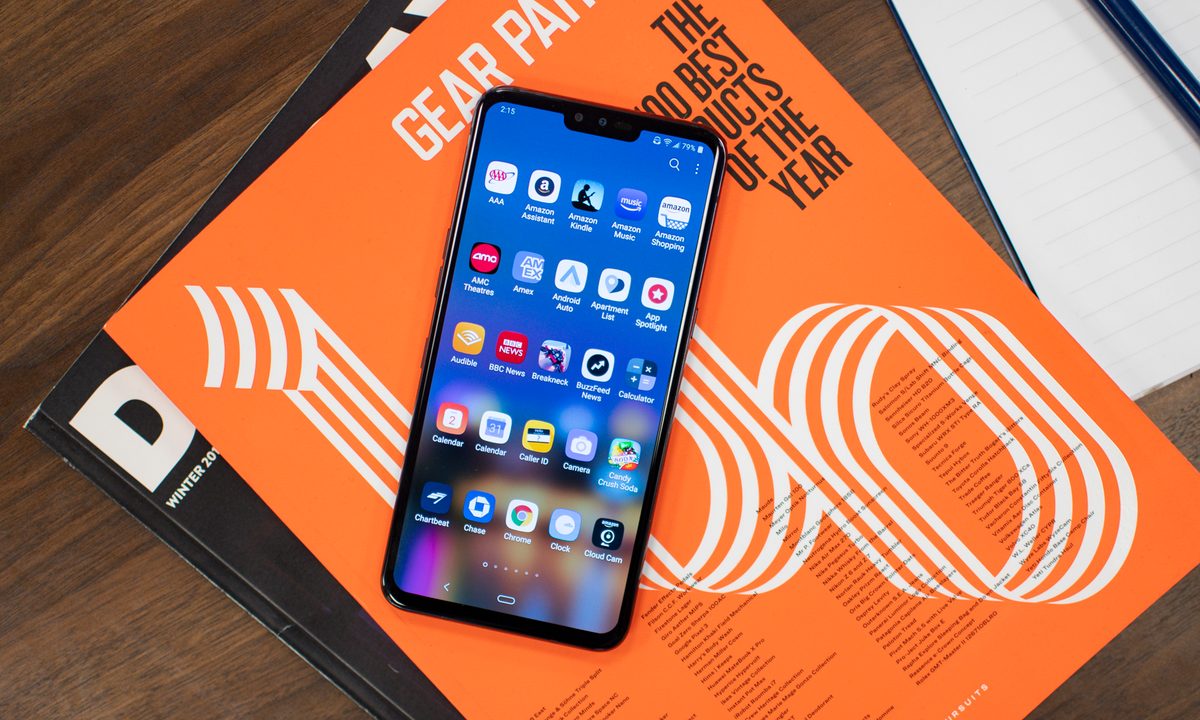
The V50 ThinQ runs Android 9 Pie, and while LG’s skin over it looks alright, it’s not my favorite.

Quickly switching between apps is always a hit-or-miss experience. It tends to skip over a few apps and opens another app completely. It’s the only phone where I’ve ever noticed this issue. The App Drawer is also frustrating. Anytime I installed an app, I had to manually sort it “Alphabetically,” because it would keep adding new apps to the very end of the list. Just…why?
I can’t forget to mention that I had to manually customize the camera app interface for it to make sense. By default, you must swipe various modes all the way to the left to get to the More menu, all just to tap on features like Night View. I realized later you can customize the interface to make your most-used features more accessible, but the overflow menu shouldn’t be so far away by default. It’s unintuitive.
Versatile camera
I wasn’t a fan of the five cameras on the LG V40 ThinQ, so I expected little from the LG V50, which has the same camera setup. However, LG has improved image processing, so results have improved.


The V50 has a triple-camera lens system on the back comprised of a 12-megapixel f/1.5 standard lens (with optical image stabilization), a 16-megapixel f/1.9 wide-angle lens, and a 12-megapixel f/2.4 telephoto lens. The best part of this phone’s camera is its versatility. Want a close-up? The telephoto lens offers a 2x optical zoom. Want to take it all in? Switch to the wide-angle lens for a 107-degree field of view.
Photos from all three lenses are detailed in good lighting. Colors veer toward oversaturation, but they’re otherwise close to accurate. It’s low-light situations where the wide-angle and telephoto lens start to falter. The standard does better, but grain pops in and images can be blurry.


That’s why LG has added Night View mode, which captures multiple images together and stacks them to produce one strong photo. It works well, though you need to stand still when capturing photos in this mode. It’s not as good as the Google Pixel 3a’s Night Sight, but comes close.


Portrait Mode on the V50 does a great job of making the blur outline around a subject look natural, but I’ve found it wildly overexposes the image in high-contrast scenarios. The bokeh effect doesn’t look as appealing as the ones on other phones.
A new feature called Portrait Video works when you’re in Portrait Mode on the camera — tap the video record button, and it will add a bokeh effect around a subject while filming. The same feature is on phones like the Galaxy S10 5G and the Huawei Mate 20, and I’ve yet to see it work perfectly. Errors are common and obvious.
You’ll find two selfie cameras on the V50. One is an 8-megapixel lens with an f/1.9 aperture, and the other a wide-angle 5-megapixel lens with an f/2.2 aperture. The latter lets you capture more in a shot, which is great for group selfies.


Selfies look good in good lighting but can be overexposed. Selfies can also look a little soft and not entirely in focus. The sharpness issues become more obvious in poor lighting.
The LG V50 ThinQ takes decent photos, but it doesn’t match phones like the Google Pixel 3 and Pixel 3a (which are less expensive).
Battery life
The V50’s Achilles’ heel is battery life. With average use, I ended work days with around 30 percent by 7 p.m. If I took the phone out for longer, it would be dangerously close to dying by the end of the day. Heavier usage saw it drop much faster, and I’d need to plug it in before the day ended.
It’s a 4,000mAh battery, but keep in mind I’ve maxed out the resolution and toggled most of the features on. If you leave it at the default resolution, your battery life will be better.
In our battery test playing a 1080p YouTube video on max brightness over Wi-Fi, the LG V50 managed to last 10 hours and 30 minutes before dying. That’s a decent result, but it’s not as good as other phones with similarly sized batteries. The Galaxy S10 Plus (4,100mAh) lasted 12 hours and 40 minutes; the Huawei P30 Pro (4,200mAh) lasted 16 hours and 4 minutes; and the Google Pixel 3a XL (3,700mAh) lasted 10 hours and 45 minutes.
While testing Sprint’s 5G network in Dallas, the phone’s battery dipped to around 50 percent after 3 to 4 hours of intensive testing. It’s difficult to gauge what battery life will be like on 5G without prolonged testing.
When it comes time to recharge, you’ll find support for Qi wireless charging and Qualcomm’s Quick Charge 3.0 for faster wired charging.
Price, availability, and warranty information
The LG V50 ThinQ is available from Sprint for $1,152, and $1,000 from Verizon, or $41.66 for 24 months. It’s unavailable unlocked, and the device is not interoperable, so 5G will only work on the carrier you bought the device from. You can only buy the phone in the cities where 5G is available on Sprint.
LG offers a two-year warranty on its devices, though you’ll need to register your device online to ensure coverage for the second year within 90 days of purchase.
Our Take
LG’s V50 ThinQ is not exciting, but it’s a good phone that satisfies in almost every department. Its spotlight feature is 5G, but it’s not yet time to buy a 5G phone, and that sadly makes the phone overpriced.
Is there a better alternative?
If you’re looking for a 5G phone, your options are limited. There’s the Samsung Galaxy S10 5G, which is similarly overpriced, but there’s also the cheaper Moto Z4 or Moto Z3 with the 5G Moto Mod. Those are limited to just Verizon’s network, though, and they’re not as strong options.
If you’re looking for a good flagship phone, I recommend the Samsung Galaxy S10 Plus, iPhone XS, or Google’s Pixel 3. If you don’t need all the bells and whistles and just want a good phone without breaking the bank, the Google Pixel 3a is your best option at just $400. The OnePlus 7 Pro and Asus ZenFone 6 are powerful and good choices to consider, but their cameras aren’t as good.
Check out our best smartphones guide for more.
How long will it last?
The LG V50 ThinQ is covered in glass, so a case is a necessity if you want to prevent scratches and cracks in the event of an accidental drop. Thankfully, it’s IP68 water resistant, so it will survive a dip in the pool.
LG’s track record with Android version updates is spotty. The V50 ThinQ will get Android Q, but the question is when? The LG V40 ThinQ only just got Android 9 Pie on the unlocked model, so it’s likely you’ll have to wait more than six months for the next Android version after Google releases it.
Should you buy it?
No. It’s a good phone, but the V50 ThinQ is overpriced for what it offers. 5G networks may be live, but the speeds and coverage are not worth shelling out more than $1,000 for a phone at the moment.