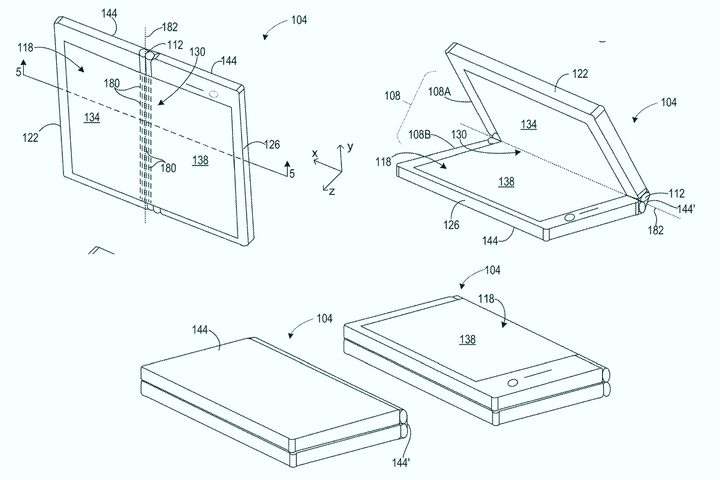
Microsoft has filed an interesting patent application that details a very promising handheld foldable device. Instead of the rotating two-screen design of the Surface Duo and its successor, the device sketched in the patent application has a single foldable panel that can go from zero to 360 degrees.
In doing so, essentially, it goes from a seamless tablet to a one-handed smartphone mode. The idea is rather radical and hasn’t been attempted by a smartphone manufacturer so far. What is remarkable here is that the foldable screen bends both inwards as well as outwards. A bi-directionally folding screen not only eliminates the need for a secondary display to be used in one-handed mode but also reduces the stress on the battery for powering a cover display.
The likes of Samsung Galaxy Z Fold 3 and Oppo Find N have adopted the inward folding design with a secondary cover display on top, while Huawei has experimented with the outward folding design on phones such as the Mate Xs. But in each implementation, the foldable panel only allows 180 degrees of movement, and that too, in a single direction.
Microsoft’s Surface Duo actually went full 360-degree mode, but it adopted a two-screen design attached to a hinge. Despite the flexibility, the gap was an eyesore and didn’t offer the same seamless experience as a single foldable panel. But it looks like the company wants to carry over the 360-degree folding DNA and blend it with a foldable screen. At least, in the imaginative world of patents.
There’s some hope for this one
But there’s some glimmer of hope here. Even though it’s still strictly a patent, the tech is already available. LG recently showcased what it calls a 360-degree Foldable OLED that can fold both inwards and outwards and appears to be tailor-made for the next generation of foldable phones. Samsung’s display division also has something similar in its kitty called Flex S that can fold inwards alongside one crease and outwards alongside the other.
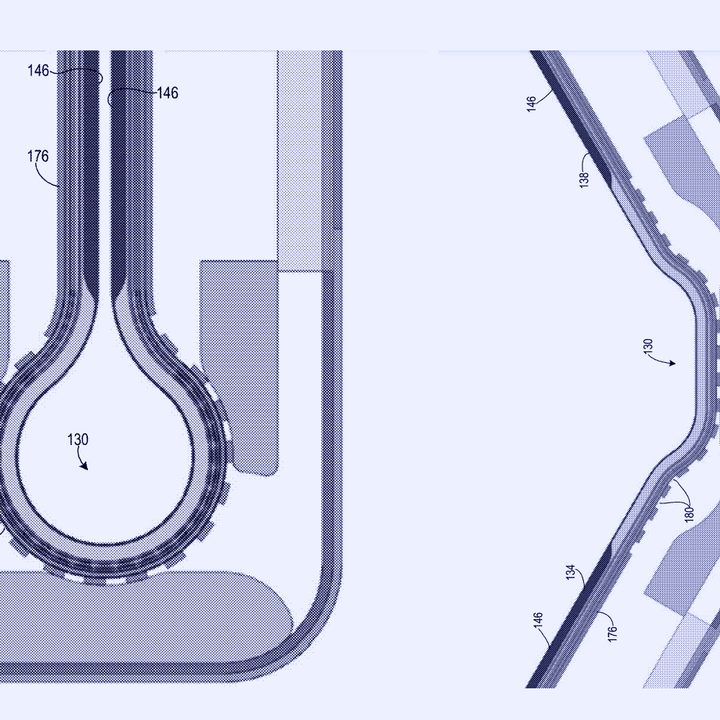
Microsoft’s patent application not only imagines a more versatile foldable phone but also appears to solve one of the biggest issues with the category — the darn crease. One of the patent design implementations shows the screen folding to create a teardrop-shaped outline alongside the middle, instead of folding flat like a piece of paper and creating a crease.
Motorola did something similar with the Razr, which had a system of movable metal plates alongside the hinge. When the phone was folded shut, the gap between the plates widened, allowing the screen to form a waterdrop shape to avoid the generation of a crease. Microsoft’s patent application is apparently chasing a similar design, with the patent lingo clearly namedropping a backplate system that moves to make space for the screen movement.
But here’s the disheartening part. Despite the immensely promising approach toward making a truly versatile foldable phone that blends one-of-a-kind hardware with Microsoft’s skills at tweaking Android for a great tablet experience, this is still a patent imagination. As is the case with a majority of patents, this may end up on the chopping board if it can’t meet the criteria set by the company.