 Update: In addition to the new 256GB Extreme Pro CF card, SanDisk today unveiled the Extreme Pro CFast 2.0 (available in 60GB and 120GB capacities), the first card to use the CFast 2.0 spec. SanDisk says it’s the world’s fastest memory card, with read speeds of up to 450MB/second and write speeds of up to 350MB/s – way, way faster than the card mentioned below (SanDisk says a 100GB file takes 4 minutes to transfer at the max theoretical speed). The durable card, which was introduced at the International Broadcasters Convention, is designed for professional broadcast, cinematography, and next-gen pro photography. ARRI, maker of the documentary-style Amira camera, is the first manufacturer to support the card. No pricing was listed, but if SanDisk’s 256GB Extreme Pro costs nearly $2,000, expect this card to cost a lot more.
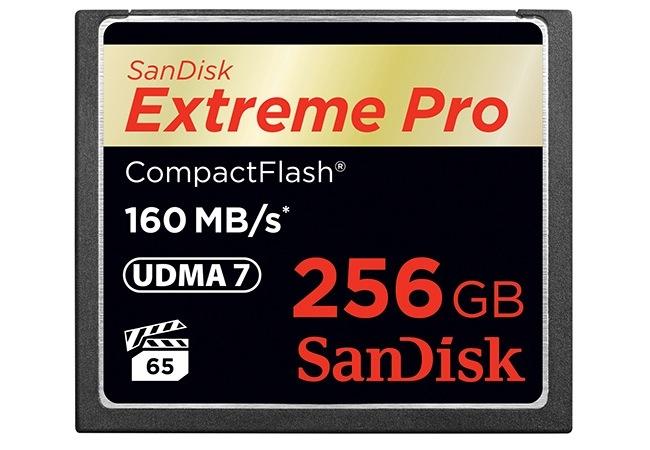
If you shoot HD videos and lots of photos, you know how important it is to get a large-capacity memory card that’s fast and durable. For professionals like videographers or anyone looking for such a card, and if you have $1,810, SanDisk just announced a CompactFlash card with a whopping 256GB of storage capacity.
Yes, flash memory is coming down in price every day; you can get a fast, decent-sized SD card for less than $20 or a terabyte SSD drive for your computer for around $600. But SanDisk’s new Extreme Pro isn’t for the casual user. It has a write-speed of up to 65MB/second – designed to support cinema-quality 4K and Full HD video capture –transfer speeds of up to 160MB/second, and fast shot speeds of up to 140MB/second.
SanDisk says the card meets the latest Video Performance Guarantee (VPG-65) specification. Inside is RTV silicone coating for shock and vibration protection, and the card will hold up in temperatures from minus 13 degrees Fahrenheit to 185 degrees – great for shooting in varied climates, or Mars. SanDisk also throws in RescuePRO recovery software to help retrieve accidentally deleted images.
If $1,810 is too much money for you to swallow, or if 256GB is overkill, SanDisk also announced that the rest of the Extreme Pro CompactFlash cards will see increased performance. But a 16GB version will still cost you a bit at $220.