Knowing who’s following you on Twitter offers a wealth of information, although it’s information that isn’t always easy to come by since predictive social metrics are still in their infancy. But if you want to get a better look at the people that who you’re following or are following you, one solution is the newly-launched Demographics Pro.
Face it: social media has turn us all into brands. You might not have a business, but if you’re actively using Facebook, Twitter, Tumblr, or Instagram, you’ve got an agenda of some sort. And there are plenty of resources you can get your hands on to help analyze your networking acumen, but social analytics services like TweetCounter and Hootsuite are 1.0 platforms. They organize retweets, follows, favorites, and other surface-level metrics into bar graphs or pie charts. There really isn’t much that’s analyzed here more than what we can probably dig up ourselves if we had the time.
But the Demographics Pro algorithm takes you beyond these surface-level data bits. It painstakingly digs through demographic information and extracts information in a way that’s so specific, we had to grill its creators on how it works.
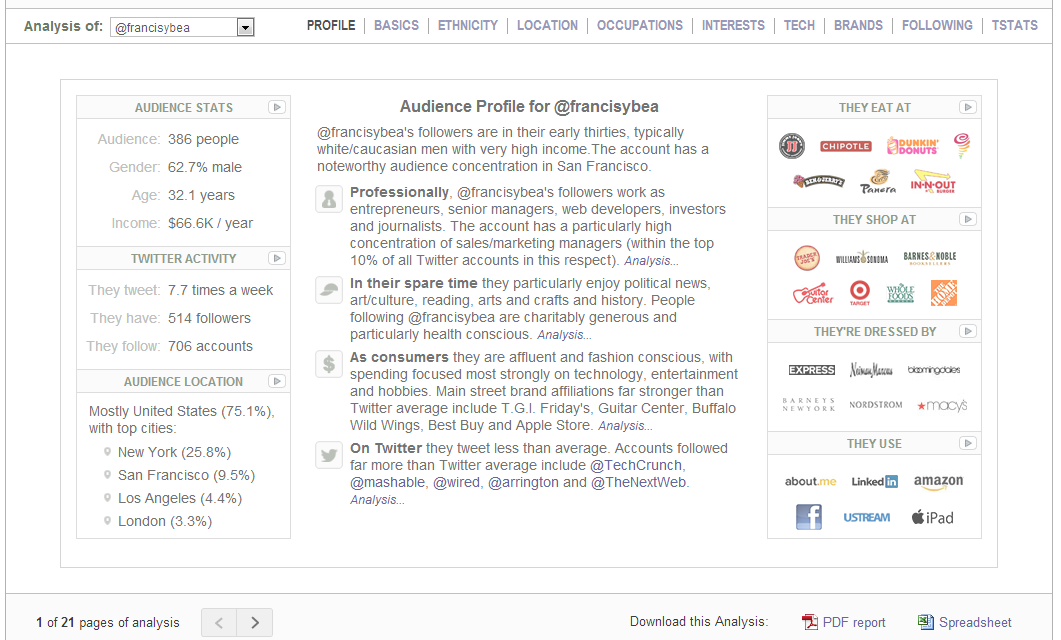
So for demonstration purposes Schmap, the company responsible for creating Demographics Pro, gave me a look at the demographics of my own Twitter followers. And for the first time, an analytics service painted a clear picture about what types of people were following me and was even able to tell me why.
The beauty of Demographics Pro is that the data can be rather specific and pinpoint stats down to how much on average my followers are earning ($66.6K per year), their average age (32.1 years old), where they’re from (25.8 percent from the N.Y.), and what types of jobs they hold (a high concentrations of sales/marketing managers follow me – no surprises there). But this is the easy part.
The product is powered by a predictive analytics engine, something we’ve been increasingly seeing among this wave of analytics 2.0 platforms. For instance we credited Salorix, which is powered by an Artificial Intelligence algorithm that tracks, predicts, and creates profiles on individual users, as among the first wave of 2.0 social analytics services.
Likewise Demographics Pro uses similar predictive methods, and breaks down user or hashtag demographics point-by-point, even down to the ethnicity of my followers.
On the other hand, Demographics Pro will give you a good look at the places my followers eat and shop at, products they use, and brands they wear. And in a conversational tone, the service will tell me what my follower’s free-time activities are. And you can even click through for a more in-depth analysis that breaks down each demographic topic from top to bottom, brand-by-brand, criteria-by-criteria.
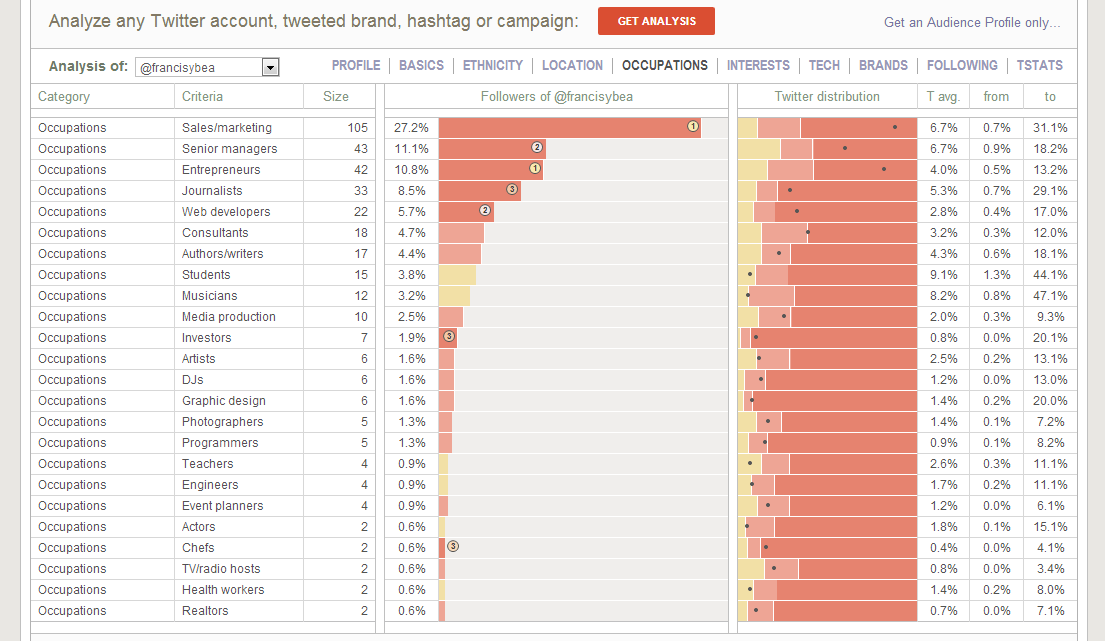
Since you’re privy to what your followers like, eat, and maybe even a general idea about what they look like, you can target your tweets to your followers accordingly. For instance, since the majority of my followers hold jobs in sales/marketing, consume technology news, and love Starbucks, I’d probably want to share Starbucks’ latest tech escapades (or failures) – like a report last month about how Starbucks baristas couldn’t figure out how to accept Square payments.
Schmap CEO Paul Hallett says the predictive algorithm looks at four broad signals: networks, consumption, language, and physical appearance. These are matched up to “proprietary knowledge bases of established correlations between data points and demographic characteristics.” This just means that based on the data from these four signals, its algorithm looks at trends in the data to fill in the gaps where it’s unable to figure out certain pieces of info just from the tweets. In a simple example, if your followers are on average 33 years old, skewed male, and make $55,200 per year, Demographic Pro will tell you that they shop at Best Buy and Nordstrom based on previous trends culled from a database of 250 million people that Schmap has profiled.
Twitter does some of its own algorithmic work behind the curtain. Datasift CEO Rob Bailey recently explained Twitter has its own “powerful” predictive algorithms that make sense of tweets accurately to better target ads, but this type of algorithm and demographic specific data aren’t available to Twitter’s Firehose partners (perhaps they’re part of the analytics service Twitter teased awhile back). So Startups like Demographics Pro are filling in the gaps where it can to meet the demand for next generation analytics.
While not 100 percent accurate (yet), Demographics Pro’s engine can predict what your audience likes to eat, shop, wear, marital status, ethnicity, location, and other data “based purely on their Twitter presence and usage,” says Hallett. Any predicted data must have an accuracy greater than 95 percent.
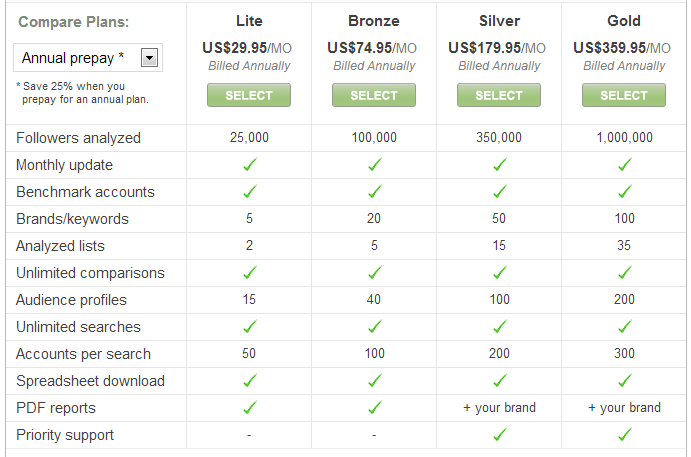
The one caveat of Demographics Pro is the cost of the service. So we’d have to stress it here when we say that the service is really intended for hardcore Twitter users: If you’re trying to take your Twitter presence to the next level, you might find that spending the $29.95 per month (for the cheapest subscription plan) is a small investment. Brands on the other hand probably won’t mind the $359.95 monthly price tag for its premium “Gold” plan. And Demographics Pro also offers pay-per-use plans if you’re just looking for a one-time analysis. Although as another word of caution, this will run between $80 and $150.
Editors' Recommendations
- Why is Twitter called X now? Here’s everything you need to know
- Can’t stand using Instagram in 2022? This app fixes everything you hate about it
- You no longer have an excuse to forget alt text on your Twitter photos
- Twitter Circle is coming soon. Here’s what you need to know
- Twitter wants to give your photos and videos ‘more room to shine’


