“The RX 580 skates by on slightly higher performance, at the cost of power and size.”
- Smooth 1080p gaming
- Performance boost over previous model
- Versatile connectivity
- Large, quiet fans
- High power usage
- Massive size for performance level
- Needs two 8-pin power connections
“Why you can trust Digital Trends – We have a 20-year history of testing, reviewing, and rating products, services and apps to help you make a sound buying decision. Find out more about how we test and score products.“
AMD’s Radeon RX 580 enters an exceptionally crowded mid-range GPU market. The RX 480 just ten months prior set the record straight with impressive performance at the $200 price point. Then, the GTX 1060 fired back by bumping performance again, while cutting the power.
AMD came back early with the RX 500 Series, and it didn’t go unnoticed. The RX 570 broke the RX 480’s performance by a decent margin, and even traded blows the GTX 1060, leaving the RX 580 to define the next step up the power chart. With the chips stacked against it, does the RX 580 redefine mid-range performance once again?
Under the hood
Not much has changed under the hood between the RX 480 and RX 580, as the new hardware is still based on the Polaris architecture. AMD has bumped the base clock from 1,120MHz to 1,257MHz, and the boost clock from 1,266MHz to 1,340MHz, but there’s still just 2,304 stream processors and 36 compute units. As before, the RX 580 is available in both 4GB and 8GB renditions, both with a 1,750MHz memory clock.


The biggest change actually comes from a boost to the RX 580’s thermal design power, or TDP. The RX 580 pulls a recommended 185-watt TDP, as opposed to the 150-watt suggested TDP for the RX 480. The RX 480 already pulled more power than its competitor, the GTX 1060. Increasing that figure is evidence that AMD’s underlying Polaris architecture is ready to be replaced by its successor, Vega, due later in 2017.
MSI goes big with the Gaming X Plus
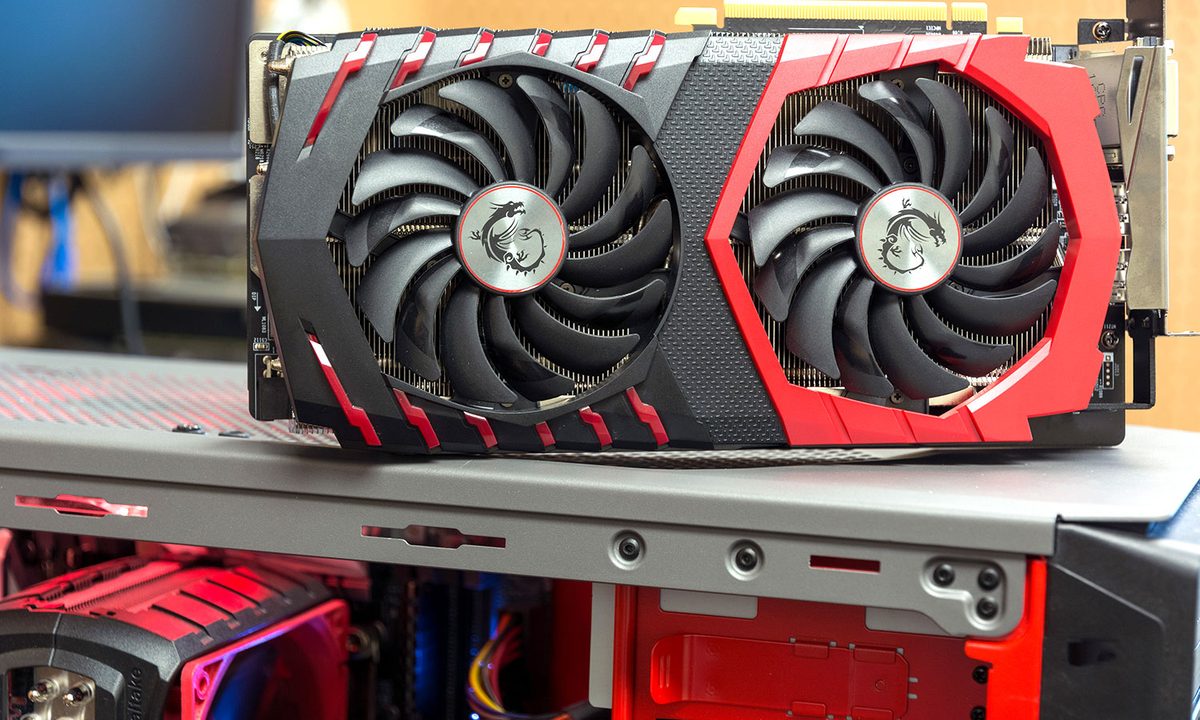
With AMD making an even bigger push towards AIB partner cards, it should come as no surprise our review unit was an upgraded MSI Radeon RX 580 Gaming X+ 8G version. It had a surprisingly large PCB and cooler, even for the Gaming X line. MSI pushed the card even further, to a 1,441 MHz maximum clock speed — a healthy 101MHz over the stock clock speed.
The RX 580 grabs a few frames per second on average from the GTX 1060.
That lofty overclock, plus the 8GB of memory, means the MSI Radeon RX 580 Gaming X+ 8G is 140 millimeters wide — just three millimeter narrower than our MSI GTX 1080 Ti. It also takes a full pair of 8-pin PCIe power connectors to support the extra power. The cooler on our model was a bulky black and red affair with two large fans, which helped keep the card quiet.
For connectivity, the card featured two HDMI, two DisplayPort, and a DVI connection. That strays from the three DisplayPort and one HDMI configuration that’s becoming more popular. The MSI route is a better one for two monitor setups that don’t use DisplayPort, or for hooking up a VR headset and television at the same time.
Charged up
With the details sorted out, let’s jump right into the performance.


The RX 580 beat out both the RX 570 and GTX 1060 in all three 3DMark synthetic benchmarks. No real surprise there, as the early RX 500 series cards are likely a response to the GTX 1060’s value proposition. Unfortunately, it didn’t push much further than that. It’s less than a ten percent difference between the GTX 1060 and RX 580, at the cost of a larger card and more power inputs. How does ten percent look in real-world games?


It’s not exactly an exciting new world for PC gaming. The RX 580 grabbed a few frames per second on average from the GTX 1060, although in some games that are well optimized for AMD, the difference was more pronounced.
That said, all the cards fall within a narrow performance margin, and the difference between them isn’t going to mean moving to a higher refresh rate monitor, or a higher resolution. That means the corresponding monitor technology, power draw, available connections, size, and even aesthetic appeal become more important.


The results at 2,560 x 1,440 tell a similar story. The RX 580 provides a noticeable performance bump over the GTX 1060 and RX 570, but it’s isn’t quite game-changing. The RX 470 falls well behind the pack here in 1440p performance, while the RX 570 beats out even the RX 480 in most tests, making both of AMD’s new cards preferable over their predecessors.
None of these cards are appropriate for full-on 1440p gaming, at least for those seeking 60+ FPS averages at the resolution. Games are far from unplayable, but anyone who likes to crank up the quality should be looking towards Nvidia’s higher-end cards at almost twice the price.
Warranty information
MSI covers the Radeon RX 580 with a standard one year warranty. That’s what we’re used to seeing from most cards, although the occasional high-end offering will bump it to three years, like the Asus Strix RX 570.
Our Take
At $245, the MSI RX 570 8G Gaming X+ sits at the top end of the mid-range GPU spectrum, with a higher thermal design power to match. Its performance beats out everything else in the category, but only by a little bit. In real-world gaming, it’s unlikely anyone could tell the difference, so a lot of it comes down to what each card costs on the day you’re ready to buy.
Is there a better alternative?
Unfortunately for the RX 580, better alternatives significantly hurt its value proposition. The Zotac GTX 1060 AMP! sits at the same price, but it’s a smaller card with a much lower 120-watt TDP. Even the RX 570, at just 150 watts, competes very well, and sits under $200. There’s nothing wrong with the RX 580, but it’s far from a revelation.
How long will it last?
With a healthy set of output options, plenty of power for overclocking, and solid performance on newer games, there’s nothing stopping the RX 580 from lasting as long as any other card in any gaming rig. Our review unit also had 8GB of memory, which should help as games become more demanding.
Should you buy it?
No. With comparable performance across a small price range, it doesn’t take much to make one card worth recommending over another. The MSI Radeon RX 580 Gaming X+ 8G has the highest thermal design power, the widest physical size, and requires extra internal power connections. That makes the RX 570 or GTX 1060 — whichever is cheaper — a better option for most situations.