1. Home
  2. Wearables
  3. Emerging Tech
  4. Health & Fitness
  5. News

Tiny wearable device changes color to indicate UV light exposure

Add as a preferred source on Google

Wearable devices are getting smarter, and have already ventured beyond recording just the steps we take to tackle other metrics, like heart rate and hydration levels. A new health-focused piece of research coming out of the University of Southern California’s Viterbi School of Engineering represents another step forward in that progression.

Researchers Andrea Armani and doctoral candidate Michele Lee have created a color-changing wearable device that notifies users when they have had enough sun exposure for one day.

Recommended Videos

“We made a flexible, waterproof plastic patch that changes color when exposed to UV light, which is the harmful or cancer-causing part of sunlight,” Professor Armani told Digital Trends. “It has a sandwich structure. The middle layer is the color-changing UV-responsive smart material, and the transparent top and bottom layers provide mechanical support, as well as waterproofing. The patch is initially clear, and the longer that the patch is in the sun, the more the color changes. After about 15 minutes, it begins to turn orange, and after an hour, it is dark orange.”
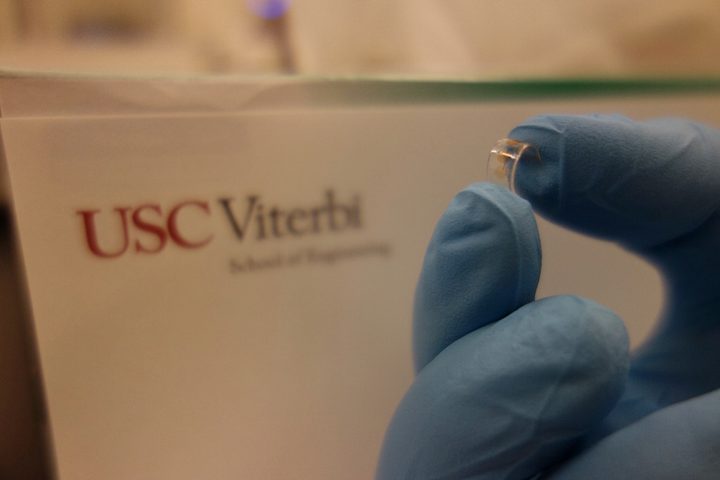
sun-sensor
Image used with permission by copyright holder

By making users more aware of sun exposure, the “smart band aid” has the potential to help cut down on the approximately 5.4 million basal and squamous cell skin cancers diagnosed each year. Unlike other wearable tech like the Apple Watch, it also doesn’t need to be connected, or even charged, for it to work.

“Additionally, having a simple read-out [in the form of a] color-change will make the technology much more accessible to a broader user group,” Armani continued. “From a broad adoption perspective, it is hard to remember numbers like maximum recommended UV dose per day, but it is easy to remember a color.”

At present, the technology is still a research project. However, with such positive upsides, hopefully it won’t be too long before one of these sensors is integrated into a next-gen wearable.

Luke Dormehl
I'm a UK-based tech writer covering Cool Tech at Digital Trends. I've also written for Fast Company, Wired, the Guardian…
This smart ring makes a blood pressure promise Apple and Oura still won’t
The $399 Signal Ring provides actual systolic and diastolic readings, but it’s launching as a wellness device without FDA clearance
Oura Ring 4, Galaxy Ring and RingConn Gen 2 in the palm of a hand

Vital Signals has unveiled a $399 smart ring that goes further than Apple and Oura currently dare. The Signal Ring displays numerical blood pressure readings without requiring an arm cuff for initial or recurring calibration.

Bloomberg reports that preorders open July 16, with shipping scheduled to begin in October. The ring can collect readings during the day and overnight, then display the results through an iOS or Android app.

Read more
HTC’s smart glasses are apparently coming to the US, but HTC hasn’t said so
Amazon briefly listed the VIVE Eagle for a September 1 launch, while HTC still says the $499 glasses are only available in Taiwan
A woman wearing the HTC Vive Eagle smart glasses

HTC’s VIVE Eagle smart glasses could finally be heading to the US. Apparently, Amazon got the memo before HTC was ready to share it.

Notebookcheck spotted six versions available for preorder at $499, each carrying a September 1 release date. Amazon has since pulled the pages, so new orders are closed and anyone who already placed one is left wondering whether it still counts.

Read more
Don’t expect smartwatches and fitness bands with replaceable batteries anytime soon
Turns out even the EU thinks your smartwatch is too small for a battery swap.
Wristwatch, Arm, Body Part

The EU has a habit of pushing tech companies to adopt meaningful changes in their product. It's the reason your iPhone finally has a USB-C port, and it's also why companies now have to offer spare parts and repair support for electronics for several years after launch. So naturally, many of us assumed wearables were next in line for mandatory swappable batteries. Turns out, the EU just went the other way.

So what did the EU announce?

Read more