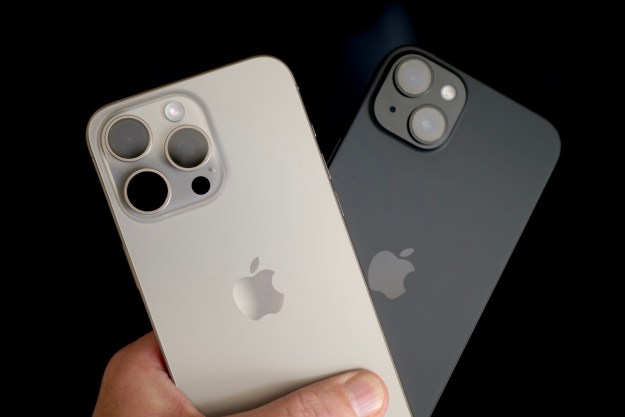
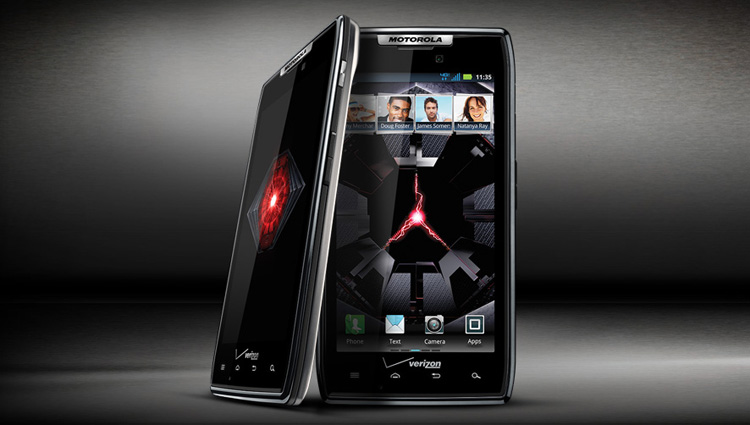
On paper, the Droid Razr is the first phone that has come out, that I can recall, on top of an iPhone launch that is more advanced in nearly every way. It is thinner, it is lighter, faster, has longer battery life, and it is a 4G rather than a 3G phone. Based on specs alone, the Droid Razr obliterates the iPhone 4S, but I doubt many Apple folks will switch.
Interestingly, I’m at an EMC event today and one of the questions to the business audience was on smartphone platforms: The only one they would block? Android.
I think this highlights the long-term competitive problem for Google, and perhaps a possible opportunity for the Windows Phone platform on Nokia.
It isn’t just about the hardware
As this mostly CIO audience pointed out, the iPhone stands out because it’s the best overall solution on the planet. The app store is both the largest and the most aggressively vetted, the breadth of services the most complete, the accessories the most prevalent, and the integration with other things (like cars) the most common.
In addition, it has the most loyal audience, and Apple traditionally has both the highest customer satisfaction and the highest customer advocacy scores (people who will actively promote Apple products). Representatives from company after company said they recently enabled Mac and iPad use in their firms, and were immediately overwhelmed by demand they didn’t have any idea existed. Clearly a cautionary tale for Microsoft and Windows.
Apple seems to spend more time thinking through the complete solution, and in caring for its users, which gives it a sustaining advantage.
Moldy Apples
Apple’s many benefits aside, it is hard to ignore the fact that the Razr is more advanced than the iPhone 4S in almost every way in terms of hardware. This suggests that Apple’s vertical integration is starting to work against it, particularly on the chip that powers the iPhone 4S, which is clearly a generation behind the Razr’s. Apple does buy its cellular radios from third parties, but it is clearly using an older generation here as well, on the argument that 4G was just too power-intensive to use. However, the fact that the Razr has this technology, and is both lighter and has longer battery life, just makes it look like Apple is trying to cover up that it can no longer compete on hardware.
Part of the reason folks buy iPhones is because they believe them to be technologically superior. This round, they aren’t.
Perplexing Androids
Even with superior hardware, Android has a sustaining problem as well. It has gained the perception of being relatively hard to use, and much more prone to security problems than any other major platform. This is what delayed Netflix on the phone, and why the business folks I’m sharing the room with are blocking it. The most recent smartphone attack was a hacked Netflix app that functioned as a Trojan. It contained a key logger, and it scared the hell out of business buyers.
It doesn’t matter how good the hardware is if folks become scared of the software.
Enter Mango
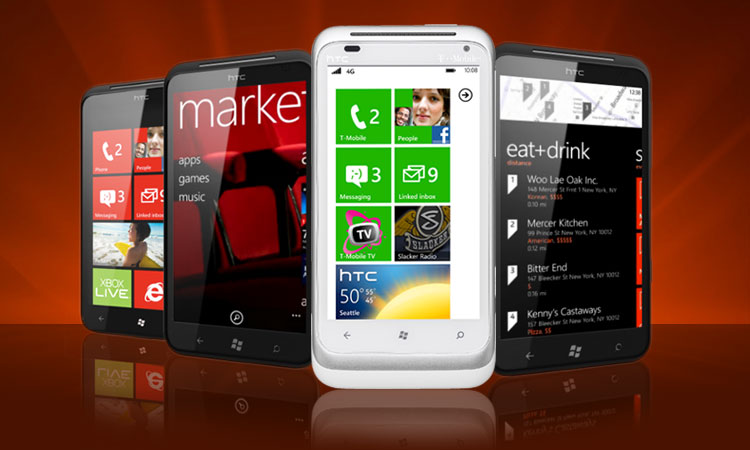
Both Apple and Google, who currently dominate the smartphone space, have major exposures. Apple is overmatched by its reliance on its own hardware, and Google is overmatched by its open and kit-like approach to products, which results in a less desirable solution. This suggests that Microsoft, which has a hardware solution like Google’s and has packaged it more closely to Apple’s, should have a massive opportunity here.
It should be no surprise that when the IT folks who were blocking Android were asked if they would allow Mango, they said yes. It was sad to note that when they were asked if anyone wanted a Mango phone, they said no. Microsoft is massively underfunding demand generation for Mango devices, and several attendees commented that they couldn’t believe that Microsoft’s market share actually dropped when Windows Phone 7 shipped. This leaves the door open for Nokia, which hasn’t yet entered a Windows Phone product to pull an Apple. We’ll shortly see if Nokia will step up.
Guest contributor Rob Enderle is the founder and principal analyst for the Enderle Group, and one of the most frequently quoted tech pundits in the world. Opinion pieces denote the opinions of the author, and do not necessarily represent the views of Digital Trends.

mango is pretty limited though, which is hurting them.
I Think the lack of Apps in Windows Phone is going to end when Nokia launch their phones and when Windows 8 hits our Computers. MS just have to wait a little bit more till everyone notice how great is Mango
I agree with what you are saying. But sadly you are also right about microsoft not doing enough to spread the word about WP7. I love the OS, but like most people haven’t switched from Android due to the lack of apps. Everyone I know who has used WP7 really enjoys it, but no one knows about it.
but I like mango more. :D
mango is pretty limited though, which is hurting them.
The iphone has all the power i need and then some. I am looking forward to seeing a nokia window’s phone, i remember nokia’s hey day, back in the 90′s they were king because of their ease of use,and good design, much like why apple are popular today. Mango could be just the break nokia need in order to keep up with the pack.
Mangos’s biggest handicap is its screen resolution restriction, which is a paltry 800×460, which to be honest is absolute crap. I was looking at a Windows phone recently and loved everything about it except for the fact that the resolution was so poor, it makes everything look blocky and pixelated. Where is Mango going to be 2 years from now when all other phones are sporting super HD displays? The new Nexus already has a dot pitch which is smaller than the Retina display. Honestly, when you look at an HD display and then look at a low-res Windows display it’s like looking back in time. This will put off potential customers in the same way as most Android phones put them off with their stuttering, laggy UI.
Not really though….
I actually like the way the new Nokia phones look. The sole reason why I stick with the iPhone is because of the hardware and software ecosystem around it. It works with my Sonos system, the Bluetooth in my car and my sound dock at the office. I have a tough time finding peripherals I like that support Android phones.
Hopefully that changes in the future though!
“i have had all 3 phones and andorid and ipod are tied, windows phone will never come close because it lacks everything android and iphone has”
Um…what? Mango has just as many features as iOS and Android and it doesn’t needed to be rooted right out of the box. Win7 Mango has an awesome SDK and I think is far superior than iOS and can be compared and contrasted to Android.
Once MSFT can get Mango on a good phone, it will blow the iPhone away. Right now, Mango is more stable and (arguably) secure than Android but Droid-based phones are superior. Because of its flawless integration with Exchange will over take BB OS for Enterprise phones if BB OSX flops.
Choice will never hurt the consumer.
i kinda hope that mango works out for the best, i would’ve loved to get the window phone, but i just go so much more for cheaper with the droid
“It was sad to note that when they were asked if anyone wanted a Mango phone, they said no. Microsoft is massively underfunding demand generation for Mango devices, and several attendees commented that they couldn’t believe that Microsoft’s market share actually dropped when Windows Phone 7 shipped. ”
Glad to see that you realize this. Unfortunately Nokia alone will not be able to save Mango. Microsoft needs a much stronger ecosystem tied to Windows Phone 7 than just an App Store. I want to see Microsoft more tightly integrate Mango with the Xbox and any other Windows platform that they can. They need to use their strength in software, the Xbox and Windows 8 to help bolster their phone offering.
Now if someone can only get the different divisions and Microsoft to work together nicely…..
i have had all 3 phones and andorid and ipod are tied, windows phone will never come close because it lacks everything android and iphone has
I’m a .net developer so I’m pretty big on Microsoft and windows. I’ve used a windows phone since they were released, started with a Samsung focus and have an HTC trophy as well. I have developed several apps for wp7.
As much as I am a Microsoft fan boy, I recently said fuck it and picked up a Galaxy Nexus (android). After getting back on android and using the new android 4.0, It really feels like Microsoft is going backwards with wp7.
The wp7 live tiles, while an interesting concept and definitely useful, are nothing compared to Android widgets and you can even have folders of icons on your Android home screen. The wp7 live tiles are huge and you can only fit about 8 of them on your screen at once. Once you have a bunch of tiles on your start screen this gets old fast.
Wp7′s new browser, even though it’s IE9 and somewhat html5 compatible… is still internet explorer. It’s not that good. The new Chrome beta for android on the other hand is amazing.
Another thing about windows phone is the fact they locked in on the 480×800 resolution. Stupid. Users will probably be stuck with 480-800 on there for a year or more. I’m thoroughly enjoying myself in 720p right now.
For a while I lied to myself and convinced myself windows phone was good enough, was developing apps for wp7, etc, but after coming back to reality and “getting real” I really don’t want anything to do with windows phone. I’ll just watch and see what happens from a distance.
I’m with you there, WP8 is supposed to address the resolution issues but it is tough to catch Apple and Google from behind. Still love my WP 7.5 phone but those new Android superphones are calling my name and my latest Android Tablet is damned good.
I went into a Verizon store the other day fully content with my WP7 device, started playing around with a Galaxy Nexus that was on display, and a few minutes later I walked out with one.
It is going to be really hard for MS to catch up. They’re innovating with WP7, but unfortunately a lot of that innovation is just being strat-jacked by the other platforms. A couple examples that come to mind are WP7′s software keyboard – very nice, but unfortunately android 4.0 has basically an EXACT REPLICA. They straight up jacked the whole layout, my jaw dropped. The similarities are ridiculous, its exactly the same. Once they get Swype working on my Galaxy Nexus, it’s game over – there’s no way I would ever go back to tap-tap-tapping on a WP7 device. Another example is how Facebook recently upgraded their Photo viewer modal – great idea, but you may have noticed it’s very similar to the modal that Google plus uses. That’s the thing about playing catch-up… you can crank out innovation after innovation and your bigger-badder competitor will just go “OOOOH” and now they’re got it too.
Another disadvantage to windows phone is the Zune client… I cannot stand Zune and for the most part it’s probably just bringing the platform down. When you’ve got a huge music library that’s supported by millions of users like iTunes it’s not a problem, but Zune is just kind of garbage that no one wants to deal with. It takes forever to recognize the device via USB and half the time it doesn’t even detect my device. It’s one of those “just because you can, doesn’t mean you should” things. They really should have just skipped the zune-in-the-middle plan and let people USB. I realize they’re using Zune for DRM and whatnot, but still.. Zune is just bad, no one uses it, no one wants to deal with it.
One thing that IMO windows phone has down, as usual for microsoft, is the developer toolkit. Visual Studio is great and the WP7 development tools are much better than iOS and Android imo. However the SDK is kind of locked up as far as tapping into the phone’s API’s. The calendar is read-only, etc, etc. Prior to WP7 mango the toolkit was even more locked down. It really limits application development, I mean I can’t even write a WP7 app that adds events to the phone’s calendar.
While the development tools are easy to use and very developer friendly, the marketplace and certification process is not. “App Hub” is absolute garbage and the website barely ever works. The application analytics are absolute garbage and you’re basically forced to either develop blind or purchase expensive third party analytics tools in order to see how your applications are performing. App Hub stats are delayed by a full WEEK. You can’t even see how your applications are performing until you’ve broke the $275 payout mark. The $100 / annual developer fee is dumb, and the certification process is slow and frustrating. You basically submit an application, wait a week, and if you fail certification they’ll give you ONE error message. Then you can go fix that error, submit again, wait another week, and they’ll give you another single error message that they could have just told you the first time around. It’s really frustrating getting apps into the WP7 marketplace.
I could go on and on about my experiences with WP7 both as a user and a developer, but long story short I just don’t have much faith in WP7 at the moment. Feels like it’s going backwards. I’ll be developing for WP7, but not for the native market. It seems like a safer bet to go with cross platform web apps using web standards and tools like PhoneGap, so you can deploy them into each native marketplace, avoiding the 30% marketplace cut, and giving you the ability to update your application on the fly.
I’m feeling much the same way. It feels like they are starving the platform. Boy if Nokia fails I wonder if anyone will trust MSFT again.