Today, Nokia unveiled its first Windows Phone 7.5 handsets: the Lumia 800 and Lumia 710. They look fantastic, and Nokia has a consistent marketing and advertising plan, but there’s one problem: Neither of them will be coming to the United States this year. They’re launching all over Europe and Asia, but not here. The reason boils down to how much control wireless carriers exert in the U.S., but no matter the politics of it, Nokia’s failure to secure placement spells out the future of Windows Phone in holiday 2011: not good.
Despite the fact that Windows Phone 7.5 is pretty great, Microsoft’s platform has a lot of problems. It’s possible that 2012 will mark a massive resurgence for Windows Phone, but this year is a goner. Here are a few reasons why.
No flagship handsets
Since Microsoft launched Windows Phone a year ago, one thing the platform has really lacked is a flagship device, or a handset that will drive consumer interest toward the platform. There are plenty of Windows Phone 7 handsets, but none of them have garnered much attention. No company has really made the WP7 platform a strategic focus like so many companies have done with Android. The first year of Windows Phones has been marked by decent, but uninteresting devices and a lack of momentum. Where are the Windows Phones that try to compete with Android on specs and features? Where is the Windows Phone that tries to go toe-to-toe with the iPhone? Where is a Windows Phone that has tried to do anything but sit quietly behind a window? Nokia is the first manufacturer to put real energy into the WP7 platform. Its Lumia 800 has some great exclusive apps like turn-by-turn navigation and defining features like NFC integration, but it wasn’t able to get a U.S. release this year. Why? Well, read on.
No dual-core or LTE support
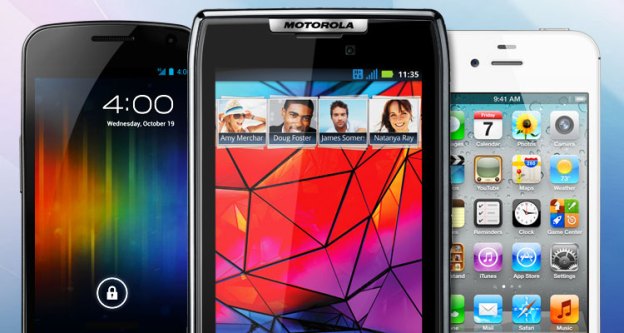
A year ago, Microsoft’s first batch of Windows Phones were powerful, and competed with Android devices on specs. They all had 1GHz processors and touchscreens, among other things. Unfortunately, a year has changed a lot. The first dual-core Android phones were unveiled last January at CES 2011 and began to pop up on carrier shelves throughout the first six months of the year. Verizon announced its first LTE phones at CES as well. It took until summertime, but now the hottest new trends in phones are dual-core processors and LTE technology. Yet, despite knowing all about these emerging technologies, Microsoft still doesn’t support dual-core processors or LTE for Windows Phones.
Unlike Android, Microsoft controls the hardware specs of its devices, and it hasn’t been keeping up with trends. Microsoft claims that it’s waiting to make sure it gets the technologies right and delivers on battery life and performance, but while it’s quietly whittling away at these technologies, Android partners are releasing cutting-edge phone after phone. Even Apple’s new iPhone is dual-core. It’s understandable to wait on LTE, since only one U.S. carrier currently supports it, but Microsoft needs to take a leadership position in introducing cutting-edge hardware and new features to phones if it hopes to steal any marketshare away from Android. Or, more importantly, keep its platform alive at all. Throughout 2011, Microsoft’s smartphone marketshare actually shrunk.
When you’re fourth place in a marketplace of four smartphone operating systems, you can’t afford to sit on your hands. Microsoft claims it is setting itself up to “leap frog” the competition. While I hope it’s right, how long will it be before Android leapfrogs right back? Redmond needs to pick up the pace.
No carrier support
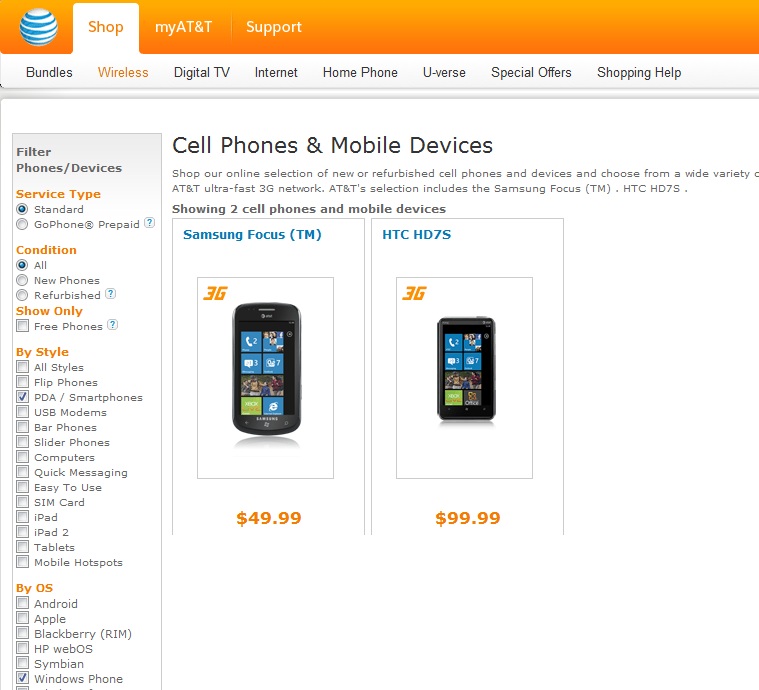
A year after release, only AT&T has more than a single Windows Phone device on its network. There have been half a dozen new Windows Phone devices announced in the last few months, but only one of them is finally hitting a U.S. carrier. The HTC Radar will be released on T-Mobile soon. Fantastic, but where are the rest of the phones? Windows Phone 7.5 (Mango) is an outstanding operating system and really brings the WP7 experience up to where it should be to compete with Android and iOS. But try as I might to get people interested in Windows Phone, there are no good handsets to choose from that aren’t six months to a year old. If you’re on Verizon, only the HTC Trophy is available and it doesn’t support LTE, making it quite noncompetitive on that network. If you’re on AT&T, you can choose between the old Samsung Focus or HTC HD7s. Both of these devices are mostly similar and neither is new. We know that Samsung has two new Focus phones ready. Where are they? Worst, on Sprint, only the HTC Arrive is available and it has a QWERTY keyboard. If you don’t want a QWERTY keyboard or want a 4G phone, you’re out of luck on that carrier.
There is no choice in the Windows Phone ecosystem right now, and the choice that exists is minimal. I don’t think Microsoft needs to let handset manufacturers run hog wild with Windows Phone like they do with Android, but they need the ability to compete and keep up with Android devices, or at the very least, technologies like LTE that carriers are demanding.
Pray for 2012
Windows Phone is an awesome OS and if I find a way to get a hold of a Nokia Lumia 800, it may be my next phone. But my contract is up, as are millions of others who will be picking phones this holiday season. Google’s ecosystem has pumped out several great choices for top handsets like the Galaxy S II, HTC Amaze 4G, Droid Razr, Atrix II, and Galaxy Nexus. Windows Phone has the HTC Radar 4G on T-Mobile and maybe two or three more stragglers coming to AT&T. That’s it. I’m finding it hard to believe Microsoft when it says WP7 is going to have a good holiday season. I don’t see how it can without a slate of solid new handset. When are the Samsung Focus Flash, Samsung Focus S, and HTC Titan coming out? And if all three of those handsets are destined for AT&T, where does that leave users on Sprint and Verizon?
2012 could be a great year for Windows Phone: Windows 8 is set to be released, the Xbox 360 is getting a Live Tile makeover, and Nokia claims it has more tricks up its sleeve. But without new phones and competitive features this holiday, Windows Phone will continue to languish. At this point, Microsoft is going to have to put some energy into its ecosystem or Windows Phone may not be a factor at all this time next year.

Microsoft were responsible for bugs, viruses, crashes & malware on the PC. As a software designer I can clearly say, MS shouldn’t be let *near* a programmer’s editor or IDE.
Android by comparison, is clean, click & easy to use. Google have harnessed the power of “open source” and “standards”, to enable technology to advance & improve more quickly, with better quality. This is the fundamental power of the Internet.. standards, openness & compatability.
And, security-wise — Unlike WP7, Android is built & runs on a “virtual machine” which prevents viruses/ malware from taking over your computer. MS by comparison, inventing flawed security & “run the HTML page” (including viruses & attacks) rather than the correct, safe, approach of “view the HTML page”.
Microsoft always fought against standards, trying to subvert these & trap customers in it’s buggy, locked-in, incompatible proprietary systems. Death to Microsoft. Enjoy the crashes & DLL hell on your WP7 brick.
What does your post have to do with windows phone?
“Microsoft were responsible for bugs, viruses, crashes & malware on the PC. As a software designer I can clearly say, MS shouldn’t be let *near* a programmer’s editor or IDE.”
- All software has bugs, crashes, and vulnerabilities that lead to viruses and malware. Last time I checked, the android marketplace was full of malware. You don’t see that on windows phone, there is no such thing. Apps only have access to isolated storage, they can’t screw around with other shit on your phone. Plus there’s an actual APP CERTIFICATION PROCESS, there’s little to no malware apps on the WP marketplace.
PLUS, Eclipse is a fucking horrible IDE. who wants to use eclipse? Visual Studio beats the shit out of every other IDE
“Android by comparison, is clean, click & easy to use.”
- Really? Android phones have dual core processors, and they run choppier than a single core WP7 phone. The UI looks like an outdated iOS ripoff.
“Microsoft always fought against standards… ”
– Not going to argue with the fighitng against standards, but they are starting to embrace standards. HTML5 comes to mind, .NET is open source now, etc.
” trying to subvert these & trap customers in it’s buggy, locked-in, incompatible proprietary systems. Death to Microsoft.”
– Apple does the exact same thing, maybe just less buggy
“Enjoy the crashes & DLL hell on your WP7 brick.”
– I’ve never experienced a crash. There is no such thing as “DLL hell” on WP7. You’ve obviously no idea what you’re talking about. Rage moar.
Who needs dual core in WP7? it runs perfectly with single core, even better than ios and android…this is just the 2nd gen of windows phones (with metro UI and new Tech)… if you have an OS that runs perfectly with the current specs, why you have to increase the cost of the phones by adding something innecesary?
Dear GOD, this article is full of research flaws and biased opinions…1) the Titan will be coming to AT&T not T-Mobile 2) THE ONLY reason why Android devices have dual core processors in them is because the Android OS and apps use A TON of resources on the phones. Have you ever tried making an app for Android? Any developer of a huge APP on Android would tell you the same. WP7 on the other hand is a total different story…Microsoft has stated many times that their new OS does not need the extra processing power. In fact I think my HD7s (1GHz single core on AT&T) runs faster than my EVO 3D (daul core android on Sprint) 3) LTE is not on many phones out there today. LTE is a fairly new technology that was first released by T-Mobile. AT&T (who has the most WP7 phones out now) just released LTE in 5 cities I believe…one being San Antonio (where I live currently). I wouldn’t be expecting LTE on many Windows Phones for awhile seeing that Microsoft pointed AT&T as heir to their mighty throne for WP7.
AND FINALLY IMO: As for a flagship device for WP7…I would think that the HTC Titan would be considered a flagship device. Some people may disagree due to the hardware inside the phone…but going back to 1) WP7 does not need the extra processing power of a dual core. The second gen Snapdragon has had remarkable benchmarks already. And the 4.7″ screen is what makes it different from the rest of the crowd of phones. If I recall, the Dell Streak is the only phone that has a bigger screen at 5.0″ There is no other phone with a size like that. -The general size of most phones out there now is ~4.3″
1) I corrected that oversight. I mixed up the Titan with the Radar and referred to it correctly in the last section of the article, but failed to correct the first mention.
2) I think your argument is flawed. Android doesn’t need faster hardware, but then again, nothing ever needs faster hardware. We get it because of competition and the more powerful the hardware, the more we can do on these devices. Windows Phone definitely seems more stable than Android and I would concur that it probably uses less resources, but there are still limits to Windows Phone. The Samsung Focus I have gets bogged down on some tasks. No dual core isn’t needed, but as I said it’s a perceptual thing as much as anything else and no, more power wouldn’t hurt.
3) As far as I know, T-Mobile does not have a working LTE network nor did it release LTE technology. Verizon has the only active LTE network. AT&T is ramping up but hasn’t yet released its first phone. No most carriers don’t have LTE yet, but Verizon does and it seems to want phones that use it. Manufacturers like HTC could deliver those devices except Microsoft isn’t yet allowing it.
I’m currently using Android over WP7 because of app selection and a major bug in the Zune software that causes the phone to crash. I’m sure the Zune crash will get fixed soon, but the lack of apps is hard to get past until Microsoft can get some momentum.
I don’t understand why people choose android over windows, the marketing strategy is where Android wins. Windows Phone is an amazing OS way better than Android, not only for the tiles and hubs but the intergration, apps, quality. Windows Phone is at par with Apple quality, maybe better. I really wish people see this amazing piece of technology
Its Windows Phone OS7.5 that might be at par with Apple iOS5 usability but that’s where it ends. IMO, until someone else comes up with the end-to-end solution of controlling the OS/hardware/apps/backend services like Apple, it’ll never be the same.
Call me shallow but user interface and user experience is what i’m all about. I dislike the tiny Android icon’s,cell phone’s have become pocket computer’s now, and who better to lead the way than Microsoft and Apple. For me there is only two choice’s, IOS or Metro with it’s live tile’s. IMO android is well linux and sure it’s great for all the amateur software tinkorer’s out there, (much like it’s desktop counter part), for someone like me who is not interested in looking under the hood it’s not appealing.
I think someone could argue that the HTC Titan could be viewed as a flagship device, but who knows when it will come out. I think a dual core sounds good on paper, but I’m curious how much one is actually needed with Mango and the Metro UI. The iPhone 4 preforms great with its single core.
Hey I hope you’re right about the Titan. As for single and dual-core, it may be that single cores perform just as well, but perceptually it looks bad when the two major players now have a lot of dual-core phones.