“Why you can trust Digital Trends – We have a 20-year history of testing, reviewing, and rating products, services and apps to help you make a sound buying decision. Find out more about how we test and score products.“
Lexar’s Pro MicroSD card offers faster performance than most hard drives.
MicroSD memory is a magic trick – it has to be. Like something out of the Harry Potter universe, it’s small on the outside and expansive on the inside. For those of us who have been around a while, it doesn’t seem like that long ago when we expected a four gigabyte hard drive to offer more space than we would ever need.
Yet now, we’re looking down at a 64GB Lexar Professional 1800x MicroSD card that’s no bigger than a fingernail and weighs practically nothing. We’re reminded of Saturday Night Live’s 2005 parody of Steve Jobs introducing the so-small-it’s-invisible iPod Invisa that holds one million songs and floats in midair if you drop it. Like, we’re almost there.
Blazing speed for any application
A 64GB card is hardly the largest MicroSD card. Lexar’s Professional line of 1800x cards tops out at 128GB, but larger cards are available at slower speeds. It’s a similar story from other manufacturers, with SanDisk offering a 128GB Extreme Pro card at 275MB per second or a 256GB Ultra card at 95MB per second. The format may soon grow even larger, as Microdia has demonstrated a proof-of-concept MicroSD card with a staggering 512GB capacity. (SanDisk just launched a 1TB SDXC card, which makes us wonder, how quickly will it follow that up with a MicroSD variant?)
It is speed, however, that makes the Lexar Professional card so impressive. It is built to the Ultra High Speed II (UHS-II) spec, and features a transfer rate of 270MB per second. That puts it just a smidgen behind the SanDisk Extreme Pro in terms of read speed, but that’s only half the story. Write speed is equally important when it comes to high-end media applications or any time you want to offload files from a device to the card. This is where the Lexar comes out ahead, with a 245MB per second write speed, compared to the SanDisk’s 100MB per second. We don’t own anything that comes close to requiring that kind of performance, but it certainly handled everything we threw at it, including 4K action camera footage.
To test the transfer speed, we shot 4.5GB of RAW photos with a Fujifilm X100T using the included MicroSD to SD adapter, then plugged the card into a computer via the minuscule USB 3 card reader (also included). In the first test, we simply dragged and dropped the folder of images onto the computer and the transfer completed in about 48 seconds.
While fast, we were a little disappointed, so we decided to run the test a second time, this time going from the card straight to a LaCie Little Big Disk SSD RAID. This resulted in a transfer time of just 17 seconds, proving the card’s real-world performance matched its stated transfer rate, and that our giant, 27-inch, full-featured iMac was the bottleneck to a fingernail-sized plastic memory chip. The Fusion drive in this particular iMac is going on three years old, and we understand how the unrelenting pace of technology works, but this was still a little mind boggling.


Equally astonishing is just how inexpensive flash memory has become. The 64GB card tested carries an MSRP of $137, but can be found online for much less (Amazon currently lists it at just under $62). The 32GB version can be had for as little as $35, while the 128Gb card goes for $120. While these street prices are quite good, the cards are likely overkill for most users, and you can still save money by opting for a lower-performance card. For professional users, however, the blazing speed of the 1800x series is likely well worth the investment.
Lexar Professional MicroSD cards are large enough and fast enough for just about anything, save the most demanding applications. We still prefer using physically larger SD cards when we can (they’re just easier to keep track of), but the MicroSD format is quickly becoming the new normal, spurred on by increasingly powerful drones, action cameras, and even phones.
To paraphrase Louis C.K., everything is amazing and nobody cares, but we will allow ourselves a moment to be impressed by the magic of MicroSD. At least until UFS is widely available.
iOS compatibility
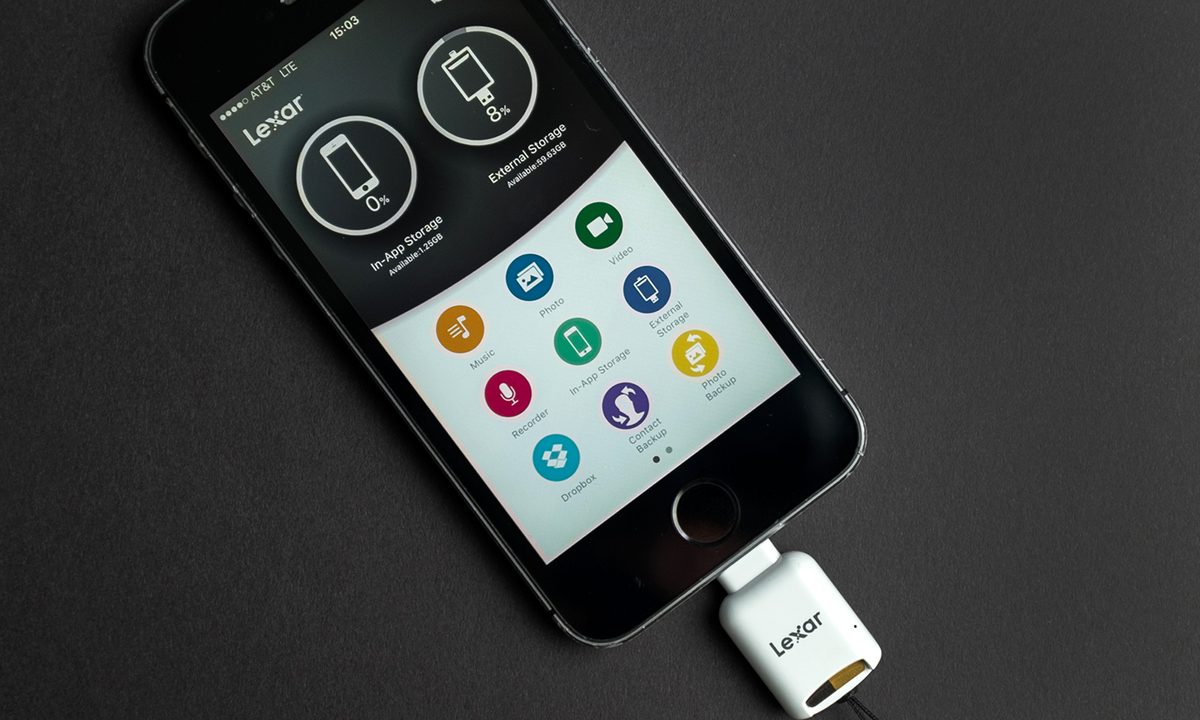
While this particular card is probably overkill for smartphone use, we did try it out with Lexar’s new iOS-compatible card reader that plugs into the Lightning port of an iPhone or iPad. Until such a time as Apple deems fit to include a built-in MicroSD slot on its phones (probably never) this is a fantastic option for iOS users who want to expand their device’s storage. Owners of 16GB iPhones could greatly benefit from this.
It’s not the biggest-capacity card you can buy, but it’s the speed that’s impressive.
The iOS reader is part of Lexar’s commitment to providing complete workflow solutions that go beyond the memory card, as product manager Steffi Ho explained to Digital Trends previously. “It’s great for drones and action cameras,” she said. “You can offload content immediately after shooting, to an iOS device.”
This is the scenario we were in at the GoPro Mountain Games in Vail, Colorado. After shooting a lot of footage with our GoPro cameras, we wanted to create a some quick videos on our iPhone. Since the video files were fairly large, it would take some time to transfer the content wirelessly from camera to phone. With the card reader, we quickly pulled the video we needed off the card, edited them in the Quik app, and shared the finished video to our social media channels. If we had relied on a direct Wi-Fi connection, it would have taken extra time, filled up our phone’s storage, and drained the batteries quicker.
The reader works in conjunction with the Lexar Mobile Manager app, which allows users to transfer files to or from the memory card. Beyond saving files from a camera while in the field, it can also back up your iOS device automatically whenever a card is connected and the app is open. We wish it were possible to save files straight to the card without having to go through the app first, but such are the limitations of iOS. At the very least, having a spare 64GB of storage was certainly welcome. The reader is available now for $30.
Highs
- Very fast read and write speeds
- Includes USB 3 card reader
Lows
- Your hard drive may not be fast enough to take full advantage of the card
- Less expensive alternatives are suitable for most uses