1. Home
  2. Emerging Tech
  3. Computing
  4. News

Robot uses its tail the same way Indiana Jones cracks his trusty bullwhip

Add as a preferred source on Google

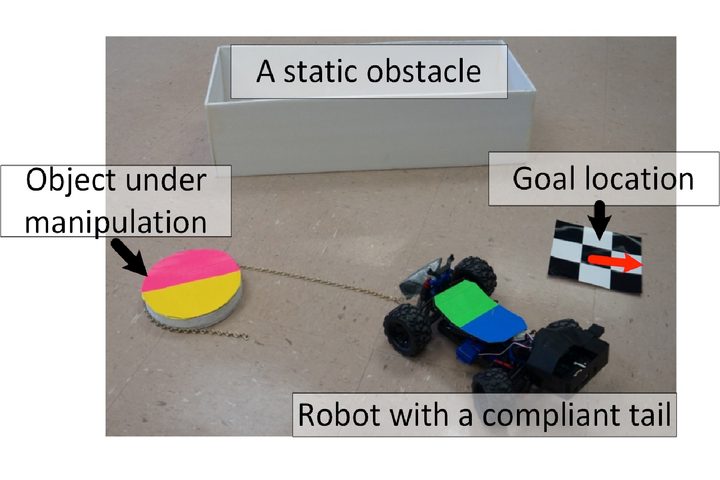
In the Indiana Jones movies, the titular hero uses his trusty bullwhip for a variety of tasks — from punishing evildoers to pulling levers from across the room to moving objects at a distance. That same idea — minus the evildoers part — is now driving researchers at Texas A&M University, who recently published a paper on a robot that uses a “compliant, unactuated tail to manipulate objects.”

“There has been an increasing amount of interest in robots that don’t look like the stereotypical rigid, Wizard of Oz Tin Man-style machine,” Dylan Shell, associate professor of computer science and engineering, told Digital Trends. “In my lab, we’ve were thinking a lot about everything you can do with a flexible structure. I thought of this particular mechanism while I was tying my shoelaces. If you look around you, there are a lot of tools that humans use which depend on rope, twine, strings, and tools of that nature.”
robotcar
Image used with permission by copyright holder

Working with Ph.D. student Young-Ho Kim, Shell attached a bullwhip-inspired “flexible rope-like structure” to a remote control car to investigate its various use cases. The concept explores the mathematical properties of such tools, which requires working out data concerning tension and mass in real time — and figuring out how to use them to move objects through either harsh whipping movements or slower dragging ones.

Recommended Videos

“The idea was to have a tail which, depending on how fast you move, can either be flexible or somewhat rigid, and you can play with that dynamic,” Shell said. “Our paper concerns the reasoning about how to use such an appendage. If you’re trying to get an object from point A to point B as quickly as possible, you can use a combination between coarse and finer movements to move it. The robot is able to optimize that route planning to take advantage of its different abilities.”

Going forward, Shell plans to explore concepts like multiple robots working together, with the ability to combine different tails in order to carry out conjoined collaboration tasks. “It would be possible scoop up objects, for instance,” Shell said.

Right now, there are no immediate plans for this unique robot to find its way into the real world. But who knows? With octopus and worm robots all the rage right now, who’s to say a bullwhip-inspired machine isn’t the next big thing?

“I think this could certainly be a flexible tool in both senses of the word,” Shell concluded.

Luke Dormehl
I'm a UK-based tech writer covering Cool Tech at Digital Trends. I've also written for Fast Company, Wired, the Guardian…
Starlink V5 is here, and it’s lighter, smarter, and far more efficient
The next-generation satellite internet kit promises improved efficiency while maintaining high-speed connectivity.
Starlink V4 vs V5

Not every hardware upgrade needs to be about speed. With Starlink V5, SpaceX is betting that a lighter design and lower power consumption matter just as much. The company has officially introduced its next-generation Starlink V5 kit, featuring a smaller and lighter design with significantly improved power efficiency.

Smaller, lighter, and far more efficient

Read more
Frontier joins the Starlink club with high-speed in-flight internet
The carrier plans to roll out SpaceX's satellite-powered Wi-Fi across its fleet starting in 2027.
Frontier Starlink partnership featured

If there's one thing budget airlines aren't exactly known for, it's great onboard Wi-Fi. In Frontier Airlines' case, it hasn't offered in-flight internet at all. That's about to change. Frontier Airlines has announced a partnership with SpaceX's Starlink to bring high-speed, low-latency internet across its fleet. Installations will begin in early 2027, making Frontier the first ultra-low-cost carrier in the United States to adopt Starlink's satellite-powered connectivity.

Streaming, browsing, and even gaming at 35,000 feet

Read more
OpenAI’s first hardware product sounds more like a companion than a speaker
The AI company is reportedly building a mobile home device that understands context and proactively helps users.
OpenAI press image

For months, rumors have suggested that OpenAI's first hardware product could be a wearable AI device, or perhaps even the beginning of its long-term smartphone ambitions. As it turns out, the company's first gadget may be something far simpler, yet arguably far more ambitious. It will help control smart-home appliances, play media, answer questions, respond to messages, and tap into the range of capabilities offered by OpenAI's ChatGPT, according to people familiar with the matter.

OpenAI's first AI device could end up being a speaker, following plenty of hype that the company is actually working on a wearable AI device and might even launch a smartphone down the road. According to a Bloomberg report, the speaker will serve as a human-like AI companion that will integrate directly with the smart home ecosystem.

Read more