Self-driving cars require a multitude of sensors to safely navigate the world around them, but more important than that, they need powerful processors to interpret all the data. At CES 2017, automotive engineering firm ZF Group unveiled the first serial production electronic control unit (ECU) with artificial intelligence software built specifically for self-driving vehicles. Its name? ProAI.
The ProAI computer comes from a collaboration between ZF and Nvidia, and the system is built on Nvidia’s high-performance Drive PX 2 platform. With Nvidia’s powerful AI software and machine learning running underneath the skin, ZF believes the ProAI ECU will make autonomous cars safer, while also laying the foundation for continued advancements in driverless tech.
“With Nvidia, we are bringing the supercomputing power required for artificial intelligence into cars and commercial vehicles,” explained ZF CEO Stefan Sommer. “ZF is enabling vehicles to see, think and act. Nvidia’s AI platform lets us take a giant leap forward when it comes to enabling vehicles — whether cars, trucks or forklifts — to think.”
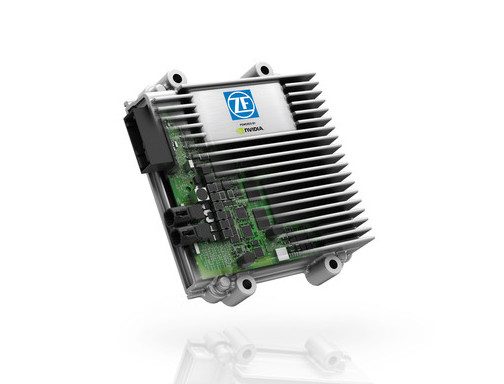
A brain as robust as the ProAI has nearly endless applications — self-driving passenger cars, autonomous semi-trucks, and even driverless commercial equipment like tractors and plows. This is due to the scalable nature of the Drive PX 2 platform, meaning it can process inputs from optical cameras, ultrasonic sensors, lidar, radar, and just about anything else an autonomous vehicle could use to map its route. Production is slated for 2018.
In addition to the ProAI reveal, ZF also showcased its X2Safe app at CES. The program essentially links cars, smartphones, and smartwatches to the cloud, meaning just about every road user can be connected through X2Safe. But instead of emphasizing convenience, the app calculates if two users might collide, and will warn both parties to prevent accidents. There are approximately 1.25 million traffic fatalities worldwide each year, and according to the World Heath Organization, about half of those are pedestrians, cyclists, and motorcycles. Mobile devices are often criticized for being distractions to motorists (and justifiably so), but in this case, your smartphone might just save a life.
There are approximately 1.25 million traffic fatalities worldwide each year, and according to the World Heath Organization, about half of those are pedestrians, cyclists, and motorcycles. Mobile devices are often criticized for being distractions to motorists (and justifiably so), but in this case, your smartphone might just save a life.