This has been the year of the full-screen phone. It started with the LG G6 and Samsung Galaxy S8 — two devices that featured massive 18:9 displays, with only minimal bezels on the top and bottom. Then Essential announced its PH-1, which pushed the display all the way to the top, around the front-facing camera. We discovered Apple appears to be taking a similar approach with the upcoming iPhone 8, though Sharp could very well beat them both to the market with the Aquos S2.
Announced Tuesday in Beijing, Sharp bills the Aquos S2 as its 29th full-screen phone. While the definition of “full-screen” may have changed over the years, Sharp has been a pioneer of bezel-less handsets. The Aquos Crystal, released three years ago, was one of the first to popularize the trend worldwide.
The S2, however, can best be described as a cross between Essential’s PH-1 and the latest iPhone 8 renders. At the front, we see a camera notched into the screen, just like the Essential. However, Sharp has put its own stamp on the design with angular, diagonally cut corners toward the top of the panel. It is an awkward look that makes the whole thing feel a bit busy and we are not entirely sure why Sharp has gone for it. Perhaps it was an attempt to show off the firm’s free-form display technology.
As for the display itself, Sharp advertises a resolution of 2,048 x 1,080 as well as a screen-to-body ratio of 87.5 percent. The earpiece lives just above it, along the top edge of the phone. Moving to the bottom, there is a traditional fingerprint sensor that may double as a home button. Other devices in this segment have gone with rear-mounted sensors to maximize display real estate, so it is somewhat surprising Sharp has not done the same with the S2.
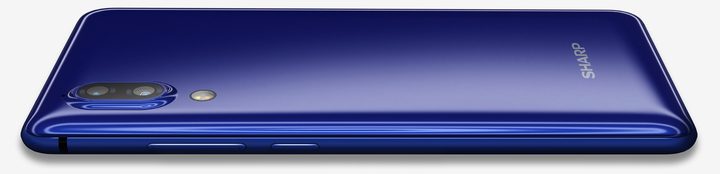
Around the back, the full-screen flagship is a dead-ringer for the iPhone 8, thanks to that vertically stacked, dual-lens arrangement for the camera. The way the 3D glass rises to meet the housing is also very evocative of the iPhone 7. Sharp’s use of glass looks not all that different from HTC’s implementation in the recently released U11.
We did not expect the Aquos S2 to set any new benchmarks for smartphone performance and it seems those expectations were justified. There is a choice of two mid-range Qualcomm chipsets to power the S2: The Snapdragon 630 and Snapdragon 660. They are respectable processors that will do a decent enough job of driving that big display but they simply cannot compete with the 835 system-on-chip found in the latest high-end Android handsets. Still, they should achieve solid longevity on a charge thanks to the 3,020mAh battery.
In other respects, the S2 is decidedly more high-end. The standard, Snapdragon 630-powered version comes with 4GB of RAM, while the premium model can be had with 6GB. Sharp also has not been shy about praising the cameras in these phones. The main shooter has an f/1.75 aperture with large 1.4µm pixels for better performance in low-light scenarios. It combines 12-megapixel and 8-megapixel sensors for special depth-of-field tricks. The selfie camera is another 8-megapixel unit but with an impressive f/2.0 aperture.
Sharp so far has only announced the S2 for sale in China. The 630-powered version with 4GB of RAM and 64GB of storage can be pre-ordered now for the equivalent of $370. The more powerful option containing the 660 chipset, 6GB of RAM, and double the internal memory sells for about $520. Those are fair asking prices for full-screen phones that are high-end in just about every capacity, except for the processors. Sadly, if you live in the west and want to take the plunge, it seems you will have to find a way to import one.