  1. Home
  2. Emerging Tech
  3. Health & Fitness
  4. Wearables
  5. News

New augmented reality ‘coach’ aims to help autistic people build life skills

Add as a preferred source on Google

For people on the autistic spectrum, the kind of everyday social interactions that most of us take for granted can be enormously difficult. After manifesting in early childhood, these challenges can create difficulties for sufferers from school age right through their years in the workplace. A startup based in Cambridge, Massachusetts, thinks it has one possible way to help them — and it involves augmented reality, smart glasses, and some cool emotion-tracking technology.

Launched in early November, Brain Power’s Empower Me system is hailed as the world’s first wearable smart glasses platform that’s designed explicitly to help people with autism. A bit like the kind of “brain training” apps that have been popular for years, the technology functions as a “digital coach. It runs on Google Glass and provides various games — with a focus on aiding those on the spectrum in building important life skills.

Recommended Videos

“Some of the challenges we address include decoding the emotions of others, face-directed gaze, language, context-appropriate conversation skills, controlling behaviors, and general cognitive enhancement, among others,” Dr. Ned Sahin, founder and CEO of Brain Power, told Digital Trends. “Our applications are gamified and engaging, and run on smart glasses. Unlike with a tablet or phone, the person is looking up, and our software encourages social interaction with other people.”
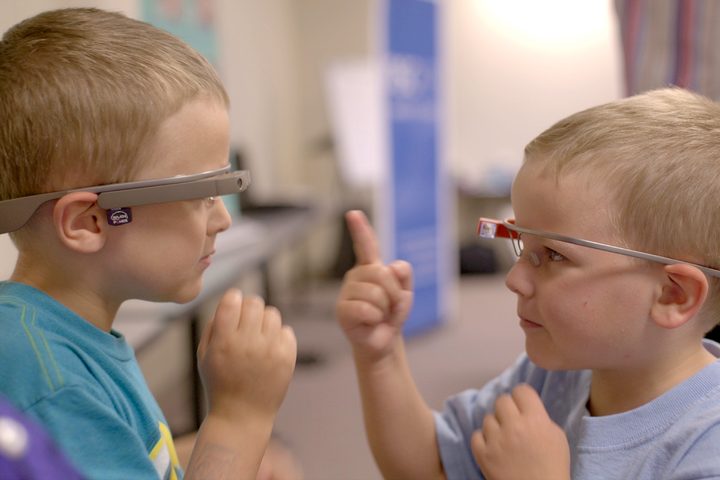
Image used with permission by copyright holder

Empower Me features a suite of apps. For example, in the kid-oriented Emotion Charades, players must identify different emotions in siblings, parents, or therapists and then match them with emojis. The emotions are recognized by the smart glasses using cutting-edge facial recognition technology, so the player gets to learn based on real live people, rather than avatars.

“People on the spectrum enjoy the engaging format of the applications we have designed, and parents truly appreciate the ‘connectedness’ they feel with their child,” Sahin continued. “We’ve studied this formally and scientifically during those clinical trials in children and adults across the spectrum. Results from stage one of our clinical trials are being published now, with many more papers to come.”

The technology has been in development for several years. It’s got some impressive names behind it. It’ powered by neuroscience developed at MIT and Harvard University, and was created in close partnership with Affectiva, the world’s leading emotion AI company, and X, formerly known as Google X.

Those interested in the Empower Me system can pledge support on Indiegogo. Prices start at $945 for the suite of apps, minus the Google Glass headset. Shipping is set to take place in August 2018.

Luke Dormehl
I'm a UK-based tech writer covering Cool Tech at Digital Trends. I've also written for Fast Company, Wired, the Guardian…
Anti-surveillance clothing is getting cheaper, but don’t expect an invisibility cloak
Affordable shirts now claim to confuse facial recognition, although their protection depends heavily on the camera and software watching you
Chart, Plot, Adult

Anti-surveillance clothing is starting to look less like an art-school experiment and more like something you could actually wear outside. Shirts designed to confuse facial recognition systems now cost about as much as ordinary streetwear, although buying one won’t make you disappear.

The Guardian reports that designers are using face-like prints, unusual cuts and infrared lights to interfere with computer vision. These techniques target specific weaknesses, so their success depends on what happens to be watching you.

Read more
This spinning drone hides in plain sight using a visual illusion
This drone doesn't turn invisible. It tricks your brain into thinking it has.
Phantom Twist

For decades, engineers have chased the dream of an invisible drone. The usual approaches have involved transparent materials, camouflage coatings, or complex optical systems that bend light around an object. Researchers at Northwestern University decided to take a completely different route. Instead of hiding the drone itself, they chose to fool the human eye.

The result is Phantom Twist, an experimental drone that spins so rapidly it almost disappears into the background. It's not technically invisible, but to anyone watching, it looks more like a faint blur than a flying machine.

Read more
This smart knitted fabric can flip switches, count your steps, and even change shape
Grandma's knitting just entered its Iron Man era
Representative Image

For most of us, knitting brings to mind sweaters, scarves, and perhaps an ambitious grandmother determined to make winter more fashionable. Researchers at Harvard University, however, have a far more futuristic vision. They've transformed ordinary knitted fabric into a programmable material capable of changing shape, acting as an electrical switch, sensing movement, and potentially forming the foundation of tomorrow's wearable technology.

The research, published in Advanced Functional Materials by scientists at the Harvard John A. Paulson School of Engineering and Applied Sciences (SEAS), demonstrates how machine-knitted textiles can "snap" between multiple stable shapes without relying on motors or rigid mechanical parts.

Read more