NASA’s exoplanet-hunting satellite TESS is fully operational and has begun scanning the skies for distant planets, NASA reported on Friday. And maybe, just maybe, it will spy signs of life outside of our galaxy.
“I’m thrilled that our new planet hunter mission is ready to start scouring our solar system’s neighborhood for new worlds,” said Paul Hertz, NASA astrophysics division director based in Washington. “Now that we know there are more planets than stars in our universe, I look forward to the strange, fantastic worlds we’re bound to discover.”
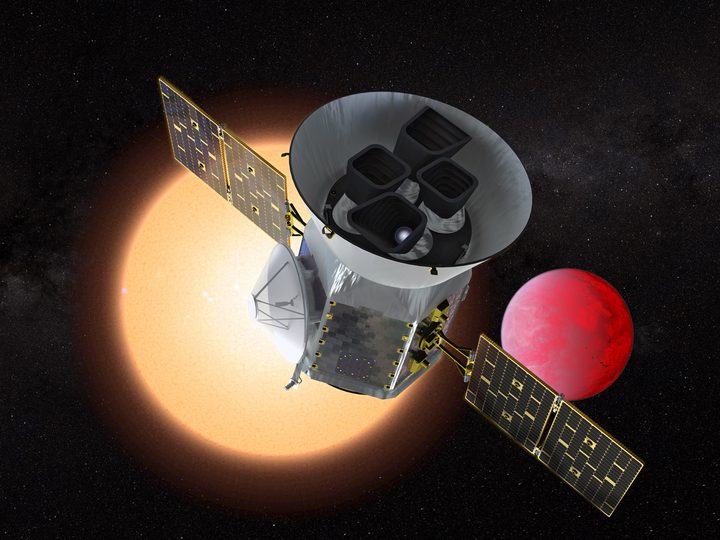
The space agency launched its TESS satellite on April 16, with an aim of replacing the aging Kepler space telescope. It will spend the next two years rocketing through the cold reaches of space, training an array of cameras and monitors on the darkness — and looking for the periodic dips in light that suggest the presence of planets against the fiery brightness of the stars they orbit. The mission is led and operated by the Massachusetts Institute of Technology in Cambridge and managed by NASA’s Goddard Space Flight Center in Greenbelt, Maryland. The satellite itself was built by Northrop Grumman in Dulles, Virginia, and the company continue to direct mission operations for NASA. TESS should come relatively cheaply: according to Space.com, the cost is capped at $200 million, while the Kepler telescope it replaced cost about $600 million.
NASA began the process of waking up TESS in May, and found the satellite was in good health and all systems reporting that they were healthy. For a satellite, that means more than a shower and a cup of coffee: It entails a commissioning period of testing and adjustments before scientists can truly rely upon the data being beamed back to Earth. According to NASA, “every new mission goes through a commissioning period of testing and adjustments before beginning science operations. This serves to test how the spacecraft and its instruments are performing and determines whether any changes need to be made before the mission starts observations.”
NASA's newest planet hunter, @NASA_TESS, the Transiting Exoplanet Survey Satellite, is currently undergoing a series of commissioning tests before it begins searching for planets. https://t.co/kYnDwjhpKS pic.twitter.com/rodPbAknUQ
— NASA_TESS (@NASA_TESS) July 11, 2018
In May, as the craft prepared for that final orbit, NASA’s latest satellite danced a funky little jig. “In one of the last passes, TESS performed a ‘break dance,’ rotating around to evaluate any stray light sources to characterize camera performance for the duration of the mission,” the space agency wrote on Twitter in June.
“We learned from Kepler that there are more planets than stars in our sky, and now TESS will open our eyes to the variety of planets around some of the closest stars,” said Hertz prior to the satellite’s launch. “TESS will cast a wider net than ever before for enigmatic worlds whose properties can be probed by NASA’s upcoming James Webb Space Telescope and other missions.”