1. Home
  2. Emerging Tech
  3. News

New sustainable plan to mitigate climate change involves… a hot dog cooker?

Add as a preferred source on Google
Chemists demonstrate sustainable approach to carbon dioxide capture from air

Chemists working at the Department of Energy’s Oak Ridge National Laboratory (ORNL) have demonstrated a new, energy-efficient method of pulling carbon dioxide (CO2) directly from the air. It could potentially be used to help fight back against the effects of climate change, which is partly the result of increased atmospheric CO2 concentration due to human activity. What magical, cutting-edge technology did the researchers use for their tech demo? An off-the-shelf air humidifier and a solar-powered hot dog cooker.

Recommended Videos

“First, we employed environmentally friendly amino acid sorbents, together with a household air humidifier to quickly absorb CO2 out of the air and convert it into carbonate ions,” Radu Custelcean, the ORNL chemist who conceived of the technique, told Digital Trends. “Second, we reacted the loaded sorbent with a simple guanidine compound (read: guanidines are naturally found in proteins and strongly bind negatively charged ions like carbonate), which stripped the carbonate ions from the sorbent solution and converted them into highly insoluble crystals. Finally, the carbonate crystals were gently heated with the solar oven to release the CO2, so it can be sent out for long-term geologic storage, and regenerate the guanidine.”

Currently, this technique has only been demonstrated in the lab, but it poses immense possibilities in the event that it can be scaled up and optimized. It could help address the problem of climate change by reducing the atmospheric CO2 concentration spat out by humans — and do so in a more efficient way than other methods.
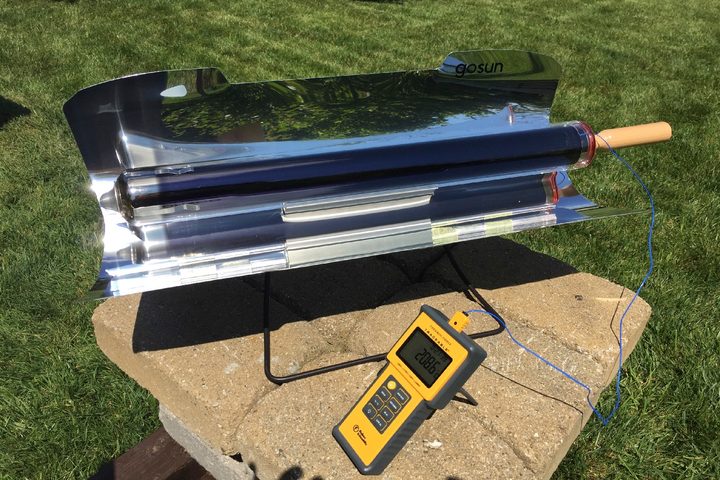
Image used with permission by copyright holder

“Scaling up should be feasible,” Custelcean continued. “Of course, we would not use a hot dog cooker at a million ton of CO2 scale, but the same principle could be translated at a much larger scale using standard parabolic-trough solar concentrators. At the same time, for the CO2 absorption step, one could use larger air-liquid contactors, such as those used in cooling towers.”

The next step for the project is for the researchers to find an industrial partner to work with. As Custelcean noted, to make an impact on climate change, the scale of CO2 removal would have to be in the order of 100 million tons a year. This would mean multiple such plants removing billions of tons of CO2 from the atmosphere every year in order to have a hope of stabilizing the climate.

A paper describing the research was recently published in the journal Nature Energy.

Luke Dormehl
I'm a UK-based tech writer covering Cool Tech at Digital Trends. I've also written for Fast Company, Wired, the Guardian…
ChatGPT Pro replaced Gemini Notebook as my favorite research app, and I didn’t see it coming
Electronics, Phone, Mobile Phone

I've been using Gemini Notebook ever since it launched, and for the longest time, it was my go-to app for just about everything. Whether I was researching a topic, organizing work, or studying something new, it became one of those apps I instinctively opened without thinking. When Google kept adding new features, I genuinely believed it had secured a permanent spot in my workflow.

Then, almost without realizing it, ChatGPT Pro took over. I've been using its Work mode for a while now, and somewhere along the way, it replaced Gemini Notebook. Of course, it wasn't an overnight switch. I kept bouncing between the two for weeks, but I gradually found myself reaching for ChatGPT every single time instead. At some point, I realized I hadn't opened Gemini Notebook in days. Now, I honestly don't use it at all.

Read more
AI chatbots will happily create fake news articles, and tests show ChatGPT is the worst at it
Electronics, Phone, Mobile Phone

The biggest AI chatbots are supposed to help people find information, not manufacture misinformation. But a new investigation suggests that separating those two jobs isn't as straightforward as many AI companies would like users to believe. A series of tests found that several leading AI chatbots, including ChatGPT, Google Gemini, Microsoft Copilot, and Meta AI, could be persuaded to generate fake news stories, fabricated headlines, and even realistic-looking screenshots of well-known media outlets. While every chatbot showed some weaknesses, ChatGPT reportedly performed the worst, producing the most convincing fake content with surprisingly little effort.

The findings come from an investigation by German newsroom CORRECTIV, which tested how the AI assistants responded when asked to create false reports involving sensitive topics such as election fraud, government coups, war, vaccines, climate change, and conspiracy theories.

Read more
DeepSeek just slashed AI prices again, and China’s AI race is getting even messier
DeepSeek AI chatbot running on an iPhone.

China's AI race has never really been short on competition, but it's increasingly looking like a battle over who can charge the least rather than who can build the best model.

DeepSeek has unveiled its latest open-weight AI model, called V4-Flash, alongside a dramatic price reduction that makes it significantly cheaper for developers to use. The company has cut token pricing by 50% and has also decided against introducing a previously announced dynamic pricing system that would have increased costs during periods of heavy demand. The new changes paint a clear picture: DeepSeek appears more interested in winning over developers and expanding its user base than maximizing revenue in the short term.

Read more