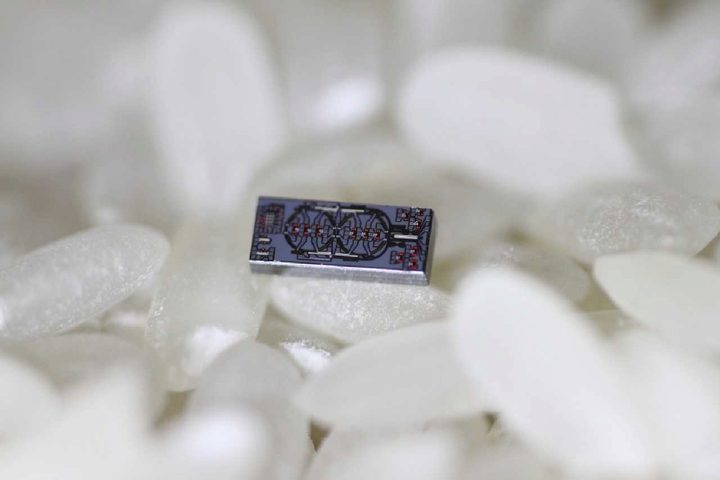
It’s no secret that the components used in our everyday technology keep getting smaller. But just how much tinier they’re getting might surprise you. At the California Institute of Technology (Caltech), researchers have found a way to significantly shrink optical gyroscopes, the devices used for measuring or maintaining orientation and angular velocity. Simple gyroscopes are found in devices like phones and tablets. However, the higher quality optical gyroscopes used in navigation are still relatively large — slightly bigger than a golf ball. They function very well, but this larger form factor makes them inappropriate for use in certain portable devices.
That’s where the Caltech researchers come into play — since they have found a way to shrink down these high-end gyroscopes to something smaller than a single grain of rice. This is an astonishing 500 times smaller than current state-of-the-art gyroscopes.
“Optical gyroscopes are one of the most accurate types of gyroscopes, and they are used in various navigation systems,” Professor Ali Hajimiri, who worked on the project, told Digital Trends. “However, a regular optical gyroscope is very expensive and bulky. Miniaturizing this type of gyroscope can reduce its cost and size and can potentially replace mechanical gyros. Optical gyroscopes operate based on a relativistic effect known as the Sagnac effect, whereby the output signal is proportional to the size of the gyro. Therefore, reducing the size of the gyro will directly affect the strength of the output signal. In our work, we presented a technique that uses the reciprocity of passive networks to decrease the level of noise, making the signal detectable.”
The Sagnac effect is named after the French physicist Georges Sagnac. It calculates orientation by splitting a beam of light in two and then sending them in separate directions. By measuring the variations in the two beams of light, it’s possible to work out rotation and orientation with a high degree of accuracy. To shrink down the device, the Caltech researchers found a way to improve the signal-to-noise ratio of this system, thereby making it more efficient.
“This demonstration shows the potential of integrated optical gyros, and can open all kind of applications that need low-cost, small, and highly accurate gyros — like gaming devices, autonomous vehicles, wearables, CubeSats and nanosats,” Hajimiri continued. “[The] next step is to improve the sensitivity and make it smaller, as well as enhancing integration capabilities. We are thinking about commercializing our device.”
It might take a while to get to that point, but it seems that tinier, more efficient gyroscopes are definitely in our future. A paper describing the work was recently published in the journal Nature Photonics.