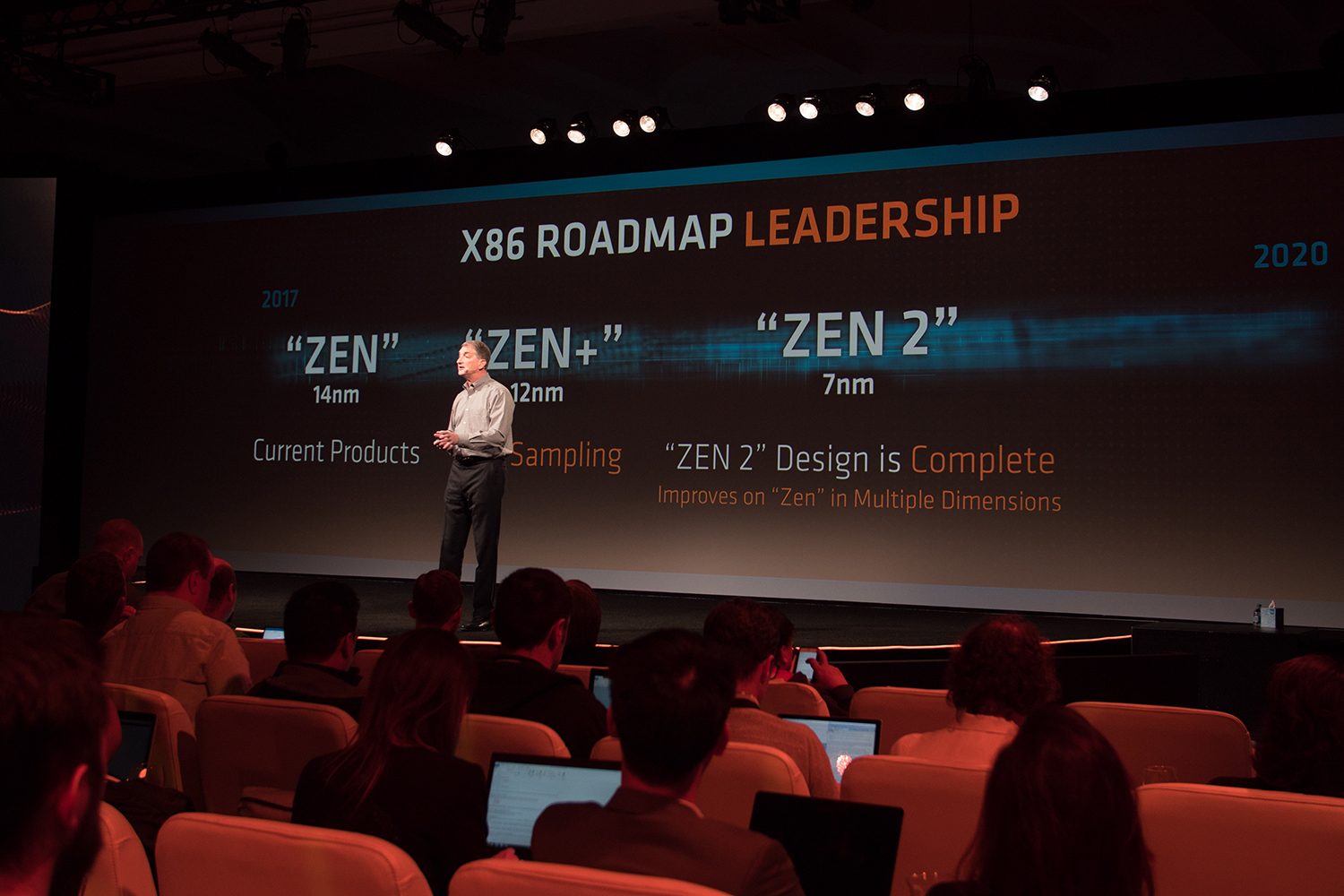
In the race to pack more and more transistors into smaller and smaller silicon packages, AMD is set to pull ahead in 2019. With a release schedule that plans the debut of both 7nm CPUs and 7nm graphics cards for consumers within the next year, its products based on the TSMC FinFET process will for the first time in a long time be more compact at the die level than the competition’s best offerings. We don’t know yet whether they’ll be more powerful, but considering how capable AMD’s Zen and Zen+ CPUs have been, it certainly could pull ahead in that market with Zen 2.
This impending leapfrog achievement is impressive considering the lead companies like Intel held over AMD in the years prior. Intel was initially expected to debut its first 10nm CPUs back in 2016, but repeated delays of the code-named Cannon Lake architecture, due to what we’re told are yield problems with the 10nm process, have left us still awaiting its arrival in late 2018. While Intel denied recent rumors that it had scrapped the architecture altogether, it doesn’t seem likely that we’ll see Cannon Lake or its eventual successor, Ice Lake, until late 2019 at the earliest.
AMD on the other hand is well on track with its 7nm components. It debuted its 7nm Zen 2 architecture in early November with its “Rome” Epyc-series server CPUs, featuring a unique combination of a 14nm I/O die and 7nm CPU “chiplets.” While it’s not entirely clear whether this configuration will make its way into consumer-targeted Ryzen 3000-series CPUs, it seems likely that the chiplet approach will be repeated. Manufacturing CPU cores in such a fashion and then stitching them together later makes for much higher yield rates for the miniscule processing cores — a problem that Intel has been trying to deal with for years.
Performance enhancements with the Epyc CPUs are said to be impressive. With doubled instruction widths and improvements to memory latency with the chiplet design, AMD claims a doubling of floating-point performance per core, as per SemiAccurate. Earlier reports suggested Ryzen CPUs could enjoy as much as a 15-percent improvement in instructions per clock. If such a gain were combined with improvements in clock speed, AMD’s Ryzen 3000 CPUs could steal the performance crown that Intel has held for over a decade, with no obvious sign of a potential retaliation on the horizon.
We don’t have a firm release date for the next-generation Ryzen processors, but AMD is expected to debut them at CES 2019, with a potential launch within the first or second quarter of the year.
It’s not just in the world of 7nm CPUs that AMD will be making a splash next year, though. Alongside the Epyc CPU showcase, it announced the debut of the world’s first 7nm graphics card in the Vega 20-powered Instinct M160 and M150, with the former of the two slated to ship out before the end of 2018. That suggests AMD shouldn’t have much difficulty in producing the 7nm graphics cores that are slated to be at the heart of its upcoming Navi architecture. This isn’t an RX 590 Polaris 30 refresh we’re talking about, but a real next-generation GPU.
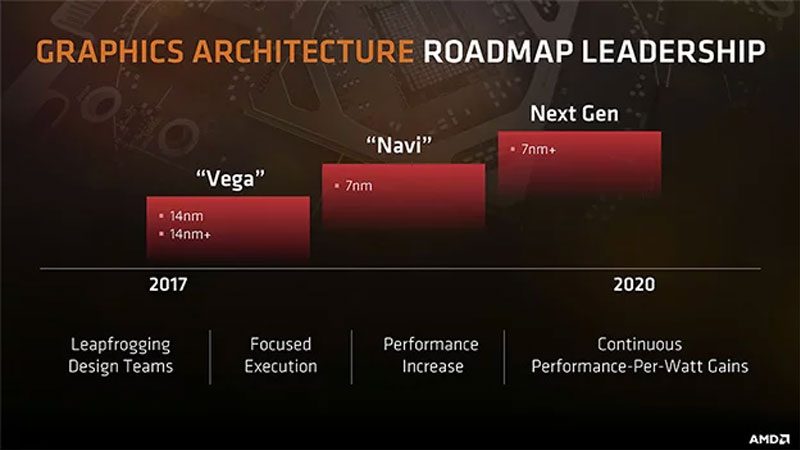
Navi will, like the Vega 20 Instinct graphics cards, be very much a 7nm product, as outlined by AMD’s own roadmap. We don’t have anything in the way of specifications or pricing, but rumors continually point to the first Navi cards being more of a replacement for AMD’s midrange offerings, like the RX 580, than for its Vega range. However, were AMD to offer Vega-level performance at a midrange price point, it could offer credible competition to whatever Nvidia plans to offer with its sub-RTX 2070 GPUs, like the rumored GTX 2060 and 2050.
Regardless, AMD’s 7nm offering would operate on a much smaller die than the 12nm GPUs Nvidia’s Turing cards are built on. That doesn’t mean AMD’s hardware will be intrinsically better, but it is an advantage and one that AMD fans will hope that the red team fully exploits.
Although there’s still some time to wait before AMD’s next-generation of CPUs and GPUs are fully revealed to us, one thing is clear: Some of 2019’s most exciting hardware is going to be built around the 7nm process and AMD will be at the forefront of its development.