  1. Home
  2. Computing
  3. News

Nvidia’s RTX shows how Neil Armstrong would appear if Apollo 11 landed today

Add as a preferred source on Google

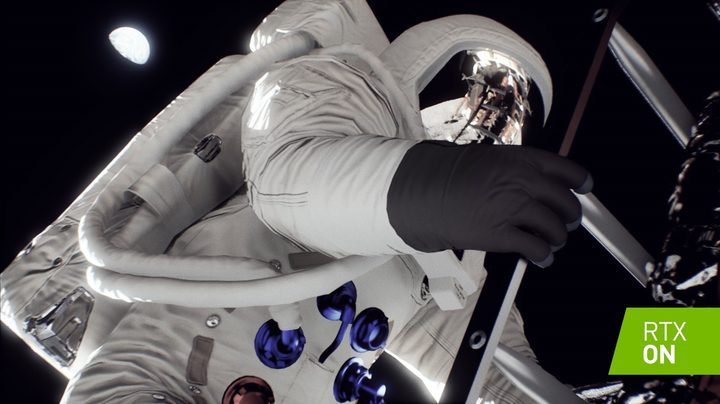
Apollo Moon Landing with RTX Technology; courtesy of Nvidia Image used with permission by copyright holder

What was a small lunar step for man in 1969 has turned into a giant leap forward for computer graphics a half-century later. To commemorate the 50th anniversary of the Apollo 11 moon landing, Nvidia is showing the capabilities of its GeForce RTX graphics in a new demo that illustrates how the grainy images from the moon in 1969 that we’ve come to know would look if it had been captured today. Thanks to the power of real-time ray tracing, Nvidia had remastered those images by applying the principles of light to re-create the moon landing images with cinematic realism in a newly released demo of its RTX technology.

Recommended Videos

“With RTX, each pixel on the screen is generated by tracing, in real time, the path of a beam of light backwards into the camera (your viewing point), picking up details from the objects it interacts with,” Nvidia said of its new moon landing demo in a blog post. Nvidia claims that this project took its researchers more than five years. The team researched the details of the lunar lander, identified the properties of dust particles on the moon, and measured the reflectivity of the materials of the spacesuits worn by the astronauts.

That knowledge was then combined with Nvidia’s real-time ray tracing capabilities found on the RTX graphics cards to re-create the original scene in 1969, showing the sun’s rays emerging from behind the lunar lander and how it is reflected off of the surface of the moon and partially absorbed by the spacesuits worn by the astronauts Neil Armstrong and Buzz Aldrin.

Though real-time ray tracing remains in its infancy today, with limited support in game titles despite a big splashy debut late last year when Nvidia launched its GeForce RTX cards, the technology is often credited for bringing cinematic realism to scenes thanks to the way it is able to translate how light is absorbed, reflected, or refracted off of surfaces in real time. By using ray tracing, Nvidia was able to simulate how the sun’s rays react to every surface, the company said in a YouTube video highlighting this project, noting that the dynamic light and shadows gives us new perspectives on the moon landing. Nvidia’s latest effort to remaster the images from the 1969 Apollo 11 moon landing is not unlike its previous efforts in bringing more realistic details to older games, like Quake 2, by using ray tracing.
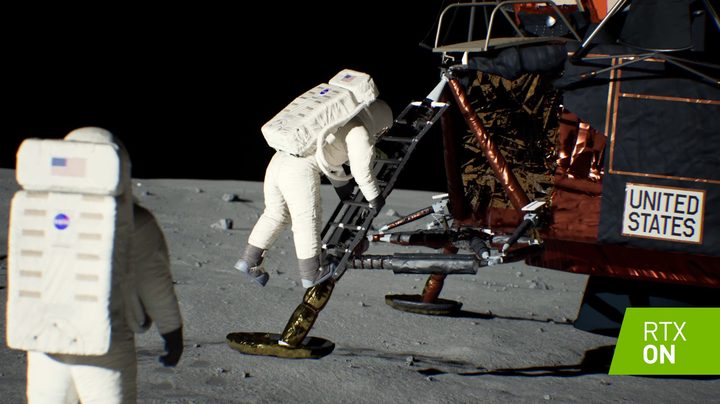
Apollo Moon Landing when seen with real-time ray tracing on RTX graphics; source: Nvidia Image used with permission by copyright holder

The graphics silicon-maker even showed Aldrin the re-created video. As the second human to walk on the surface of the moon, Aldrin appeared to be impressed with the technology. “I’ve got a photo that you can work on next — it’s called the first selfie in space.” Aldrin joked.

Chuong Nguyen
Silicon Valley-based technology reporter and Giants baseball fan who splits his time between Northern California and Southern…
South Korea wants to give every citizen free, unlimited access to its own AI chatbot
The government-backed service could turn generative AI into public infrastructure instead of another monthly subscription
Electronics, Mobile Phone, Phone

South Korea wants to give every citizen free access to an AI chatbot with no usage limits. That puts the technology closer to a public utility than another premium service demanding a monthly subscription.

The Ministry of Science and ICT announced the AI for Everyone project on July 13. Private companies will build the platform around locally developed models, while a separate AI agent will help people navigate government services. It’s a more practical job than generating emails or settling arguments nobody wanted to research themselves.

Read more
Falling in love with a chatbot is now off limits for kids in China
The crackdown targets emotional AI relationships as regulators worry about the country's record low birthrate.
Replika AI companion app on an iPhone in hand

Ever since AI chatbots arrived on the scene, there has been one aspect that has worried lawmakers and experts a lot: humans forming emotional connections with chatbots. There have been plenty of cases where over-reliance on these AI companions or partners has resulted in medical emergencies, lost lives, and triggered multiple lawsuits against the likes of OpenAI and Meta.

China cracks down on AI companion apps

Read more
Russian hackers keep finding their way into critical networks through neglected routers
A multinational warning says outdated firmware, weak passwords, and insecure settings are giving state-backed attackers an easy opening
A Wi-Fi router next to a laptop.

Russian state-backed hackers have spent more than a decade exploiting a stubborn weakness in critical infrastructure networks. Organizations are still leaving poorly configured and outdated routers exposed to the internet.

In a joint cybersecurity advisory, the NSA, CISA, FBI, and international partners warn that hackers linked to Center 16 of Russia’s Federal Security Service are continuing to target vulnerable networking equipment. Energy, healthcare, and government networks are among the sectors facing the highest risk.

Read more