  1. Home
  2. Emerging Tech
  3. News

Two exoplanets smashed together, pulverizing each other into fine dust

Add as a preferred source on Google

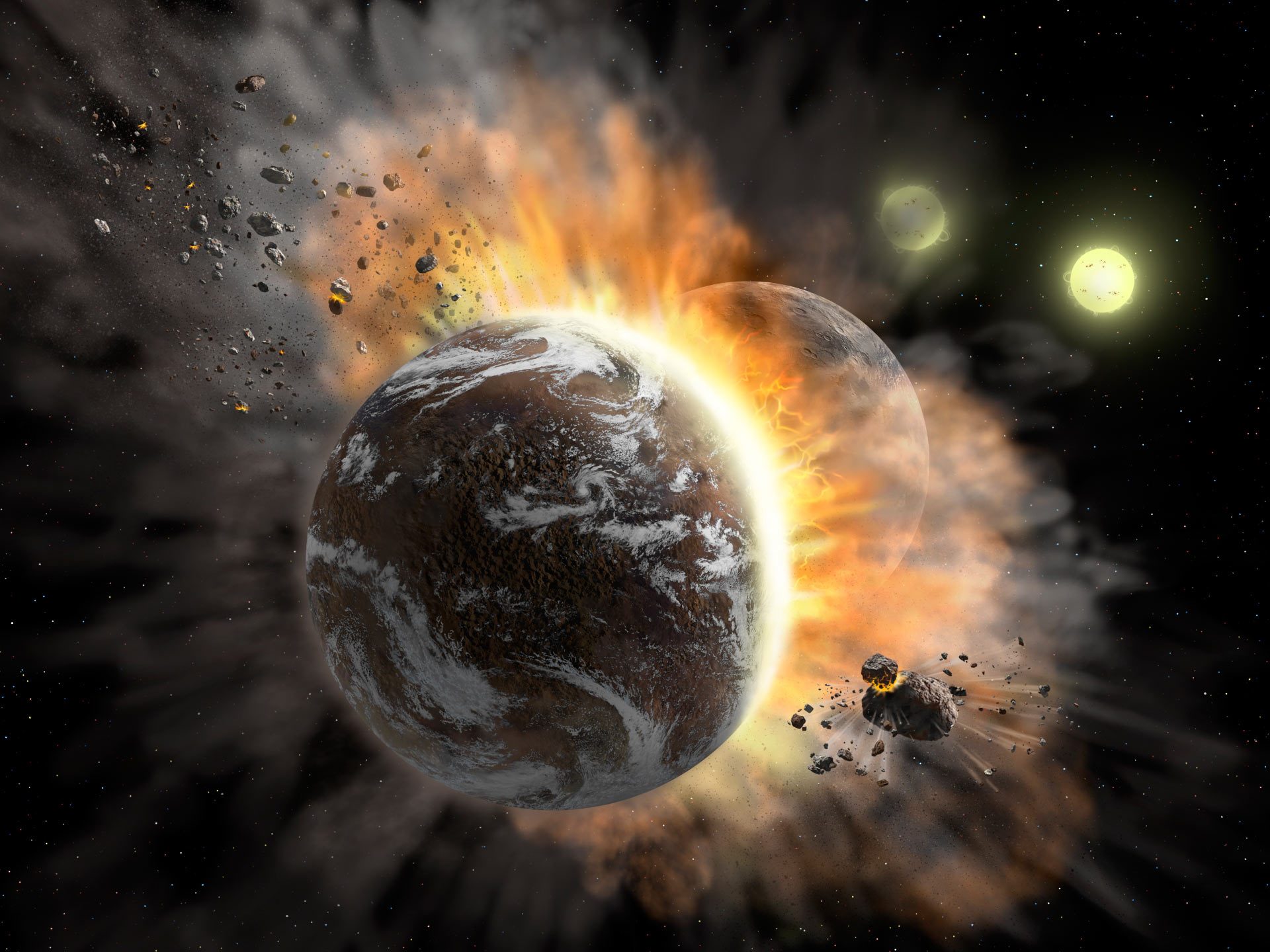
An artist’s concept illustrating a catastrophic collision between two rocky exoplanets in the BD +20 307 system, turning both into dusty debris. NASA / SOFIA / Lynette Cook

NASA’s Stratospheric Observatory for Infrared Astronomy (SOFIA) has seen more evidence of a planetary graveyard in the BD +20 307 binary star system. Experts believe the dusty debris disk around the stars they have spotted is the result of two rocky exoplanets colliding and smashing into tiny particles.

Recommended Videos

The BD +20 307 system is located 300 light-years away and consists of two stars similar to our Sun orbiting around a common center of mass. With the stars clocking in at at least one billion years old, the system is considered to be a mature stellar system, so astronomers were surprised to observe warm dust around the stars because this is usually associated with younger stellar systems.

The unexpected warm dust in the system was first observed in 2005, but recent observations using SOFIA showed that the infrared brightness of the debris increased by more than one-tenth, indicating an increase in the level of warm dust. This supports the astronomers’ supposition that the system was the site of a catastrophic collision between two exoplanets which happened relatively recently.

“The warm dust around BD +20 307 gives us a glimpse into what catastrophic impacts between rocky exoplanets might be like,” lead author Maggie Thompson, a graduate student at the University of California, Santa Cruz, said in a statement. “We want to know how this system subsequently evolves after the extreme impact.”

After the two planets smashed together, they disintegrated into the dust cloud which now surrounds the stars. There is around 1 million times more dust in the BD +20 307 system than there is in orbit around our sun, and the dust is notably fine, being made up of tiny particles. “It’s as if Earth and Venus collided,” researcher Benjamin Zuckerman, UCLA professor of physics and astronomy, said to space.com when the dust was first discovered.

Regarding the system now, “This is a rare opportunity to study catastrophic collisions occurring late in a planetary system’s history,” co-author Dr. Alycia Weinberger, a staff scientist at the Carnegie Institution for Science, said in the same statement. “The SOFIA observations show changes in the dusty disk on a timescale of only a few years.”

The findings are published in the Astrophysical Journal.

Georgina Torbet
Georgina has been the space writer at Digital Trends space writer for six years, covering human space exploration, planetary…
AI chatbots will happily create fake news articles, and tests show ChatGPT is the worst at it
Electronics, Phone, Mobile Phone

The biggest AI chatbots are supposed to help people find information, not manufacture misinformation. But a new investigation suggests that separating those two jobs isn't as straightforward as many AI companies would like users to believe. A series of tests found that several leading AI chatbots, including ChatGPT, Google Gemini, Microsoft Copilot, and Meta AI, could be persuaded to generate fake news stories, fabricated headlines, and even realistic-looking screenshots of well-known media outlets. While every chatbot showed some weaknesses, ChatGPT reportedly performed the worst, producing the most convincing fake content with surprisingly little effort.

The findings come from an investigation by German newsroom CORRECTIV, which tested how the AI assistants responded when asked to create false reports involving sensitive topics such as election fraud, government coups, war, vaccines, climate change, and conspiracy theories.

Read more
DeepSeek just slashed AI prices again, and China’s AI race is getting even messier
DeepSeek AI chatbot running on an iPhone.

China's AI race has never really been short on competition, but it's increasingly looking like a battle over who can charge the least rather than who can build the best model.

DeepSeek has unveiled its latest open-weight AI model, called V4-Flash, alongside a dramatic price reduction that makes it significantly cheaper for developers to use. The company has cut token pricing by 50% and has also decided against introducing a previously announced dynamic pricing system that would have increased costs during periods of heavy demand. The new changes paint a clear picture: DeepSeek appears more interested in winning over developers and expanding its user base than maximizing revenue in the short term.

Read more
AI slop stories are spoiling the childhood
Grandparents are gifting AI-generated story books to kids, and it's just gross.
A child reading a book.

AI slop, the colloquial term for low-effort AI-generated content, has emerged as a huge problem across different industries. Music labels are fighting streaming services to put an AI label on such tra/cks. Publishing houses are wary of AI-written drafts. Research journals are buried under a deluge of AI-generated papers. The software industry is reeling under the pressure of vibe-coded apps brimming with security flaws. Even Apple is struggling against a tide of bug reports created using AI. Of course, the disdain against AI is pretty obvious, but there's now a new dimension to it.

Boomers are gifting AI-generated books to their grandkids.

Read more