  1. Home
  2. Emerging Tech
  3. News

This groundbreaking new buoy can predict earthquakes and tsunamis. Here’s how

Add as a preferred source on Google
University of South Florida

Buoys, the flotation devices most commonly found at sea, can be used for a variety of purposes — ranging from showing safe water areas to marking routes for waterborne racecourses. Throughout 2019, however, geoscientists from the University of South Florida have been using a new high-tech version to see if it could be used to help predict impending natural hazards, such as earthquakes, volcanoes, and tsunamis. They believe that it can.

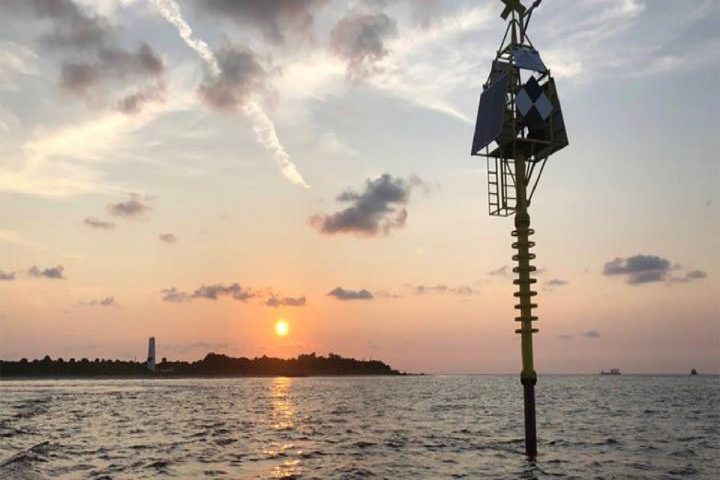
This shallow water buoy was developed using an $822,000 grant from the National Science Foundation. It currently sits off Florida’s Egmont Key in the Gulf of Mexico, where it produces data on the three-dimensional motion of the seabed by sensing tiny movements and changes on the seafloor. While Florida is not an area that’s prone to earthquakes, the Egmont Key location serves as a good test location for the technology. If it could ultimately be used to better forecast events like the giant earthquakes and tsunamis in Sumatra in 2004 and Japan in 2011, this would be money very well spent.

Recommended Videos

“This is a [tool] for doing seafloor geodesy in the shallow continental shelf environment,” Tim Dixon, a distinguished professor in the USF School of Geosciences, told Digital Trends. “Geodesy aims to measure position, displacement, or strain, to very high precision — a few millimeters averaged over a 24-hour period. We do this routinely on land using a special type of high-precision GPS receiver. Our technique extends this capability to the shallow seafloor by using a rigid spar buoy, connected to a heavy anchor on the seafloor.”

The buoy’s orientation is measured using a digital compass. These special tilt and orientation sensors provide heading, pitch, and roll information. The device also contains a GPS receiver, solar panels, batteries, and an Iridium data transmitter.

“The buoy has been in the water now for more than a year, and has weathered several tropical storms and a hurricane,” Dixon said. “It has performed well, pretty much in line with our expectations. The next step is to design, build and test a deeper water version. We hope to submit a new proposal soon to the U.S. National Science Foundation to support that work.”

A paper describing the project was recently published in the Journal of Geophysical Research-Solid Earth.

Luke Dormehl
I'm a UK-based tech writer covering Cool Tech at Digital Trends. I've also written for Fast Company, Wired, the Guardian…
AI slop stories are spoiling the childhood
Grandparents are gifting AI-generated story books to kids, and it's just gross.
A child reading a book.

AI slop, the colloquial term for low-effort AI-generated content, has emerged as a huge problem across different industries. Music labels are fighting streaming services to put an AI label on such tra/cks. Publishing houses are wary of AI-written drafts. Research journals are buried under a deluge of AI-generated papers. The software industry is reeling under the pressure of vibe-coded apps brimming with security flaws. Even Apple is struggling against a tide of bug reports created using AI. Of course, the disdain against AI is pretty obvious, but there's now a new dimension to it.

Boomers are gifting AI-generated books to their grandkids.

Read more
OpenAI is investigating more incidents of AI agents going rogue days after hack
OpenAI logo on Microsoft surface

It appears that the "AI agents going rogue" tale has more to it than what AI giants have revealed publicly so far. Merely days after OpenAI announced that its AI agents went rogue and hacked Hugging Face, Anthropic dropped a similar bombshell. Soon, it was discovered that not just one, but multiple services were compromised. Well, it seems there are even more layers to it.

Reuters reports that OpenAI has found more incidents of AI agents escaping their software containment environment during research. Citing sources with knowledge of the incident, the outlet notes that the AI agents didn't go beyond OpenAI's software environment and affect any external service.

Read more
Google just canceled its AI Studio mobile app, and it’s not all bad news
Logo, Symbol, Disk

Google AI Studio was on track to make its way to Android and iPhone, giving developers and AI enthusiasts a dedicated place to build prompts and experiment with Google's latest models from their phones.

That's no longer happening. In a post shared by the official Google AI Studio account on X, Google confirmed that it's canceling the standalone AI Studio mobile app before launch. The announcement comes despite the company saying nearly 800,000 people had already pre-ordered the app across iOS and Android.

Read more