1. Home
  2. Emerging Tech
  3. News

Global storms on Mars shoot towers of dust 50 miles into the sky

Add as a preferred source on Google

We have dust storms here on Earth, and we’ve observed them on Mars, too. But occasionally something much more dramatic happens on Mars: Multiple dust storms grow and come together to cover the entire planet in a dusty haze.

Scientists are still learning about these massive global storms and what causes them, and now they have learned more about dust towers, an extreme phenomenon seen during the storms. These huge dust clouds are denser than normal clouds and also climb much higher into the atmosphere, forming dramatic columns which reach up into the Martian sky. They can reach up to 50 miles into the air and decay to form a layer of dust 35 miles above the surface which can be wider than the continental U.S.
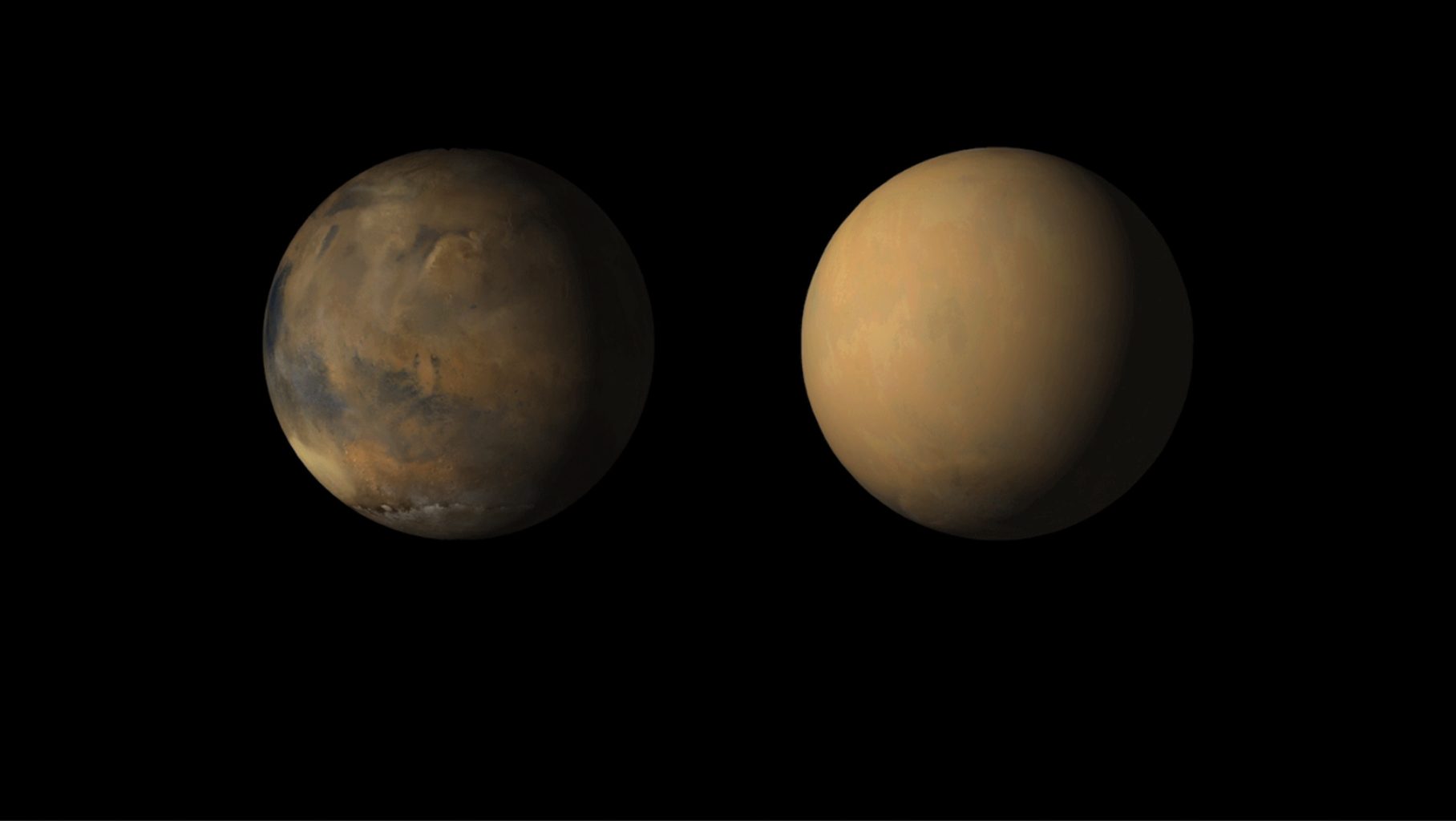
Side-by-side movies shows how dust has enveloped the Red Planet, courtesy of the Mars Color Imager (MARCI) camera onboard NASA’s Mars Reconnaissance Orbiter (MRO). The view from May shows Valles Marineris chasms (left), Meridiani center, an autumn dust storm in Acidalia (top) and the early spring south polar cap (bottom). The view from July shows the same regions, but most of the surface was obscured by the planet-encircling dust cloud and haze. NASA

Researchers think that these towers form when clouds of dust are warmed by sunlight and start to rise. Water molecules which are trapped inside the towers rise along with the dust, in a manner NASA describes as “like riding an elevator to space.” Normally, dust towers occur occasionally and might rise and fall within a few days. But during a global storm, the towers are much more common and can last for three weeks or more.

Recommended Videos

“Normally the dust would fall down in a day or so,” researcher Nicholas Heavens of Hampton University in Hampton, Virginia said in a statement. “But during a global storm, dust towers are renewed continuously for weeks.”

The researchers believe the dust tower phenomenon may even be responsible for Mars losing its water. Scientists know that billions of years ago, Mars had liquid water on its surface and could even have been a lush planet like Earth once. But this water was lost to space over time as Mars’s atmosphere thinned. The dust towers are one way in which water could have been taken away from the planet’s surface and into the atmosphere, where solar radiation can evaporate it into space.

To learn more about the dust towers, researchers need to see more global dust storms in action. But they are relatively rare events, with only about a dozen observed to date. “Global dust storms are really unusual,” Mars Climate Sounder scientist David Kass said in the same statement. “We really don’t have anything like this on the Earth, where the entire planet’s weather changes for several months.”

The findings are published in two papers in the journals JGR Planets and the Journal of the Atmospheric Sciences.

Georgina Torbet
Georgina has been the space writer at Digital Trends space writer for six years, covering human space exploration, planetary…
DeepSeek just slashed AI prices again, and China’s AI race is getting even messier
DeepSeek AI chatbot running on an iPhone.

China's AI race has never really been short on competition, but it's increasingly looking like a battle over who can charge the least rather than who can build the best model.

DeepSeek has unveiled its latest open-weight AI model, called V4-Flash, alongside a dramatic price reduction that makes it significantly cheaper for developers to use. The company has cut token pricing by 50% and has also decided against introducing a previously announced dynamic pricing system that would have increased costs during periods of heavy demand. The new changes paint a clear picture: DeepSeek appears more interested in winning over developers and expanding its user base than maximizing revenue in the short term.

Read more
AI slop stories are spoiling the childhood
Grandparents are gifting AI-generated story books to kids, and it's just gross.
A child reading a book.

AI slop, the colloquial term for low-effort AI-generated content, has emerged as a huge problem across different industries. Music labels are fighting streaming services to put an AI label on such tra/cks. Publishing houses are wary of AI-written drafts. Research journals are buried under a deluge of AI-generated papers. The software industry is reeling under the pressure of vibe-coded apps brimming with security flaws. Even Apple is struggling against a tide of bug reports created using AI. Of course, the disdain against AI is pretty obvious, but there's now a new dimension to it.

Boomers are gifting AI-generated books to their grandkids.

Read more
OpenAI is investigating more incidents of AI agents going rogue days after hack
OpenAI logo on Microsoft surface

It appears that the "AI agents going rogue" tale has more to it than what AI giants have revealed publicly so far. Merely days after OpenAI announced that its AI agents went rogue and hacked Hugging Face, Anthropic dropped a similar bombshell. Soon, it was discovered that not just one, but multiple services were compromised. Well, it seems there are even more layers to it.

Reuters reports that OpenAI has found more incidents of AI agents escaping their software containment environment during research. Citing sources with knowledge of the incident, the outlet notes that the AI agents didn't go beyond OpenAI's software environment and affect any external service.

Read more