
 In Red Faction: Guerilla, Volition, Inc. took the formerly first-person shooter series and spun it out into a third-person, open world action game. The big holdover from the series’ origins was the focus on destructible environments; you couldn’t bore through rock as you could originally, but every free-standing structure in Guerilla could be taken apart piece by piece, using anything from a sledgehammer to a rocket launcher.
Its sequel, Red Faction: Armageddonm continues to hang onto that idea, but the open world is done away with in favor of a more linear experience. The result is an undeniable improvement, a trimming away of the previous game’s considerable amount of excess fat in favor of focused action and imaginative combat scenarios. It also doesn’t hurt that it’s actually fun to shoot enemies this time around.
Previously on Red Faction…
Armageddon picks up 50 years after the events of the previous game. Players step into the role of Darius Mason, grandson of Guerilla‘s protagonist and a formidable warrior in his own right. The action actually starts 40 years after the previous game, with a prologue set during a terrorist assault on the Mars terraformer. The bad guys win that day and the giant machine is taken out, reversing all of the work done to give Mars a more habitable atmosphere and sending the local population down to live in the caves below the surface.
Jump ahead 10 years to the “present” day of 2170; Darius, who still harbors some guilt for the unintended role he played in the terraformer’s destruction, will very soon be responsible once again for a sizable disaster as a race of Martians emerge from the planet’s depths to terrorize one and all. The unfolding story gets increasingly ridiculous as it develops, up to and including a nonsensical conclusion, but where the story falls short the gameplay is there to save the day.
Gears of Destruction
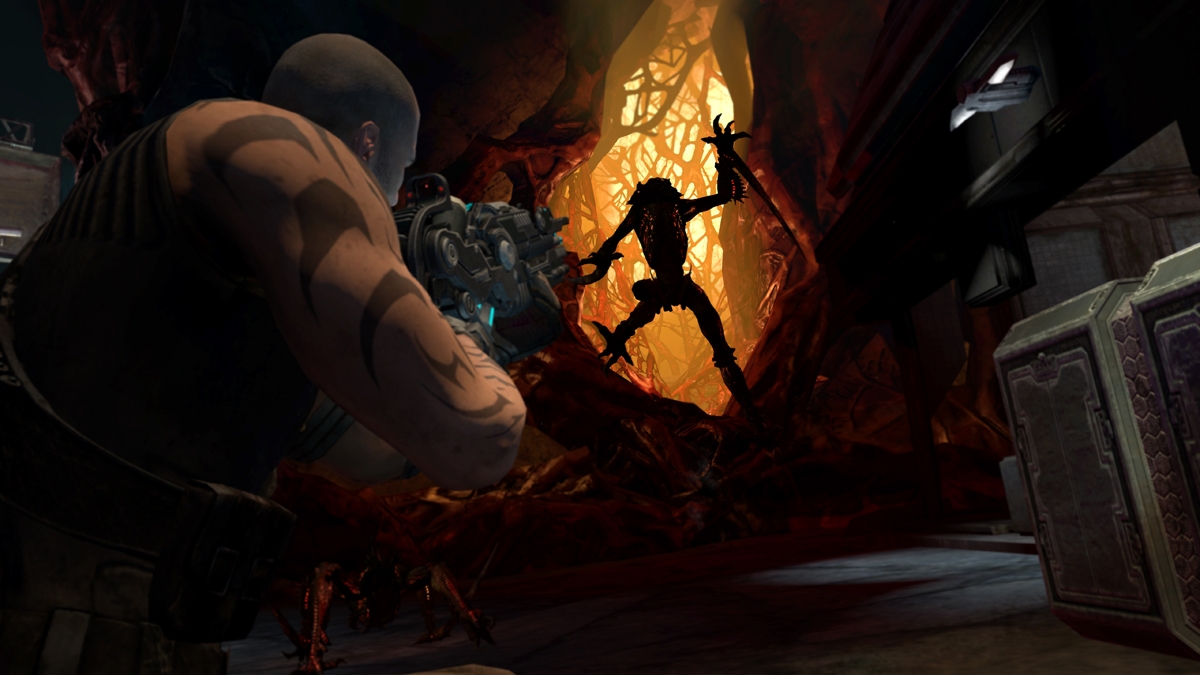
The highly destructible playgrounds returns in Amrageddon, but they dazzle from a very different perspective this time. Fans of the previous game will notice that the camera sits much closer to this Mason this time around, just behind his shoulder and set off slightly to the right. It almost… looks… like… Gears of War.
Armageddon definitely benefits in the change, and in the comparison. Squashing aliens is pretty much the sole focus of Darius’ adventure. There’s a lot of busywork as he fights to keep the people of Mars safe from an alien threat of his own (inadvertent) creation, but most of the time, the only thing standing between you and the next checkpoint is a small army of slavering creatures. There are only a handful of alien “types” that you’ll encounter, but there’s enough variation within those types — not to mention some fun environments to stage your battles in — to keep each encounter feeling fresh.

The big difference between the action here and what you get in Gears is the absence of a cover mechanic. Darius is certainly capable of cowering behind a nearby crate, and at times he is even forced to do so. By and large though, you’ll be running while you’re gunning. Darius can take a fair amount of punishment — and more as upgrades are purchased — and most of the beasties you encounter aren’t a threat individually. There are a few tank-type enemies, but for the most part your foes will go down with a few well-placed headshots… or a confident flick of the Magnet Gun.
Guns and Whammo
The ever-useful sledgehammer returns in Armageddon as a starting weapon, but you’ll quickly discover that the game’s armory offers a great many more options for picking apart your environment–or creatively offing the odd beastie. The Magnet Gun is a standout; earned early, its useful throughout the game and it basically works by linking two points: a target and an anchor point. Once the two are set, the former is pulled toward the latter, with the rate of movement increasing as the distance is closed. Or, to put it in more practical terms, the distant sniper alien is your target and the roof directly above it — several hundred feet directly above it — is your anchor point. If the alien doesn’t burst into bits when it makes contact with the ceiling, it definitely will on its return trip to the surface.
The Nano Rifle also returns, chipping away at bits of the environment (or alien bodies) by simply disintegrating them. You receive it later on in the game, though like the sledgehammer it is outclassed by the range of alternatives. Remote charges are replaced with a remote-detonating grenade launcher, which is always useful. There’s also the Singularity Cannon, which allows you to essentially shoot mini-blackholes, a great way to get out of a jam when the enemies start to press in. Beating the game unlocks the ultimate weapon though: Mr. Toots, the rainbow-farting unicorn, which works like the Nano Rifle only with a sustained beam fire mode.
Beating the game also opens up another layer of play, similar in some ways to the fourth and fifth Resident Evil games. You carry all of your character progress (upgrades, weapons and all) into a New Game Plus mode and can additionally purchase Cheats from the game’s store. They’re more expensive than your character-boosting upgrades, but they come in a variety of flavors that change the way you play, chief among them being weapon-specific “unlimited ammo” unlocks. The action is paced well on an initial playthrough, but adding unlimited ammo takes the wanton destruction up to gratuitous levels of ridiculous. This is the best kind of replay value when it changes the way you play the game.
Collateral Damage
Going along with the single-player campaign is an online co-op mode for 1-4 players called Infestation. The mode actually comes in two flavors, with players either taking on increasingly difficult waves of alien attackers or defending a single structure against those same increasingly difficult waves. You are limited to a set crop of weapons here, though the selection grows as you rise to the higher round numbers (there is a maximum of 30 rounds in a given Infestation match). The “defend” matches also require you to use your rebuild beam, a constant in the single-player game which is used to reconstruct any destroyed structure or object. In an added twist, your spawn location (and building you must defend) shifts each round, demanding constant tactical awareness and an ability to adapt.

Infestation is made more compelling by the fact that your stats in Armageddon carry over between play modes. Any upgrades you buy in either mode apply to your character profile as a whole, so no matter which mode you’re shooting a gun in, you’re earning points toward the bigger picture. That constantly dangling carrot effectively makes each encounter feel worthwhile, like you’re pushing toward a larger goal.
Separate from Infestation is Ruin mode, which comes as a free download (via a packaged code) with new purchases of the game–you can also buy it separately as DLC. In Ruin, you are tasked with destroying everything in sight for points. There’s no real rhyme or reason to it, nothing to be gained beyond high scores (with associated leaderboards) and more maps to rain destruction on. It’s fun though, maybe not enough to justify buying it separately, but a sweet bonus all the same.
Conclusion
Red Faction: Armageddon is good, goofy fun. The story is B-grade fodder, frequently laughable and occasionally downright confusing. The shift to a more Gears of War-style approach to the action though is a big improvement for the series, especially with the inventive array of destructive tools you have to work with. There are occasional frustrations with widely spaced checkpoints and stone-stupid enemy A.I., but none of the slip-ups are enough to keep Armageddon from being fun, beginning to end. That’s the real win here; instead of a filler-packed 20-25 hours you get a tightly paced 15, with the option of playing again with an entirely new approach should you want for more after the credits roll.
Score: 8 out of 10
(This game was reviewed on the Xbox 360 on a copy provided by THQ)


