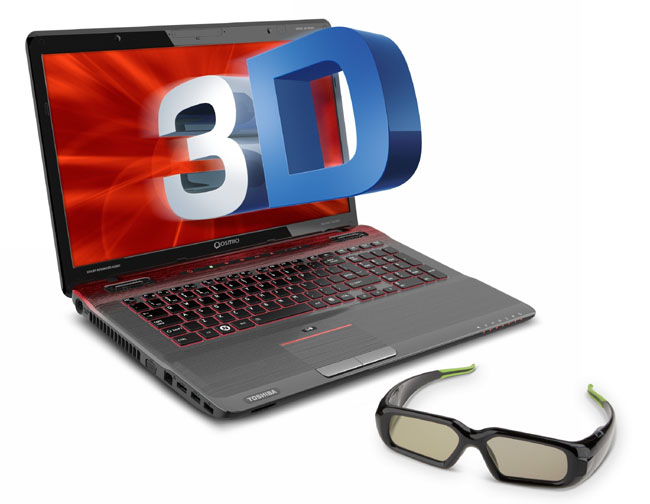
Hewlett-Packard isn’t the only computer maker rolling out new systems today: Toshiba is also smartly out of the gates with no fewer than eleven new systems of its own, ranging from entry-level and mid-range models in its Satellite line to high-end big-screened monsters at the high end designed to appeal to high-def and 3D entertainment fans. Many of the new Satellite systems are available with a choice of either second-generation Intel Core or AMD Fusion A-series processors, while the high-end Qosmios sport Intel Core i5 or i7 processors and Nvidia discrete graphics.
Starting at the high end, Toshiba’s new Qosmio X770 and X770 3D high-end notebooks sport 17.3-inch displays and a choice of second-generation Intel Core i5 or Core i7 processors, along with Nvidia’s new GeForce GTX 560M discrete graphics with 1.5 GB of dedicated video memory. The systems also sport USB 3.0 connectivity, up to 8 GB of RAM, and up to 1 TB of onboard hard drive storage. For media fans, the systems include harman/kardon speakers and a subwoofer, sound enhancement technologies, and a backlit raised-tile keyboard. Options will include Blu-ray players and Bluetooth 3.0. The Qosmio X770 3D adds to the entertainment game with Nvidia 3D Vision technology, with a 120Hz 1080p display, a pair of wireless active shutter glasses, a Blu-ray player, and 3DTV output—users can also pimp out the system with up to 1.25 TB of storage. The Qosmio X770 pricing will start at $1,199.99; the X770 3D will start at $1,899.99. Both should be available later this month.

Moving into more mainstream territory, Toshiba’s new Satellite L700 series will be available with either second-generation Intel Core or AMD Fusion A-series A4 and A6 processors. The line will have four models ranging from the L735 with a 13-inch display and stepping up through 14- and 15-inch displays all the way to the Satellite L775 with a 17.3-inch display. All systems will feature Toshiba’s Sleep and Charge technology that enables the notebooks to charge mobile devices when when powered off, and some configurations will be available with Blu-ray drives and HDMI output. The L700 series will be available in red, white, silver, graphics, and brown, and a new Brushed Aluminum Blue color. Starting pricing will land at $449.99 for the 14-inch L745 and range up to $579.99 for the L775—they should all be available later this month.
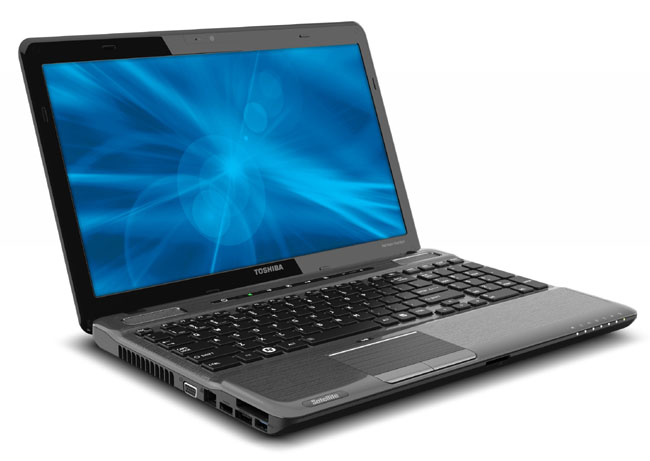
Toshiba is also introducing four models in its Satellite P700 series, all available with either second-generation Intel Core i3, i5, or i7 processors (select configurations available with Nvidia GeForce GT 540M graphics) or the new AMD Fusion A6 processor with additional AMD Radeon graphics. The four systems—the P745, P755/:755 3D, and P775—will be offer 14-, 15.6-, and 17.3-inch screens, respectively, and sport USB 3.0 connectivity, HDMI output, up to 750 GB of storage, and harman/kardon audio. Options will include WiMax 4G connectivity, Blu-ray Disc players, and one unit (the P755 3D) with Nvidia 3D Vision technology and shutter glasses so users can enjoy 3D entertainment and games. The Satellite P700-series should be available June 21; the P755 and P775 will start at $629.99, while the P745 will start at $699.99.
Finally, Toshiba is also rolling out the Satellite C600 series: these will be available with AMD C-50 and E-350 processors and feature 15.6-inch and 17.3-inch displays, 802.11b/g/n Wi-Fi, USB 2.0 connectivity, along with configurations offering up to 640 GB of hard drive storage, 4 GB of RAM. Pricing will start at $379.99.