 Yesterday Google announced it would begin offering writers a new way to promote their work on the Web. Now, in Google News, writers have the option of having their identity given some spotlight alongside their stories. Given the obvious effect Google rankings can have on a site’s performance, this is inarguably an important tool.
But there’s always a hitch, and this time it’s the fact that you aren’t linking in your Internet profile of choice. Instead, you have to sync your work to your Google+ account.
It’s a poorly veiled—maybe even completely forthright—attempt on Google’s part to create a little Google+ interest and activity. While Google continues to protest the site’s success, users and analysts (and in one case a Google team member) complain the social network has become stagnant. Google itself seems to be halfheartedly reclassifying Google+, saying long term plans for the site haven’t revealed its true purpose, that it’s really a platform for looping you into Google’s Web properties as a whole.
And if that’s the case, then tempting writers with the lure of Web notoriety makes sense. The language Google uses in linking your authorship with your Google+ account also makes us a little wary. The site asks you to go to Google+, list your work email, make it universally public, and then verify its authenticity. Call us conspiracy theorists, but combine the remaining unknowns about the Panda update, the mystery of what exactly the +1 button does for page rank, and Google’s general secrecy about its algorithms, and we can’t help but wonder if verifying your place of work doesn’t help bump your articles further up the chain.
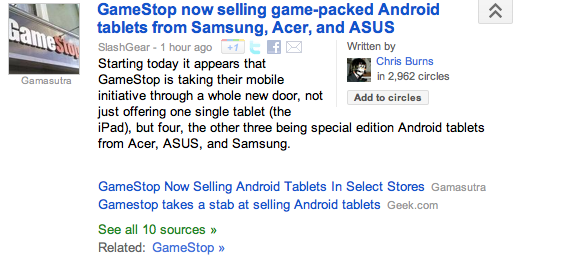 That isn’t to say there wouldn’t be any benefit from this: There are Internet “writers” and then there are Internet writers—and knowing a little more about them can help readers gauge where their information is coming from. For example, do you want to read an article by someone whose Google+ profile lists him as employed by Taco Bell and living in “the man cave,” or by someone who has a background in the subject at hand and a corresponding work email address?
Of course there are sweeping generalizations that can be made when you’re cornered into linking one specific Internet identity to your work life. Google has danced around the issue of Web anonymity, and this would seemingly force writers’ hands into proclaiming themselves—and possibly into maintaining and using a Google+ profile. And it also makes a statement: If you choose to keep things private on the Internet, you lose. Even if using this new tool from Google doesn’t improve your site’s page rank, it will likely make those who do choose to use it seem more credible. Readers will see an image, how many Circles you’ve been added to, and a link to your Google+ page. Of course, being included in three Circles isn’t exactly attractive—hence your desire to become a more active Google+ member.
Furthermore, it feels almost anti-Web to ignore the various other Web platforms writers are using to further their careers and promote their material. Does this justify new antitrust complaints against Google? Hardly. But it deserves a critical eye and a second thought about how much control the company wields—and will wield—over Internet content.