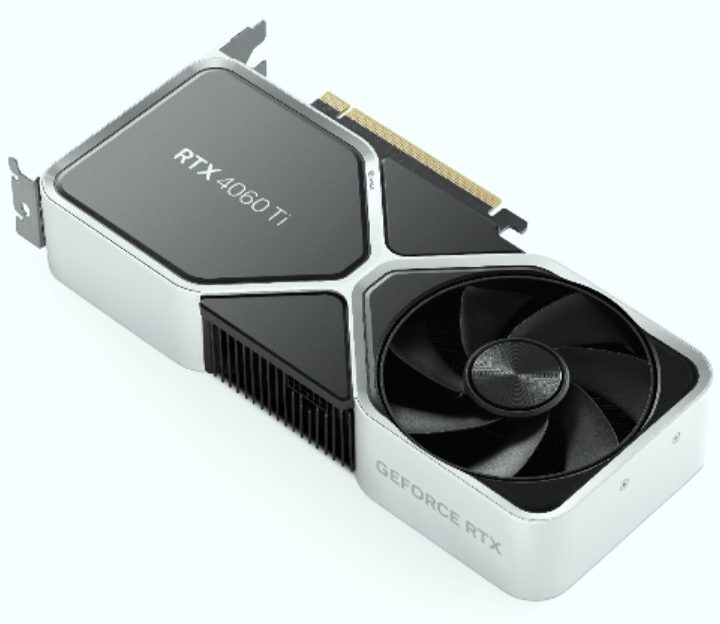
The rumors are true: Nvidia has two versions of its new RTX 4060 Ti graphics card. These are the highly anticipated new midrange GPUs, and yes, one comes with 8GB of VRAM and one comes with 16GB — and they’re separated by $100 in price.
It’s a head-scratching decision on a few different levels. Games that demand more than 8GB of VRAM are increasingly common, which is frustrating for those eying the $399 8GB model. What’s more — the RTX 4070 Ti comes with just 12GB of VRAM, despite costing $599.
That puts Nvidia in a weird spot when attempting to sell the RTX 4060 Ti, but the company does have an answer. A representative of the company explained its approach to its memory subsystems. These changes were all made as a part of the Ada Lovelace architecture in the rest of the RTX 40-series cards.
But as Nvidia notes, these become increasingly important with these less-powerful GPUs in the lineup.
| RTX 4060 Ti | RTX 4070 | RTX 4070 Ti | RTX 3060 Ti | |
| Shaders | 22 TFLOPs | 29 TFLOPs | 40 TFLOPs | 16 TFLOPs |
| VRAM | 8GB / 16GB | 12GB | 12GB | 8GB |
| L2 cache | 32MB
288 GB/s |
36MB
504 GB/s |
48MB
504 GB/s |
4MB
448 GB/s |
| Memory type | GDDR6 | GDDR6X | GDDR6X | GDDR6 |
| Memory bus | 128-bit | 192-bit | 192-bit | 256-bit |
| TGP | 160w/165w | 200w | 285w | 200w |
| Price | $399/$499 | $599 | $799 | $399 |
The major change is the size of the L2 cache, which jumps from 4MB in the RTX 3060 Ti to 32MB in the RTX 4060 Ti. This on-die cache matters quite a lot and has an important relationship with the frame buffer, or VRAM.
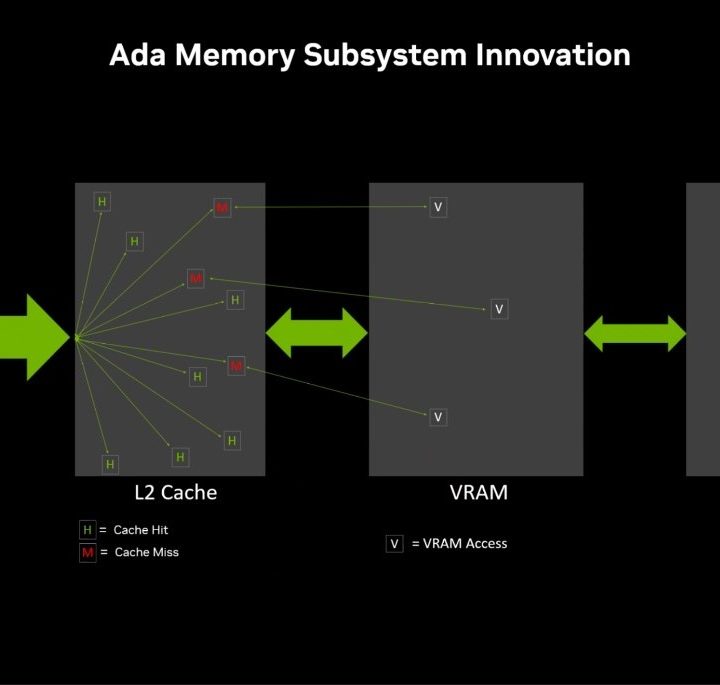
In theory, the larger cache size allows for less need to constantly look for data in the VRAM. Nvidia provided the following graphic to explain how relying on the faster and more abundant L2 cache creates less traffic going across the memory bus — and ultimately, less system memory.
This is also an explanation for why the memory bandwidth is just 288 GB/s (gigabytes per second). Notably, this is much slower than the 448 GB/s on the RTX 3060 Ti or other 30-series cards. But Nvidia has an answer there too. Because the larger L2 cache reduces memory traffic by around half, that doubles the effectiveness of that bandwidth. Nvidia’s math adds up to the equivalent of an “effective memory bandwidth” of 554 GB/s on the RTX 4060 Ti.
Nvidia’s also making a big point of it because of the significant drop in bandwidth from the RTX 4070 to the 4060 Ti — 504 GB/s down to 288 GB/s. So, Nvidia’s defense makes sense compared to the RTX 3060 Ti, but how this will fit into the lineup (or against Nvidia’s rivals) is a bit less clear.
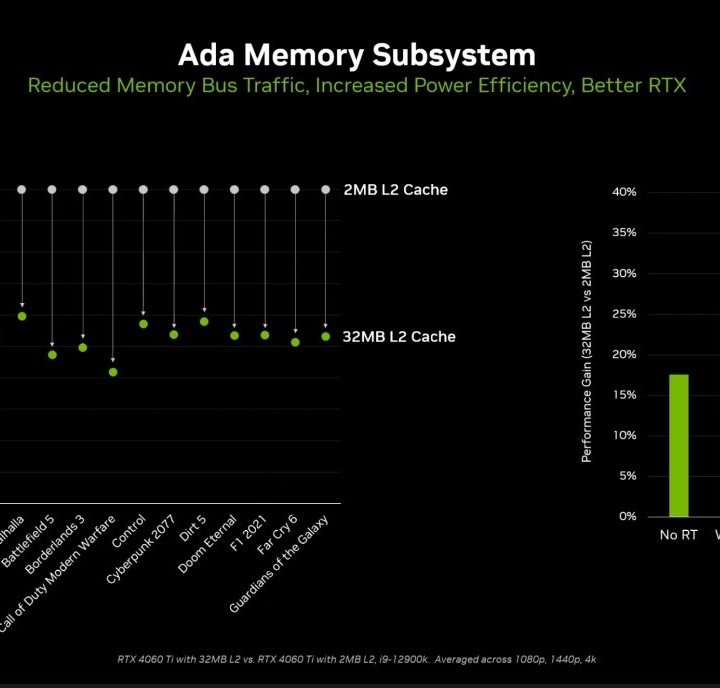
We’ve observed that Nvidia GPUs tend to use less VRAM than the AMD equivalent in our testing, though as Nvidia freely admits, it’s hard to measure that difference apples to apples. Nvidia claims that the result, however, is better performance. More specifically, Nvidia says the larger cache aids in ray tracing and DLSS performance — two technologies the company continues to hawk.
Without ray tracing on, the RTX 4060 Ti claims to be 18% faster than the last-gen 3060 Ti. But with ray tracing, it’s up 25%.
Another important reason why Nvidia calls attention to this innovation in Ada is to explain why one configuration of the RTX 4060 Ti comes with just 8GB of VRAM. That’s especially important since the 8GB model is the one Nvidia is putting its weight behind. It’s releasing first and is the only model to get a first-party Founder’s Edition release from Nvidia.
More than that, Nvidia’s competitors continue to release 16GB graphics cards even cheaper than the RTX 4060 Ti. For example, Intel’s Arc A770 has 16GB of VRAM and only costs $350. It also has an L2 cache size of 16MB, which sits in between the RTX 3060 Ti and 4060 Ti. We do know that the Arc A770 performs much better in games like Hogwarts Legacy than you might assume.
So, does the 8GB RTX 4060 Ti have enough VRAM for the price? We’ll have to wait for reviews to come out to know for sure. Nvidia obviously thinks it does. It feels that there are enough games that don’t need that extra memory — or at least that people would be willing to shell out an extra $100 for the 16GB model.