1. Home
  2. Space
  3. News

The search for habitable moons in the solar system is heating up

Add as a preferred source on Google
Promotional image for Tech For Change. Person standing on solar panel looking at sunset.
This story is part of Tech for Change: an ongoing series in which we shine a spotlight on positive uses of technology, and showcase how they're helping to make the world a better place.

In the search for life beyond Earth, one of the most exciting potential locations to explore is Saturn’s icy moon Enceladus. With its thick icy crust covering a liquid water ocean, the moon is notable both for the plumes of water spraying from its surface and the fact that it could potentially support life. Now, the search for habitable environments is heating up as astronomers discovered that Enceladus hosts phosphorus, which is an important element for life.

The research used data from the Cassini mission, which performed multiple flybys of Enceladus in the mid-2000s, investigating the water plumes and cryovolcanoes that dot its surface. The spacecraft also flew through one of the outer rings of Saturn, which carries particles that are sent out by the Enceladus plumes. While much of the Cassini data has been studied extensively, this new research is the first time that phosphorus has been detected in it.
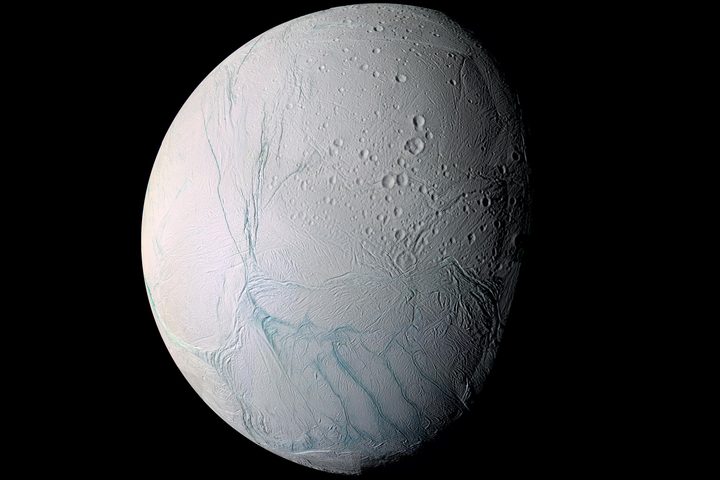
During a 2005 flyby, NASA’s Cassini spacecraft took high-resolution images of Enceladus that were combined into this mosaic, which shows the long fissures at the moon’s south pole that allow water from the subsurface ocean to escape into space.
During a 2005 flyby, NASA’s Cassini spacecraft took high-resolution images of Saturn’s icy moon Enceladus that were combined into this mosaic, which shows the long fissures at the moon’s south pole that allow water from the subsurface ocean to escape into space. NASA/JPL/Space Science Institute

“We previously found that Enceladus’ ocean is rich in a variety of organic compounds,” said lead researcher Frank Postberg of Germany’s Freie Universität Berlin in a statement. “But now, this new result reveals the clear chemical signature of substantial amounts of phosphorus salts inside icy particles ejected into space by the small moon’s plume. It’s the first time this essential element has been discovered in an ocean beyond Earth.”

Recommended Videos

Phosphorus can form organic compounds, which are chemicals with carbon or hydrogen bonds that are important for life. Phosphorus forms the basic structures of DNA, so finding it supports the idea that the moon could be potentially habitable.

The researchers make it clear that they haven’t found life on Enceladus, but that the required ingredients seem to be there. “Having the ingredients is necessary, but they may not be sufficient for an extraterrestrial environment to host life. Whether life could have originated in Enceladus’ ocean remains an open question,” said Christopher Glein of the Southwest Research Institute.

As well an making the moon an intriguing target for further study, the findings about Enceladus also demonstrate that we could investigate other icy moons for habitable conditions, such as Jupiter’s moons Europa, Ganymede, and Callisto. The European Space Agency’s JUICE mission is currently on its way to investigate these targets and to look for evidence of potentially habitability there.

The research is published in the journal Nature.

Georgina Torbet
Georgina has been the space writer at Digital Trends space writer for six years, covering human space exploration, planetary…
Space is becoming Bezos and Musk’s next data center site, and we have every reason to worry
The AI boom is coming for the night sky
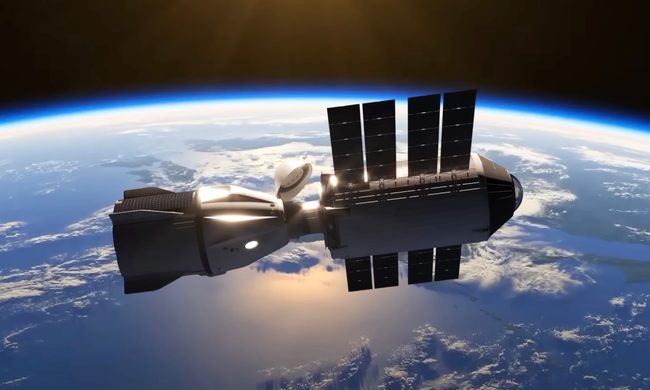
How Vast's space station will look in orbit.

AI data centers already consume vast amounts of electricity and water on Earth, so Silicon Valley has begun looking somewhere considerably more spacious... literally.

Elon Musk's SpaceX and Jeff Bezos' Blue Origin, along with several other companies, have proposed enormous constellations of satellites designed to operate as orbital data centers. However, environmental groups and former space officials are now warning that putting them into orbit at the proposed scale could have severe consequences for Earth's atmosphere and the night sky.

Read more
The first possible exomoon is here, and it makes our Moon look hilariously tiny
Scientists may have found the first exomoon, except this one is the size of Jupiter
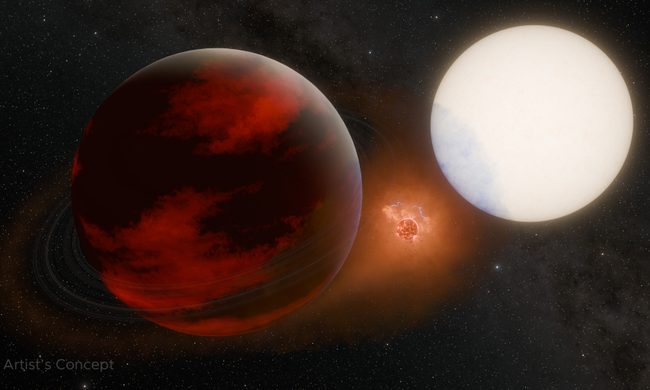
This artist’s concept depicts a potential volcanic moon between the exoplanet WASP-49 b, left, and its parent star. New evidence indicating that a massive sodium cloud observed near WASP-49 b is produced by neither the planet nor the star has prompted researchers to ask if its origin could be an exomoon.

We have already discovered more than 6,000 planets outside of our immediate neighborhood. Yet, finding a moon orbiting one of those distant worlds has proved considerably harder. Astronomers may finally have something close to the real deal, but this particular object stretches the word “moon” almost beyond recognition.

Using the European Southern Observatory’s Very Large Telescope in Chile, researchers detected strong evidence for a moon-like object in the CD-35 2722 system. Further observations are still necessary to confirm the discovery, but it could become the first confidently detected natural satellite outside our solar system. There is still one tiny complication though. This moon is apparently massive.

Read more
China’s answer to SpaceX’s reusable rockets literally catches boosters in a net
SpaceX catches boosters on legs. China just used a net.
Ammunition, Missile, Weapon

SpaceX's playbook for recovering a rocket booster generally involves legs, a precisely controlled vertical landing, and either a concrete pad or a drone ship. 

China just managed to pull off something similar, but in a slightly different way, and on July 10, it tested the method as well.

Read more