1. Home
  2. Space
  3. News

This star shredded its companion to create a stunning double-lobed nebula

Add as a preferred source on Google

Nebulae are some of the most beautiful structures to be found in space: vast clouds of dust and gas that are illuminated by light from nearby stars. These regions are often busy sites of star formation, as new stars are born from clumps of dust that collect more material due to gravity. Within the category of nebulae, there are different types such as emission nebulae, where the gases are ionized by radiation and glow brightly, or supernova remnants, which are the structures left behind after massive stars come to the end of their lives and explode.

A recent image captured by NOIRLab’s Gemini South telescope shows a rare type of nebula called a bipolar reflection nebula. Known as the Toby Jug Nebula for its similar shape to a traditional English jug, nebula IC 2220 is 1,200 light-years away in the constellation of Carina, or the Keel.
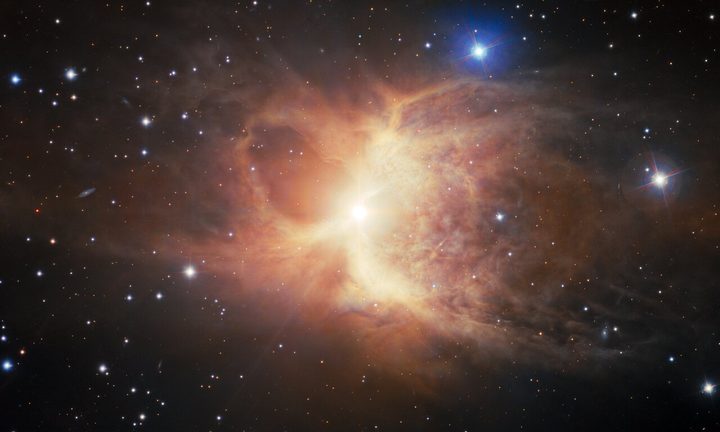
A billowing pair of nearly symmetrical loops of dust and gas mark the death throes of an ancient red-giant star, as captured by Gemini South, one half of the International Gemini Observatory, operated by NSF’s NOIRLab. The resulting structure, said to resemble an old style of English jug, is a rarely seen bipolar reflection nebula. Evidence suggests that this object formed by the interactions between the dying red giant and a now-shredded companion star. The image was obtained by NOIRLab’s Communication, Education & Engagement team as part of the NOIRLab Legacy Imaging Program.
A billowing pair of nearly symmetrical loops of dust and gas mark the death throes of an ancient red-giant star, as captured by Gemini South, one-half of the International Gemini Observatory, operated by NSF’s NOIRLab. The resulting structure, said to resemble an old style of English jug, is a rarely seen bipolar reflection nebula. International Gemini Observatory/NOIRLab/NSF/AURA Image processing: T.A. Rector (University of Alaska Anchorage/NSF’s NOIRLab), J. Miller (Gemini Observatory/NSF’s NOIRLab), M. Rodriguez (Gemini Observatory/NSF’s NOIRLab), M. Zamani (NSF’s NOIRLab)

The double lobe of the nebula refers to the two looped structures originating from the nebula’s heart, a red giant star coming to the end of its life. Lower-mass stars like our sun reach this stage when they begin to run out of fuel and puff up to a large size, before throwing off layers of gas to create a planetary nebula.

Recommended Videos

“In about five billion years from now, when our sun has burned through its supply of hydrogen, it too will become a red giant and eventually evolve into a planetary nebula,” NOIRLab writes. “In the very distant future, all that will be left of our solar system will be a nebula as vibrant as the Toby Jug Nebula with the slowly cooling sun at its heart.”

The red giant, called HR3126, is thought to be partially responsible for the unusual double-lobed shape of the nebula. Astronomers theorize that the red giant once had a companion star, which has since been pulled apart into a dense disk of matter which rotates around the red giant. This shredding of the companion star could have spurred the formation of the two-lobed structure.

Georgina Torbet
Georgina has been the space writer at Digital Trends space writer for six years, covering human space exploration, planetary…
China’s answer to SpaceX’s reusable rockets literally catches boosters in a net
SpaceX catches boosters on legs. China just used a net.
Ammunition, Missile, Weapon

SpaceX's playbook for recovering a rocket booster generally involves legs, a precisely controlled vertical landing, and either a concrete pad or a drone ship. 

China just managed to pull off something similar, but in a slightly different way, and on July 10, it tested the method as well.

Read more
Dimming the sun sounds unhinged, but this new study on El Niño makes a surprisingly good case for it
A natural test case, Australia's worst-ever wildfire season, suggests the idea deserves serious consideration.
Nature, Outdoors, Sky

When I first saw "scientists propose dimming the sun," I rolled my eyes. It sounds like a science fiction movie cooked up after watching many climate documentaries. But a new study, published on July 8, 2026, in the journal Science Advances, seems to have a genuinely compelling argument.

A Super El Niño is currently forming in the Pacific, feared to be the most intense in decades. It could escalate floods, wildfires, and extreme heat events worldwide. However, Researchers at UC San Diego's Scripps Institution of Oceanography, led by climate scientists Kate Ricke and Jessica Wan, are now proposing one of the most interesting solutions I’ve come across.

Read more
You can now walk through space and gaze into a black hole at this VR exhibit
Smithsonian Starstruck lets you drift past dying stars and see the origin point of the universe for as little as $18 a person.
Smithsonian Starstruck featured

Most planetarium shows ask you to sit still and look up. The Smithsonian's new VR exhibit takes a different approach, letting visitors walk through the vast expanse of the universe, drifting past stars, planets, and a black hole to get a physical sense of its true scale.

A $29 ticket to the edge of the galaxy

Read more