Even since I got my Steam Deck, I’ve spent too much time looking for greener pastures. I wished I could ditch Linux in favor of a more familiar Windows machine. Its enormous form factor left me wanting something a little more portable. Most of all, I yearned for a better display that would match my Nintendo Switch OLED. With each new portable PC that was released, I was sure I’d leave my Steam Deck behind the first chance I got.
I was especially ready to pack it up when I got my Lenovo Legion Go. On paper, it solved almost every problem I had with Valve’s handheld and more. It was much bigger, but with a wildly improved screen; its Switch-like design and Windows integration felt like a perfect fit for what I needed. That’s not to mention that it came with a performance boost too that would theoretically let me play more high-end games that the Steam Deck couldn’t run well.
After a short fling with the Legion Go (and a surprising Steam Deck upgrade), I’ve come running back to Valve’s handheld. I didn’t know how good I had it.
Greener grass
When I first got it, Lenovo’s Legion Go was an attractive handheld compared to my Steam Deck. Right off the bat, it had more of a flashy toy factor thanks to its detachable controllers, which allowed for an innovative FPS mode and smart tabletop play via a kickstand. It’s a more immediate joy to experiment with, as I found creative ways to play games like Gears Tactics from the comfort of my couch.
Its impressive specs got me excited too. The Legion Go sports a fantastic 8.8-inch QHD+ IPS display that can run at 1600p and 144Hz. It was an enormous jump over my Steam Deck’s washed-out LCD screen, making every game I played look much more vibrant. The performance bump was significant too. While I could only get 41 frames per second out of Cyberpunk 2077 on Steam Deck, I was hitting 67 fps on Legion Go. I was in paradise and I was sure I’d zipped up my Steam Deck case for the last time.
Then the honeymoon phase began to wane.
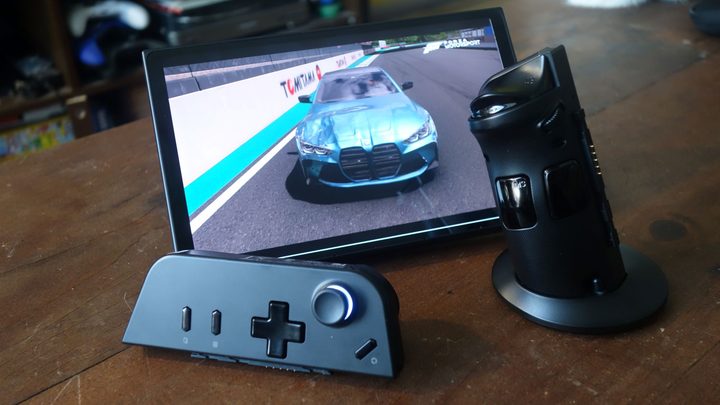
While the Legion Go is one of the better portable PCs on the market, just behind the Asus ROG Ally, it came with some unexpected problems. The biggest one came from the feature I was most excited about: Windows. Wrestling with Linux on my Steam Deck has been a nightmare since day one, so I was excited to use an OS that I knew like the back of my hand to more easily download emulators or apps like Xbox Game Pass. It turns out that trying to work Windows on a handheld console is somehow even worse.
Initially, I could barely get a game running on the Legion Go. Xbox Game Pass titles wouldn’t load at all at first. The culprit ended up being some strange Windows behavior that forced me to reset the system’s clock and date. Even once I got apps running correctly, I began running into roadblocks. Diablo 4 would freeze every time I got to the opening Blizzard logo. Sometimes games would appear zoomed in, while others wouldn’t sit flush on the edges of the screen. For every game I fired up, I’d have to set aside extra time for troubleshooting.
And that impressive display I pined over? It turned out it wasn’t exactly practical. If I tried to run games at 1600p, I’d see significant performance drops that simply weren’t worth the extra clarity. I would end up playing most of my games at 800p, not really taking advantage of the Legion Go’s defining feature. That’s not to mention that the huge display also ballooned the size of the console, making it far heavier and more uncomfortable than my Steam Deck. I was on the other side, but the grass wasn’t greener.
A new appreciation
As if Valve sensed my moment of weakness, it unveiled a brand new Steam Deck model the day after I’d published my Legion Go review. The new variant would add a bright OLED screen, alongside a few other key improvements to the battery. Suddenly I was running back to the handheld I’d taken for granted, hoping it would accept me back with open arms.
And it did. Returning to the Steam Deck after the Legion Go emphasized just how well-built Valve’s device is despite its limitations. It suddenly felt way lighter in my hands coming off a comparatively enormous device. The new OLED model also cuts down on fan noise and heat, making it a much friendlier portable option than ever before. Plus, its brand-new display fixes the biggest problem I had with the Steam Deck — and even adds a 90Hz option. I can’t say that I miss that 1600p flexibility considering I wasn’t using it anyway.

Yes, Linux is still a pain, but it turns out that using a PC OS of any kind with a standard game controller is a fool’s errand. That’s the beauty of the Steam Deck’s ultimate selling point: the incredibly elegant SteamOS. The tool is perfectly built around the Steam Deck, allowing me to navigate my library and the Steam store without much fuss. I still run into game compatibility issues, but I found that my experience was far more consistent than it was during my short-lived Legion Go era. I didn’t need to spend extra time simply getting a game running.
While I’m back together with my Steam Deck, I’m not keeping on any rose-colored glasses. Valve’s device still has quirks that could stand to be fixed in a second generation and its hardware is only going to feel more out of date as more rivals pile up. Were Valve to let its competitors implement SteamOS on their devices, it’s very possible that I could jump ship again — maybe even give my Legion Go a second chance.
For now, though, I’m finally thankful for what I have. The Steam Deck is imperfect, but it’s still the best PC gaming companion I could ask for.