Just what we needed — more price increases. According to a report by TrendForce, massive demand is doing wonders for DRAM and NAND flash revenue and prices. Both industries have been on a rapid rise in the last couple of years, and this trend is only expected to increase, with DRAM revenue set to rise by 75% this year; NAND flash revenue is also said to increase by 77% year-over-year.
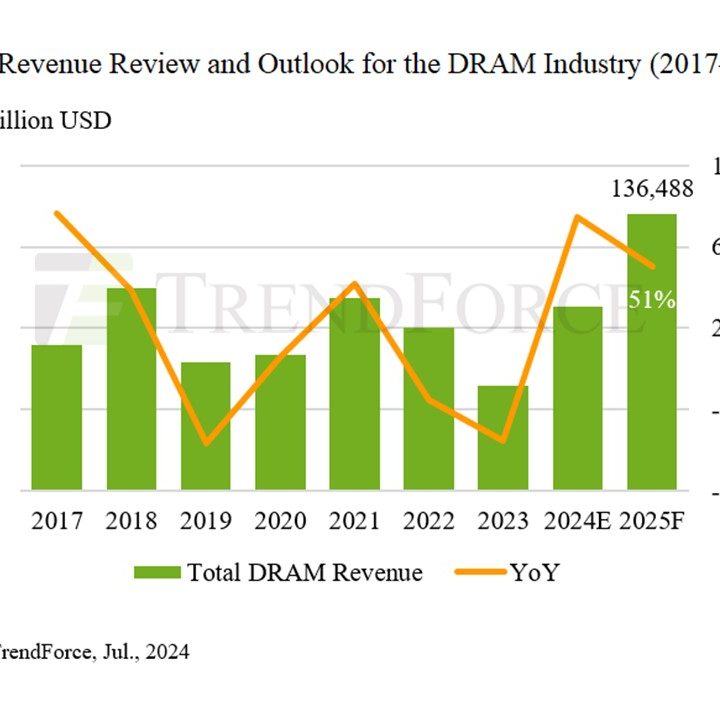
According to the market analysis, DRAM revenue is said to hit a whopping $90.7 billion in 2024. That’s a 75% increase year-over-year, and TrendForce expects that this upward trend will continue next year, with DRAM revenue being expected to reach $136.5 billion, or a 51% increase.
NAND flash, found in SSDs, is doing great, too. The market is projected to reach $67.4 billion in 2024, with a 77% year-over-year increase. While there will be signs of slowing down in 2025, with a total of $87 billion and a 29% increase, the market will still experience major growth.
There are a few reasons to cite for the success of both industries. In the case of DRAM, high-bandwidth memory (HBM) is reportedly responsible. It’s not just straight-up RAM that it’s used for, but also high-performance GPUs, which are critical during the current AI boom. Average DRAM prices are another contributing factor, which, according to Trendforce, already rose by 53% in 2024 and will grow a further 35% over the course of 2025.
HBM is not the only thing to consider here. In fact, the increasing adoption of DDR5 and LPDDR5/5X both played their parts. Compared to DDR4, some of the best RAM kits available today will cost a little more on average, even with DDR5 prices normalizing over the last couple of years. And it’s not strictly gaming RAM, either. DDR5 memory is widely used in servers, accounting for up to 40% of server DRAM bit shipments in 2024 — it’s also set to rise by up to 65% in 2025.
The growth in NAND flash revenue can be traced back to similar sources. Enterprise SSDs are starting to use quad-level cell (QLC) technology, which stores four bits of data per memory cell, up from three in triple-level cell (TLC) tech. Since there’s an enormous demand for fast and dense storage, it makes complete sense that the industry is thriving.
Should we all be raiding the stores to buy out cheap SSDs and RAM while they’re still there? Not necessarily. TrendForce speculates that these price increases may not carry over to end consumers — at least not in full.
The report states: “Conversely, rising memory prices will increase the cost of electronic products. [original design manufacturer/original equipment manufacturer] companies will find it challenging to fully pass on these costs to retail prices, leading to compressed profit margins. This cost increase may also dampen end-user sales, potentially causing a decline in demand.”
There’s still hope for us, then — but hey, if you spot a good deal on an SSD now, it wouldn’t hurt to go ahead and get it just in case.