I’m sitting on a couch next to Katamari Damacy creator Keita Takahashi playing his upcoming game, To a T. Midway through my wacky demo, I turn to Takahashi and comment on how I’m always happy to see that he’s still so committed to making completely out-there games. He goes quiet for a moment, a puzzled look coming across his face.
“Is it? I thought I was making a normal one this time,” he says with an almost sad sincerity.
That speaks to Takahashi’s limitless creativity; his version of normal is still unlike anything in the video game world today. Where else are you going to find an adventure game about a teenager eternally stuck in a T-pose? Though it may be more traditional than something like Wattam, To a T is shaping up to be an utter delight that finds one of gaming’s most playful designers embracing anime, physical comedy, and singing giraffes.
A new kind of adventure
My demo takes me through the first episode of To a T. I use the word “episode” instead of mission because the entire game is modeled after anime TV shows. Every chapter has an anime theme song as well as a closing theme in which a giraffe sings about running a sandwich shop. The more I describe all this, just keep Takahashi’s words in mind: “I thought I was making a normal one this time.”
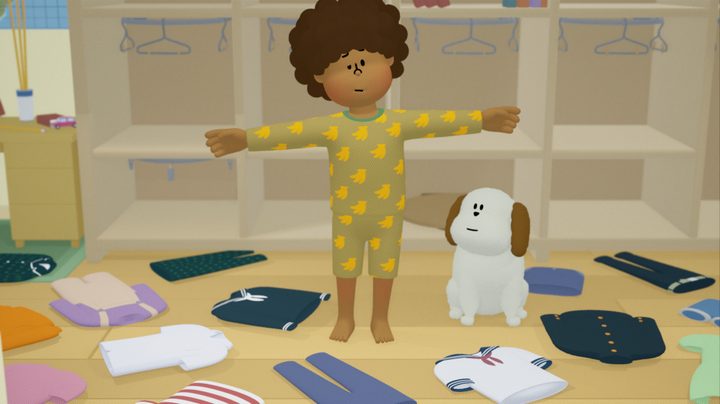
After the intro song, I’m placed in control of a 13-year-old, whose gender is purposefully undefined. They’re our average kid — other than the fact that their arms are permanently outstretched. The episode I played started off as a mundane, slice-of-life comedy about their life. The bulk of my time is spent getting ready to go to school as fixed camera angles follow me and my adorable dog around my house.
The idea for the game started with the controls. Takahashi says that he got the idea to make a game where players control their left and right arm with a controller’s matching joystick. That concept led to the idea of the fixed camera, as he felt it was a waste of the controller to dedicate an entire joystick to camera control.
I saw how those controls worked in a series of vignettes. To brush my teeth, I have to tilt the right stick to hover over my toothbrush and then press the right bumper to grab it. I swing my other hand over to the toothpaste with my left hand and press the left bumper to squeeze the tube. I perform similar actions later when I need to make myself a bowl of cereal by pouring food into my bowl at an awkward angle. Later, I clean up dog poop by twisting a joystick in circles and turning the teen into a sidewalk-sweeping tornado. It’s a physical comedy that calls games like QWOP to mind.
Once I leave the house, I’m introduced to what I imagine is the more “normal” part of the game. I can walk around my character’s small town and collect coins, which can be used to buy outfits. In between every episode, there’s a bit of free time where players can explore before starting the next chapter. The missions are more straightforward, as the one I play through has me walking to school, getting my lunch from a giraffe chef, and grappling with being bullied. It’s a sweet coming-of-age story told through Takahashi’s typically imaginative and colorful eyes.
The more we talk about the project, the more I come to understand why Takahashi was so insistent on making something “normal” this time. The designer admits that he was obsessed with the idea that his video games needed to be, well, video games. He believed each one needed an angle that could only be accomplished in an interactive medium. While that philosophy worked wonders for him previously, it eventually left him with creative burnout. To a T breaks his curse, in a sense.
While my time with To a T was brief, I’m already charmed. It’s a good-natured comedy about growing up infused with the kind of humor that only Takahashi can deliver. Players may not agree with the designer’s assessment of his own work, but who wants to be normal anyways?
To a T launches in 2025 for Xbox Series X/S and PC.