The gaming news cycle is so hectic these days that it’s easy to completely forget about a ridiculous industry saga. I was reminded of that while demoing Revenge of the Savage Planet, the latest game from Racoon Logic. When I sat down to try a demo of it ahead of The Game Awards last week, I was greeted by a satirical introduction as a corporate orientation video cheerfully explained that I was an employee on a dangerous mission. As it played, the developer showing me the demo made a crack about Google. I didn’t really understand why, so I laughed and moved on.
It wasn’t until a few minutes later that a long-forgotten thought came back to me. In 2019, Google acquired Typhoon Studios. They were folded into what was supposed to be Google’s first-party game studio, Stadia Games and Entertainment. Two years later, the entire project was shut down and Typhoon Games was spat back out. It formed Racoon Logic later that year, putting the team back to where it started as an indie team.
That isn’t just a strange bit of gaming history; it’s the backbone to Revenge of the Savage Planet. The upcoming adventure game is a fiercely satirical corporate comedy that takes clear jabs at the team’s former overlords. It’s the exact comedic zinger that Google leadership likely deserves following its Stadia disaster.
Explore-em-up
Return to the Savage Planet is a sequel to 2020’s Journey to the Savage Planet, a first-person sci-fi comedy that drew clear inspiration from Metroid Prime. It combined shooting, environmental scanning, and anti-capitalist satire to build a farcical Metroidvania about an employee for Kindred Aerospace who is tasked with traveling to an alien planet and determining if it can be safely colonized. Naturally, that leads to killing a lot of local wildlife and looting the planet’s resources.
The sequel has a similar workplace comedy of errors premise, though players control an employee who is taken out of a long cryosleep to explore five planets rather than one. The basic “explore-em-up” tenets of the first game are all there, as players explore, gather tons of materials, and scan everything in sight to get data on it. The main difference is that it’s all in third-person instead of first, letting Racoon Logic create more visual comedy as the explorer runs around with overly exaggerated arm motions that make them feel like a long-frozen person trying to remember how to use their body.
In my demo, I was free to explore two different planets. Whether or not I actually followed the main story missions or poked around randomly was up to me. I mostly did the latter, getting a taste for just how diverse world activities are. In one area, I found a chest hidden in between a maze of invisible walls that I could reveal by shooting goo at them. Elsewhere, I ended up in a cave where I needed to use conductive gel to move electricity from a shocking plant and over to a natural door shrouded by vines. Even later, I accidentally stumbled into a boss fight with Wormzilla, where I had to deflect gooey spitballs back at it to inflict damage. No two things I did felt the same.
There are two key systems underneath that varied exploration. One is a slapstick combat system, where I can slide kick adorable alien goons, blast them with different elemental shots, or toss grenade-like plants at them. The other system is crafting. This time, players have a home base complete with a 3D printer. Players can harvest materials and use them to print both suit upgrades and furniture for their base. Think Subnautica, but without the survival systems.
Goofing on Google
While the core exploration is plenty fun, it’s my conversation with Studio Lead Reid Schneider that reveals what Revenge of the Savage Planet is really going for. Like its predecessor, it’s a collection of OSHA violations in space. It pokes fun at how terribly companies treat employees and gaming’s uncritical fascination with colonization simulators. As the studio’s politics come flooding back to me, a question I’d never really thought about comes to my mind: How the heck did a studio like this end up becoming Google’s golden child?
“We joined Google because we thought it would be cool to influence a new first party,” Schneider tells Digital Trends. “And then we got there and were like ‘Oh my God, what did we do?’”
The reality is that this game shouldn’t exist.
Typhoon Studios’ brief stint as a Stadia developer didn’t yield much fruit. The entire experiment was shut down before the studio could really make its first game built for the cloud platform. It wasn’t exactly a clean break for the team, though. Even though its employees were able to reform under a new name, its Savage Planet IP was firmly owned by a megacorporation that had just shuttered its gaming operation.
“The reality is that this game shouldn’t exist,” Schnieder says. “We made the first game, we got acquired by Google, we got vomited out by Google. As we were doing that, we went back and said, ‘Google is going to wheel the IP and source code into the vault Indiana Jones style.’ So I was like, ‘Can we just get this back,’ and they said, ‘Weeeeell, OK.’”
That was a learning experience for the team as it reverted to an indie studio, but it had a bit of a silver lining for the Savage Planet series too. It’s one thing to poke fun at corporations as snarky outsiders; it’s another to do it as people who have been chewed up by the biggest machine there is.
“We realized when we were making it that we had all this great material from our time at Google,” Schnieder says. “Everything from having to go through trainings to getting fired in the middle of it all. The juxtaposition of all that material, plus the experience of going ‘how can we go bigger? … how can we merge those things together?’ So we were able to use a little bit of our backstory at Google, but retaining all the stuff that we loved from Savage Planet.”
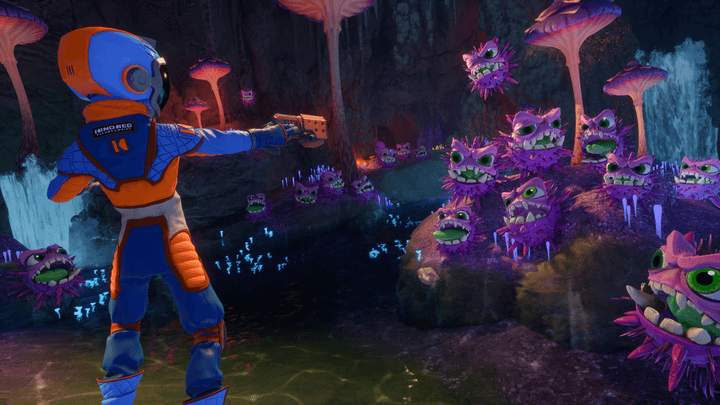
The experience also helped Schnieder better appreciate the flexibility that comes with being independent, something that wasn’t as easy to come by under Google. As an example, he points to one of the funniest jokes I catch during my demo: one planet is called Nu Florida. The location is a send-up of America’s most eclectic state, satirizing its whole aesthetic in typical Savage Planet fashion. It’s a personal gag for Schnieder, who has family in Florida, but one that he believes may have had a hard time getting approved in a sanitized corporate environment.
“I love Florida. I love the ridiculousness of it all,” Schneider says. “The lifted trucks, all that redneck stuff. Our creative director absolutely hates it. We go back and forth where I’m like ‘Florida’s awesome!’ and he’s like ‘f**king Florida!’ In the first game, we made some references to New Florida, and in this one we just blew it out because it’s so completely ridiculous. No one’s remaking Florida! It’s ideas like that that are things that would probably have a thousand layers of approval at a large company saying, ‘you guys can’t do that!’ If you’re going to go indie and make a game that’s fiercely independent, you’ve got to take some fun risks like that.”
Revenge of the Savage Planet seems to embody that indie spirit so far. It’s a game from a studio that’s seen what the grass looks like on the other side and is happy to be back on its own side of the fence. There’s a wild creative spirit to the sequel, from its biting satire to its wide variety of open-world ideas. The entire Google Stadia experiment may have been a failure, but at least we’re getting a good laugh out of it.
Revenge of the Savage Planet launches in May 2025 for PS5, PS5, Xbox One, Xbox Series X/S, and PC.