1. Home
  2. Space
  3. Computing
  4. News

Watch this Atlas rocket zip to the launchpad for Amazon’s Kuiper launch

Add as a preferred source on Google
ULA's Atlas V rocket on the launchpad at Cape Canaveral for the second Project Kuiper satellite deployment.
ULA's Atlas V rocket on the launchpad at Cape Canaveral for the second Project Kuiper satellite deployment. ULA

United Launch Alliance (ULA) has started the countdown clock for the deployment of Amazon’s second batch of Project Kuiper internet satellites.

The rocket operator released a time-lapse video on Sunday showing the Atlas V rocket moving from the Vehicle Assembly Building to the launchpad at Cape Canaveral in Florida. ULA chief Tory Bruno noted that while the rocket appears to hurtle to its destination, the vehicle carrying it is actually moving at a mere 3 mph.

Mighty Atlas out for a stroll and back on the pad. Ps this is a time-lapse. IRL, the 2.5M pound Mobile Launch Platform travels at a blistering 3 mph or so.

Tory Bruno (@torybruno.bsky.social) 2025-06-21T18:39:04.920Z

The mission was supposed to get away last week but technical issues and weather concerns caused the launch date to shift to Monday.

Recommended Videos

When the Atlas V heads skyward at 6:54 a.m. ET on Monday morning, it’ll deploy 27 Project Kuiper satellites to a low-Earth orbit, joining the 27 satellites launched by the same rocket in April.

Similar to SpaceX’s Starlink service, Amazon’s Project Kuiper is designed to bring fast, reliable internet to customers and communities around the world, with a particular focus on unserved and underserved communities.

But having started its satellite deployment in 2019, and now with a constellation of more than 7,000 serving more than 5 million customers globally, Starlink is currently some distance ahead of Project Kuiper.

Amazon is aiming for a constellation of more than 3,200 satellites, which it aims to have in place by the end of this decade.

Before then, possibly before the end of this year, Amazon hopes to be able to start offering a high-speed, low-latency internet service with just 1,000 satellites in low-Earth orbit. Expanding the constellation to the planned 3,200 satellites will enhance network performance and reliability for customers.

The e-commerce giant and cloud services powerhouse is investing more than $10 billion in Project Kuiper, which is expected to significantly expand global internet access.

If you’re interested in watching the launch as it happens, here’s everything you need to know.

Trevor Mogg
Contributing Editor
Not so many moons ago, Trevor moved from one tea-loving island nation that drives on the left (Britain) to another (Japan)…
Space is becoming Bezos and Musk’s next data center site, and we have every reason to worry
The AI boom is coming for the night sky
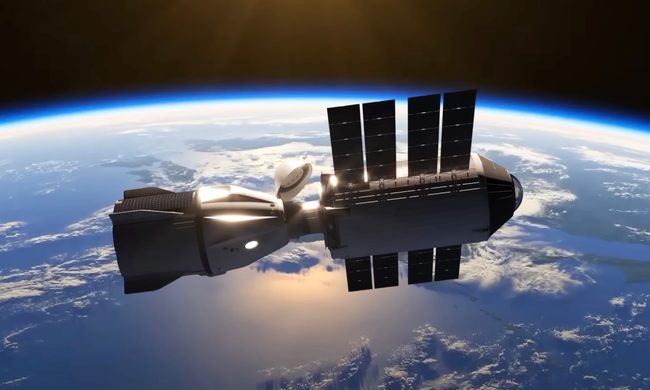
How Vast's space station will look in orbit.

AI data centers already consume vast amounts of electricity and water on Earth, so Silicon Valley has begun looking somewhere considerably more spacious... literally.

Elon Musk's SpaceX and Jeff Bezos' Blue Origin, along with several other companies, have proposed enormous constellations of satellites designed to operate as orbital data centers. However, environmental groups and former space officials are now warning that putting them into orbit at the proposed scale could have severe consequences for Earth's atmosphere and the night sky.

Read more
The first possible exomoon is here, and it makes our Moon look hilariously tiny
Scientists may have found the first exomoon, except this one is the size of Jupiter
This artist’s concept depicts a potential volcanic moon between the exoplanet WASP-49 b, left, and its parent star. New evidence indicating that a massive sodium cloud observed near WASP-49 b is produced by neither the planet nor the star has prompted researchers to ask if its origin could be an exomoon.

We have already discovered more than 6,000 planets outside of our immediate neighborhood. Yet, finding a moon orbiting one of those distant worlds has proved considerably harder. Astronomers may finally have something close to the real deal, but this particular object stretches the word “moon” almost beyond recognition.

Using the European Southern Observatory’s Very Large Telescope in Chile, researchers detected strong evidence for a moon-like object in the CD-35 2722 system. Further observations are still necessary to confirm the discovery, but it could become the first confidently detected natural satellite outside our solar system. There is still one tiny complication though. This moon is apparently massive.

Read more
China’s answer to SpaceX’s reusable rockets literally catches boosters in a net
SpaceX catches boosters on legs. China just used a net.
Ammunition, Missile, Weapon

SpaceX's playbook for recovering a rocket booster generally involves legs, a precisely controlled vertical landing, and either a concrete pad or a drone ship. 

China just managed to pull off something similar, but in a slightly different way, and on July 10, it tested the method as well.

Read more