  1. Home
  2. Mobile
  3. Legacy Archives

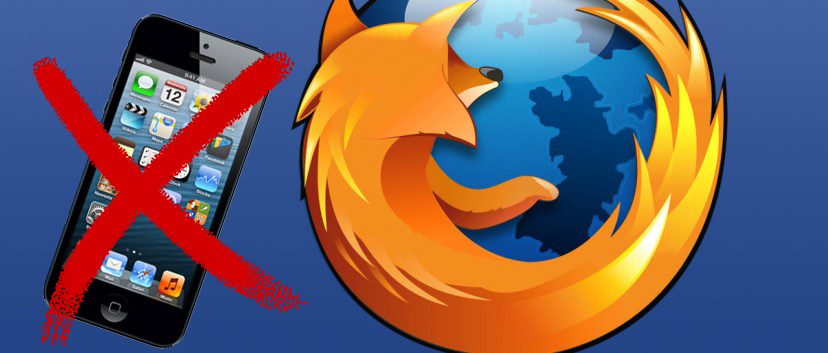
Mozilla says no Firefox for iPhone and iPad unless Apple amends its ways

Add as a preferred source on Google
no-iphone
Image used with permission by copyright holder

Mozilla’s Firefox Web browser has been a favorite among PC users for more than a decade now, and many of these same users have been hoping to use Firefox on their smartphones. While some smartphone OSes ( including Firefox’s own upcoming Firefox OS) already feature a mobile edition of the red critter, the Mozilla Foundation has announced that it will not be porting Firefox to iOS for a number of reasons. That’s right: no Firefox for your iPhone or iPad.

As the browser wars spread into the realm of smartphones, OSes like Android have had the opportunity to be graced with a suite of Web browsers, including a mobile edition of Mozilla’s own Firefox. However, iOS has, until recently, exclusively had only its in-house web browser, Safari. Even today, the few Web browsers on iOS are severely limited as Apple’s stringent policy on app development restricts the features of other Web browsers. In response to this stringent policy, Mozilla has announced that it will not be making Firefox on iOS. It won’t spend the time and resources to port its browser because of Apple’s restrictions.

Recommended Videos

The discussion came up a the ongoing SXSW expo in Austin and represents a continuing hatred by Mozilla of the walled-garden experience in iOS.

The few browsers actually on iOS are severely limited (such as Opera Mini) or are actually just Safari with a fancy skin on it (such as Google Chrome). It’s certainly fair to see why Mozilla wants so much control, and why it’s not worth developing a product when you don’t get the control you deserve.

For now, iPhone and iPad owners alike will have to deal with Safari. Then again, Safari isn’t exactly a terrible browser, and what’s at work here is less of a grudge and more of a logistics issue. Mozilla isn’t made of money, and doesn’t want to waste time investing in a browser Apple that gets the final say over. But at the same time, iOS owners aren’t exactly complaining either. Until iOS users demand more openness, it looks like Mozilla will spend most of its time investing in Android and Firefox OS, and we can’t blame it either.

Joshua Sherman
Joshua Sherman is a contributor for Digital Trends who writes about all things mobile from Apple to Zynga. Josh pulls his…
Topics
Snapchat Planets Meaning: Order, Rankings, and How Friend Solar System Works
Snapchat Planets turns your best friends list into a solar system, and yes, your orbit says a lot
Snapchat Planets being shown on the Snapchat app on iPhone.

Snapchat+ includes several exclusive features, but few have generated as much curiosity as Snapchat Planets. Part of the app's Friend Solar System, it transforms your Best Friends list into a planetary ranking, assigning each of your top eight friends a planet based on how often you interact.

From Mercury, which represents your closest friend, to Neptune, which represents your eighth closest, the system offers a quick visual snapshot of your interactions. But what do the different planets actually mean, and how does Snapchat decide who gets which one?

Read more
How to use WhatsApp Web
We'll show you how to use WhatsApp on your desktop or laptop
WhatsApp Web

As one of the most popular messaging services, you’ve already heard of WhatsApp. From its humble beginnings in 2009—two years before Apple introduced iMessage—to its acquisition by Facebook (now Meta) in 2014, WhatsApp has become the dominant messaging platform around the globe.

In recent years, it's grown even more potent with new features like video messages, self-destructing voice messages, the ability to edit sent messages, and more. We even finally got an WhatsApp iPad app in May 2025.

Read more
What is WhatsApp? How to use the app, tips, tricks, and more
From setting it up to mastering hidden features, here is your complete guide to WhatsApp.
WhatsApp app store listing open on iPhone

There's no shortage of messaging apps out there. The past decade has given us more options than we know what to do with, largely because smartphones demanded something better than plain old SMS.

Both the App Store and the Play Store are packed with apps that promise to revolutionize the way we communicate. Most of them didn't make it. The truth is, a messaging app is only as good as the number of people using it, and most apps never cross that threshold.

Read more