  1. Home
  2. Cars
  3. Photo Galleries
  4. Legacy Archives

Novitec Rosso makes the Ferrari 458 Speciale even more special

Add as a preferred source on Google

The Ferrari 458 Speciale is an aptly-named car. As the most performance-oriented version of the already spectacular 458 series, it is indeed quite speciale.

Yet serial Ferrari tuner Novitec Rosso found some room for improvement, creating a supercar that stands out from even the small crowd of limited-edition Ferrari models.

The difficulty of Novitec Rosso’s task is evident in the car’s body modifications. The company’s creations are usually pretty extravagant, but the stock 458 Speciale is already so pumped up that there wasn’t much to add.

Changes are consequently subtle. They include a revised grille, larger chin spoiler, different rocker panels, gill-shaped moldings around the rear quarter windows and engine bay, a new rear spoiler, and a smattering of extra carbon fiber.
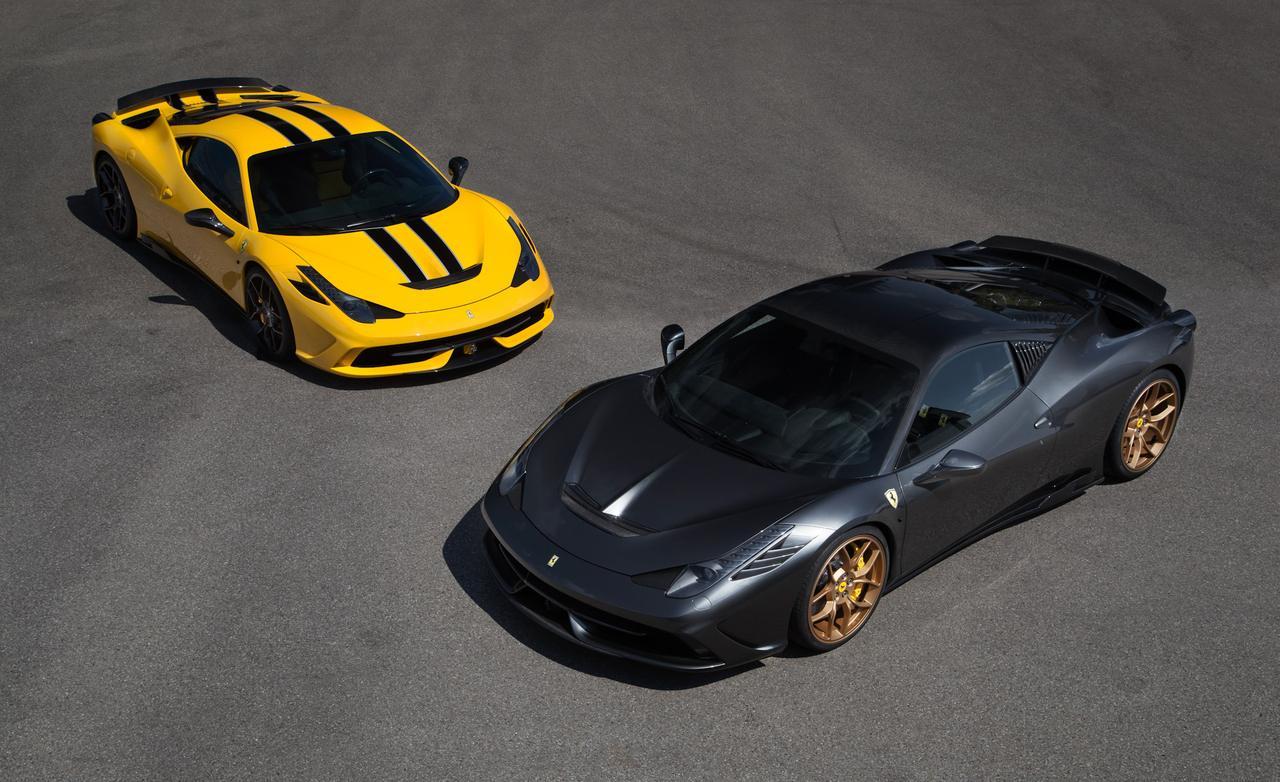
Novitec Rosso Ferrari 458 Speciale
Image used with permission by copyright holder

The most notable difference is probably the rolling stock: 21-inch gold wheels that would look perfect on a pimpmobile or a Subaru WRX rally car.

Those wheels will turn pretty fast thanks to a series of performance upgrades that offer up to 636 horsepower and 422 pound-feet of torque, improvements of 39 hp and 24 lb-ft over the stock 458 Speciale.

That’s made possible by new engine-management software mapping for the 4.5-liter V8, a raised redline, and a freer-flowing exhaust system. Novitec Rosso claims the upgrades will get the tuned Speciale up to 205 mph.

Novitec didn’t completely ignore practicality, though. A front-end lift mechanism can raise the nose 1.6 inches to clear speed bumps, which is helpful, especially since the car has been lowered 1.2 inches compared to the ground-hugging stock version.

Novitec Rosso isn’t talking price, but it’s probably fair to assume that anyone who can afford the stock 48 Speciale’s near-$300,000 asking price can afford the upgrades as well.


Stephen Edelstein
Stephen is a freelance automotive journalist covering all things cars. He likes anything with four wheels, from classic cars…
Volvo is rolling out Apple Music to over 2 million cars with a simple OTA update
Your Volvo may soon get Apple Music without needing CarPlay
Interior view of the 2024 Volvo EX90.

The line between your smartphone and your car continues to blur. Volvo has announced that it is rolling out an over-the-air software update that brings Apple Music directly to the infotainment systems of more than 2 million vehicles worldwide. Instead of relying on Apple CarPlay or plugging in an iPhone, eligible drivers will be able to stream music natively from their car's built-in system, making Apple Music another integrated feature of Volvo's software experience.

The update is arriving for a wide range of Volvo models, including the EX90, ES90, XC90, S90, V90, XC60, S60, V60, XC40, EX40 and EC40, covering model year 2020 onwards. Availability, however, may vary depending on the vehicle.

Read more
Chery’s latest EV packs flagship tech for the price of a base Tesla, but you can’t buy it
Here's everything packed into Exeed's 2027 Exlantix ES, from its 27-sensor autonomous driving suite to its 860 km range, all starting under $31,000.
Car, Transportation, Vehicle

Chery's premium arm just dropped a sedan that makes you wonder why American EVs cost twice as much for half the tech.

Exeed's 2027 Exlantix ES ships with a driver-assist system called Falcon 700. It is built around an Nvidia Orin-Y chip and a genuinely stacked sensor suite.

Read more
A new AI model wants self-driving cars to think before they swerve
Forget guessing games, this self-driving AI actually shows its work.
Self driving car

Self-driving cars have gotten pretty good at driving. The harder problem is teaching them to drive safely in situations nobody planned for. We have heard horror stories of self-driving cars, behaving erratically in emergency situations, often times delaying first responders from reaching the scene.

A team at Seoul National University, led by professor Jun Won Choi from the Department of Electrical and Computer Engineering, thinks they have cracked part of that puzzle with a new AI model called SafeDrive. The research was recently selected as a highlight paper at CVPR 2026, a distinction that goes only to roughly 3% of all submissions.

Read more