Last November, reports started circulating — stemming from a Wall Street Journal article — that Google would kill off its popular Chromebook lineup in favor of making the move entirely to Android by 2017. This maneuver made sense, given the flexibility of Android, something that’s so clearly absent from Google’s other operating system, Chrome OS. It also seemed plausible because of the recently announced, keyboard-equipped Pixel C tablet, which has been available for purchase since mid-December.
Google dismissed those allegations, likely in an attempt to retain the Chromebook’s relevance in the midst of a major product line transition. A response on the Chrome Blog refuted all claims that the company was looking to “phase out” Chrome OS, and instead, asserted that Google was “working on ways to bring together the best of both operating systems,” Android and Chrome OS alike.
The hybrid Pixel C was the first of many PC-esque Android products to come, apparently — but are consumers really interested?
Small things in big packages
I was ecstatic when Google first revealed its $500 Pixel C convertible. Finally, a high-end Android convertible complete with a keyboard — assuming you’re willing to shell out an additional $150 –entered my life.
Taking Android to the desktop was an obvious step for Google. The beloved mobile operating system, while not as stable as Chrome OS, offers a wide range of utilities extending beyond the limits of a simplistic Web browser. But being an operating system intended for mobile means it comes with a fair share of complications, as well. The Pixel C, for example, has no mouse or touchpad.
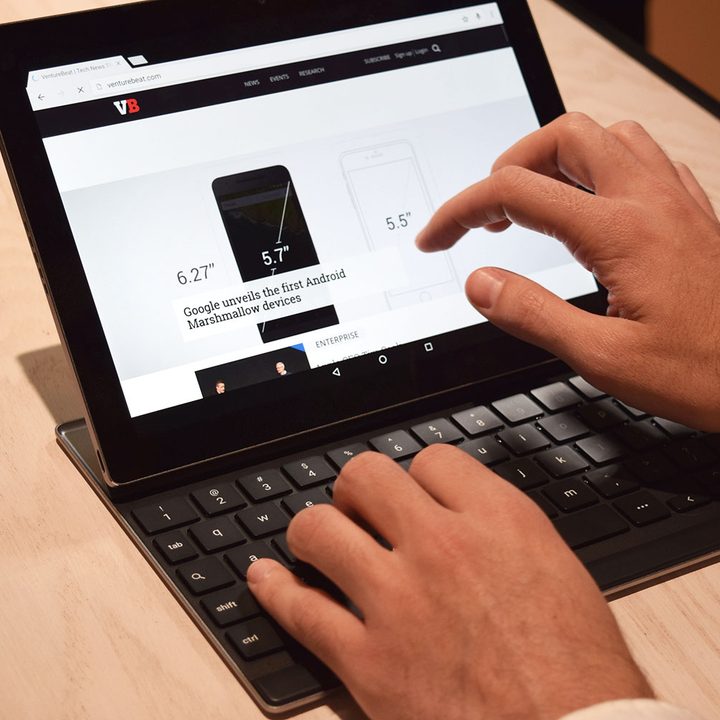
As we acknowledged in our review, the Pixel C works better as a companion device than an actual PC. If that sounds familiar, it’s because literally any other tablet on the market can serve the exact same purpose. What it can’t do is deliver an experience like what you would expect from a similarly priced Surface 3 or, to a degree, even a Chromebook.
Android exhibits a deluge of clearcut advantages over Chrome OS. Its Google Play Store, for instance, bears a voluminous catalog of essential apps and games. You could even say Android has a sort of Chrome OS built inside of it, considering the Chromebook’s operating system is, fundamentally, a re-skinned Web browser with a few necessary extras. Unfortunately, one of those extras is a big one. Multi-window support, which Chrome OS does manage to squeeze into its otherwise simplistic package, is notably absent on even the Pixel C’s rendition of Android.
The problem with bringing a mobile OS to the desktop is that it’s been refined by designers and engineers alike to ensure proper optimization on a tiny screen that fits in your pocket, or at least in the palms of your hands. Placing and resizing windows on a phone is a pain in the ass; on a desktop, it’s imperative.
Despite sharing a mutual abbreviation, Pixel C is not a PC
When the Journal revealed Google’s plans to decapitate Chrome OS a few months ago, it also became evident that Google was planning a revised version of Android for its future notebooks. Why the company decided to launch the Pixel C ahead of that revision is curious. Nonetheless, a different company, one called Jide, decidedly beat Google to the punch with its own “Android for desktop” early last month. Jide, the Chinese creatives behind the Ultra Remix tablet and the now-$70 Remix Mini PC, released Remix OS for free to anyone sporting an Intel or AMD-based computer.
Jide maintains a different approach from Google that I respectfully commend. In an email exchange with co-founder David Ko, it became clear that Jide is a lot more serious than Google about formulating a concrete definition for what it means to be a PC operating system, and in turn, what it means to be a PC. In fact, Ko asserted that “there can be no real discussion of what an ‘Android PC’ is without including keyboard and mouse support.”
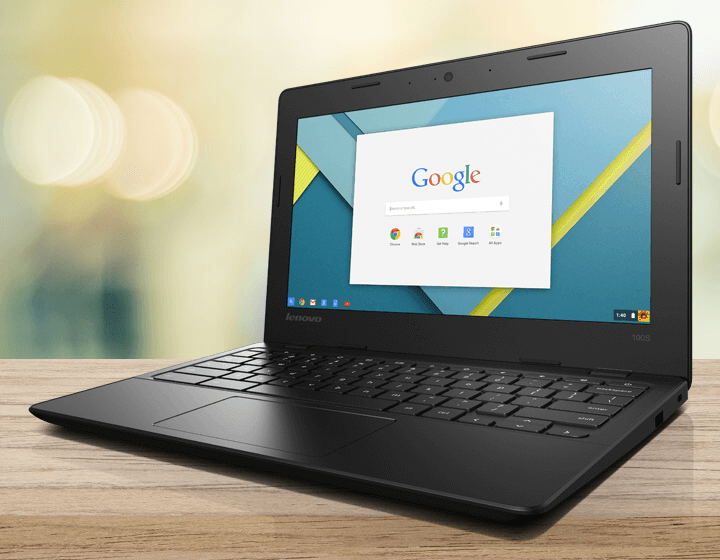
“Current mouse and keyboard support on vanilla Android is seriously lacking, and that’s largely down to the mobile interface that Android was built on,” Ko told Digital Trends. “Android was born for touchscreens, but adding keyboard and mouse support is absolutely vital for any version of the Android PC in [the] future.”
Intentionally, I neglected to bring up the Pixel C in our conversations. I wanted to learn about the company’s stance on desktop Android as a whole, rather than pigeonholing the discussion into a specific example. The executive’s responses were a fascinating, if sometimes vague, look into what constitutes as acceptable software on a PC. Unsurprisingly, what he described is a far cry from what Google has achieved thus far.
Drawing influence for the road ahead
In our interview, Ko explained to me that Jide puts a lot of effort into “perfecting the user experience” in its mobile/PC convergence. “What we hope for Google to draw influence from,” he said, “is how regularly you need to iterate and offer support with PC hardware.”
The Pixel C, which is basically a commercialized prototype for what lies ahead in the future of the Chromebook brand, is not technically a PC by Jide’s definition. Sure, it’s a sizable tablet with a detachable QWERTY keyboard and some mighty impressive hardware specs, but Google’s failure to include native trackpad support is a clumsy attempt at translating its OS to PC. And despite having been released over two months ago, a long overdue software overhaul is nowhere in sight.
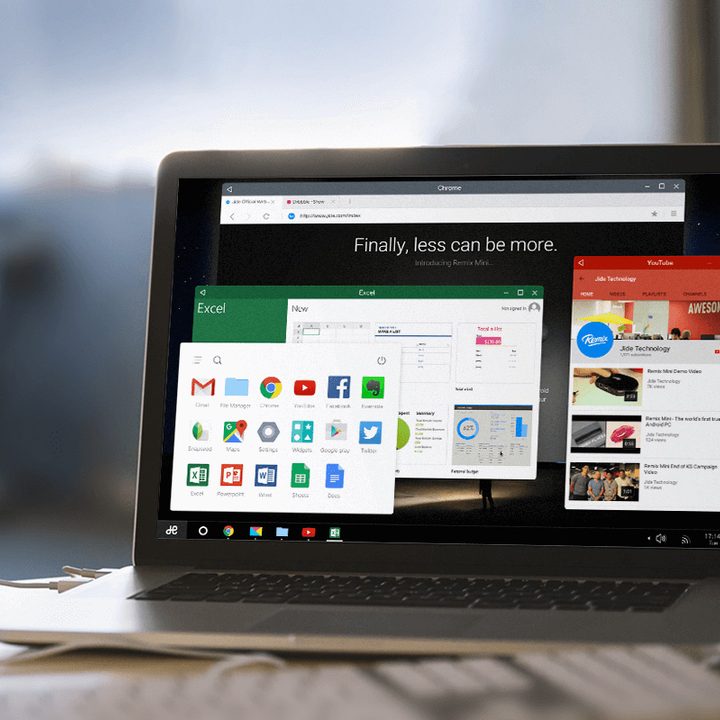
Approaching the conclusion of our conversation, Ko emphasized the difference in user environments on the PC and on mobile, arguing that on a laptop or desktop computer “you automatically want to have multiple windows and to resize them through a mouse click and drag.” With a phone in your hand, “you’re touching the screen and operating through different gestures.”
Up to this point, Google’s attempts at making this distinction have not cut it. A notebook that requires you to touch its screen to operate is less of an innovation and more of an inconvenience.
Next time Google decides to launch an Android PC, I hope it will run a version of Android that takes PC users seriously.