After a little more than two years since Google acquired the robotic design company Boston Dynamics, the tech giant announced Thursday it’s decided to put the group up for sale. Though shocking on its face, Google’s decision to sell the promising firm stems from internal strife regarding the absence of a marketable product. According to a report published by Bloomberg, potential buyers include a subsidiary of Toyota called the Toyota Research Institute, and Jeff Bezos’ Amazon.com Inc.
Google’s 2013 purchase of Boston Dynamics came in a long line of robotics acquisitions by the company, headed by former Android chief Andy Rubin. After Rubin left the company roughly a year later, Google’s robotic division (dubbed Replicant) had a difficult time finding a new director and suffered a severe lack of outside collaboration. It’s said that Boston Dynamics’ objections to working with other Google engineers are mainly responsible for the divide.
As stresses continued to mount, the conflict took a turn toward the public eye last November after a series of emails and meeting notes were accidentally published to a Google company forum. During the meeting, Jonathan Rosenberg — Alphabet CEO Larry Page’s assistant — said we as a startup of our size cannot spend 30-plus percent of our resources on things that take ten years.” Moreover, Rosenberg pointed out that Google wants an enterprise capable of generating revenue to cover its own costs.
Shortly after this meeting, Google began its complete restructuring of the company into Google Alphabet. Its new robotic division, called Google X, absorbed Replicant though Boston Dynamics was oddly absent from the move. Google X head Astro Teller reportedly told employees of Replicant that unless its robotic work provided practical solutions for Google, it would be reassigned. Shade thrown at Boston Dynamics? Likely.
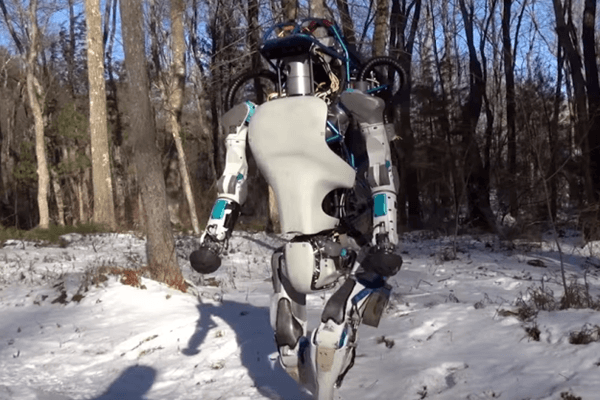
Despite what seemed like writing on the wall, Boston Dynamics trudged on with its own robotics research, posting a video of its latest accomplishment to YouTube last month. An update of its previous Atlas line of robots, the new video showed an extremely advanced AI humanoid standing on its own two feet, walking through a snowy forest, and attempting to pick up a box while an employee teased it. Once the “Humanoid Lives Matter” noise quieted down, many were left speechless at the company’s technological advancement.
Though the video amassed 14 million views and a number of ecstatic tech articles drooling over the possibilities, Google remained uncomfortable with the future of Boston Dynamics. According to more emails made public, Google had serious concerns about the company’s affiliation with Alphabet and instead desired to move away from the group.
“There’s excitement from the tech press, but we’re also starting to see some negative threads about it being terrifying, ready to take humans’ jobs,” wrote Courtney Hohne, Google’s director of communications. “We’re not going to comment on this video because there’s not a whole lot we can add, and we don’t want to answer most of the Qs it triggers.”
In the same note, Hohne advised those she was communicating with to “distance X from this video,” and cited an unwillingness to start a new “media cycle” on BD’s involvement with Google. So while people may have joked about how Boston Dynamics’ mistreatment of the robot could spark a robotic uprising, it seems Google took that response to heart and decided to take Google X in a different direction.