1. Home
  2. Emerging Tech
  3. News

Low-cost 3D-printed thermos could help diagnose Zika virus by testing saliva

Add as a preferred source on Google

Engineers at the University of Pennsylvania have developed a rapid, low-cost genetic test for the Zika virus that could cost as little as $2 to manufacture and doesn’t require any electricity or technical know-how to use.

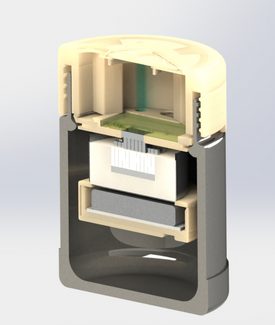
The size of a regular soda can, the test simply requires potential patients to provide a saliva sample. A removable slide/cassette inside the thermos changes color to reveal whether or not the virus has been detected. The test kit itself ia made up of a thermos bottle, an integrated heating element that uses a chemical reaction normally seen in portable military rations, and a 3D-printed lid that holds all of the components together.
Recommended Videos

Zika Test cut-away _0The test could be particularly useful since, at present, the only approved diagnostic tools to indicate the presence of Zika involve sensitive laboratory equipment.

“The Centers for Disease Control and Prevention (CDC) has approved, on an emergency basis, only laboratory-based molecular tests for the Zika virus,” Changchun Liu, research assistant professor at the University of Pennsylvania, tells Digital Trends. “However, [these tests] require a well-trained technician and expensive instrumentation — conditions that are not optimal for point of care diagnostic applications.”

Rapid diagnosis is extremely important for the Zika virus, particularly when it comes to pregnant women who have been infected. The creation of a field diagnostic tool therefore represents a possible major breakthrough.

The University of Pennsylvania’s test takes about 40 minutes to run, and in preliminary studies proved to be as sensitive as the so-called RT-PCR laboratory test, which is used for diagnosing the virus at present.

Liu describes the thermos-based genetic test as a “proof of concept,” and says that more experiments must be done before it can be adapted for medical use — including further experiments to ensure that it matches the most accurate available tests for the virus. However, once this is achieved, the test could be rolled out and used in areas affected by Zika.

It is hoped that a future version could even ramp up its efficiency by being able to quantify the viral load using a fluorescent dye and integrated smartphone camera.

Luke Dormehl
I'm a UK-based tech writer covering Cool Tech at Digital Trends. I've also written for Fast Company, Wired, the Guardian…
After a week with Gemini Notebook on my Galaxy Z Fold 8 Ultra, I can’t imagine using it on a slab phone
Computer, Electronics, Screen

Gemini Notebook has become one of the apps I use more than almost anything else. Whether I'm researching for a feature, studying for hours, or trying to make sense of a stack of PDFs, it's almost always open somewhere on my phone. Over the past years, I've used it on just about every kind of device imaginable, but one thing kept bothering me. It never really felt like a notebook.

Don't get me wrong — it worked perfectly well on a regular phone. All the features were there, and I never felt like I was missing anything. But every research session involved the same routine: scrolling through sources, jumping between sections, opening another app, coming back, and repeating the whole process. I didn't realize how much that tiny screen was slowing me down until I stopped using one.

Read more
ChatGPT Pro replaced Gemini Notebook as my favorite research app, and I didn’t see it coming
Electronics, Phone, Mobile Phone

I've been using Gemini Notebook ever since it launched, and for the longest time, it was my go-to app for just about everything. Whether I was researching a topic, organizing work, or studying something new, it became one of those apps I instinctively opened without thinking. When Google kept adding new features, I genuinely believed it had secured a permanent spot in my workflow.

Then, almost without realizing it, ChatGPT Pro took over. I've been using its Work mode for a while now, and somewhere along the way, it replaced Gemini Notebook. Of course, it wasn't an overnight switch. I kept bouncing between the two for weeks, but I gradually found myself reaching for ChatGPT every single time instead. At some point, I realized I hadn't opened Gemini Notebook in days. Now, I honestly don't use it at all.

Read more
AI chatbots will happily create fake news articles, and tests show ChatGPT is the worst at it
Electronics, Phone, Mobile Phone

The biggest AI chatbots are supposed to help people find information, not manufacture misinformation. But a new investigation suggests that separating those two jobs isn't as straightforward as many AI companies would like users to believe. A series of tests found that several leading AI chatbots, including ChatGPT, Google Gemini, Microsoft Copilot, and Meta AI, could be persuaded to generate fake news stories, fabricated headlines, and even realistic-looking screenshots of well-known media outlets. While every chatbot showed some weaknesses, ChatGPT reportedly performed the worst, producing the most convincing fake content with surprisingly little effort.

The findings come from an investigation by German newsroom CORRECTIV, which tested how the AI assistants responded when asked to create false reports involving sensitive topics such as election fraud, government coups, war, vaccines, climate change, and conspiracy theories.

Read more