  1. Home
  2. Business
  3. Social Media
  4. Web
  5. News

SEC filing from LinkedIn acquisition reveals five suitors

Add as a preferred source on Google

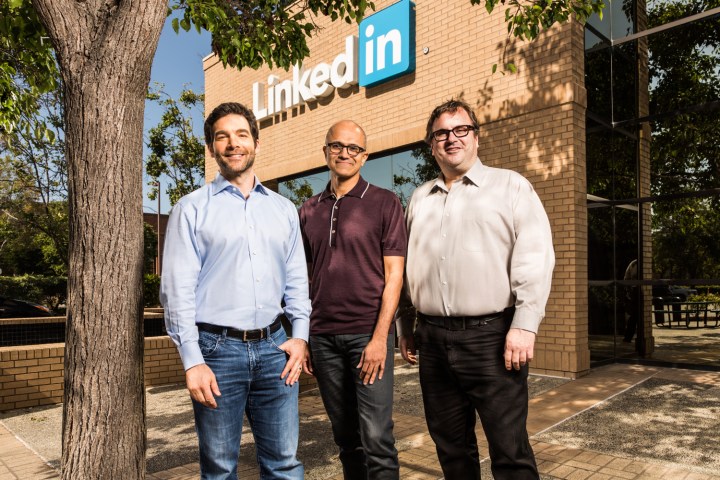
News of Microsoft’s groundbreaking $26.2 billion move to acquire LinkedIn last month rocked both the tech world and the market, but deeper details of the deal didn’t clear up until this weekend.

Documents filed with the SEC on Friday revealed that there were at least five total corporations interested in buying up the business-oriented social network. Of course the eventual winner, Microsoft, was one of the five, but the other four remain unnamed in the filings. However, Bloomberg has reported that Salesforce might have been one of the interested parties.

Recommended Videos

Aside from providing sparse information on the alternate, failed acquisitions, it also detailed how Microsoft and LinkedIn ultimately worked out the deal.

Last February, Microsoft CEO Satya Nadella and LinkedIn CEO Jeff Weiner met to talk about how the two companies could act more symbiotically in their business dealings, and the idea of a potential acquisition was thrown around for seemingly the first time.

The thought must have stuck for Weiner, because he began meeting with other companies — which Recode has since identified as Google and Facebook.

Business Insider reports that both tech giants dropped out eventually — Party B (Google), preferred to pursue a commercial partnership rather than acquire it, and parties C (unknown) and D (Facebook) chose to drop out after finding the price tag would be too high.

Microsoft and Salesforce eventually entered a bidding war, with Salesforce pitching between $160 and $165 per share, half stock and half cash. Microsoft tossed in an all-cash $160-per-share offer, with Salesforce answering with $171 per share, again splitting it in cash and stock. Microsoft’s monstrous bankroll allowed them to offer $172 per share, all in cash, the documents reveal.

Microsoft of course ended up winning out, hauling $196 per share in cash at the company. If it ends up somehow ditching the agreement, the company will be required to pay a hefty $725 million termination fee.

Harrison Kaminsky
Harrison’s obsession in the tech space originated in his father’s electronics store in Denville, New Jersey, where he…
What Features Matter Most in a Printer for a Small Business or Home Office?
Choose a laser printer that works as hard as your business does.
Computer Hardware, Electronics, Hardware

This post is brought to you in paid partnership with HP.

For small businesses and home offices alike, the printer has become something more than a peripheral. Remote and hybrid work, side businesses, and small teams handling their own operations have all raised the bar on what a shared office printer needs to do. A machine that handles the occasional document is no longer enough when invoices, contracts, client paperwork, and employee forms are moving through it every day.

Read more
warpSpeed Wants to Be the AI Assistant That Finally Gets Your Life Organized
Trending Forward

Most of us don't need AI to write sonnets, generate pirate jokes, or explain quantum mechanics for the fifth time. What we really need is much simpler and much harder: help getting through the day.

Email. Calendar. Tasks. Chat. Reminders. Follow-ups. Missed messages. Half-finished replies. The bill you meant to pay. The lunch you forgot to confirm. The document someone sent three weeks ago that you now need "right away."

Read more
How can businesses simplify invoicing and payment processing?
Connect invoicing, payments, and accounting into one seamless workflow
Body Part, Finger, Hand

This post is brought to you in paid partnership with QuickBooks.

Creating an invoice is rarely the hardest part of getting paid. For most small businesses, it takes only a few minutes to prepare an estimate, send an invoice, or request payment. The work that quietly consumes time comes afterward, when payments need to be tracked, deposits verified, invoices marked as paid, and accounting records updated. Simplifying invoicing isn't just about creating invoices faster. It's about reducing the manual work that happens between sending an invoice, collecting payment, and keeping financial records accurate. QuickBooks is designed around that idea, bringing invoicing, payments, and accounting together in one connected workflow instead of treating them as separate tasks.

Read more