Yet that is exactly what McLaren will do. It will unveil a second-generation Super Series on March 7 at the 2017 Geneva Motor Show. This marks the first time McLaren has ever replaced an existing model, something that is routine for most automakers. So what does McLaren have in store for the second act of its Super Series?
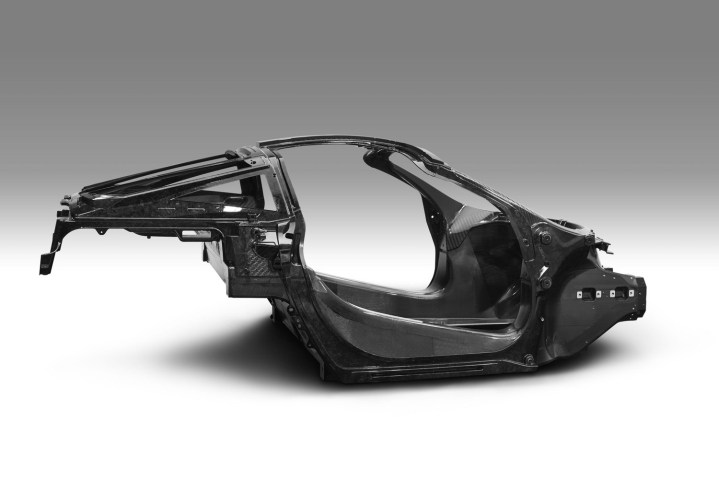
The next-generation model will be based around a new body structure called Monocage II that makes extensive use of carbon fiber, with some metal construction as well. McLaren claims it will contribute to a dry weight of just 1,283 kilograms (2,828 pounds) for the entire car, which is 18 kg (39.6 lbs) lighter than the current 650S. The new chassis also has a lower center of gravity, McLaren says, which should improve handling.
It’s not unusual to hear a manufacturer talk about making its new supercar lighter and more agile, but it is unusual for ergonomics to be a priority. McLaren claims the Monocage II body structure was designed to allow better all-around visibility, and that it has wider door openings and a lower sill, making ingress and egress easier. McLaren is so enamored with its new chassis design that will even offer a “Visible Monocage” option that allows bits of it to peek through the bodywork.
Like the current Super Series, expect the new model to spawn multiple variants. The current generation started out with the MP4-12C in 2011, which was given a restyling and a number of tweaks to create the 650S, introduced in 2014. In 2015, McLaren launched a limited-edition, high-performance version called the 675LT, with the “LT” referencing the “long-tail” racing versions of the legendary McLaren F1. All Super Series models so far have been offered as both coupes and convertibles.
McLaren adopted the Super Series name to distinguish the 650S-based models from the lower-level Sports Series, which includes the 570S and 570GT, and the Ultimate Series P1 hybrid hypercar. The company may need to come up with more names, as it plans to launch 15 new models as part of its Track22 business plan.
Editors' Recommendations
- Bowers & Wilkins and McLaren launch special-edition Px8 headphones
- McLaren applies F1 tech to health care, air-traffic control, Wi-Fi, and athletics
- OnePlus champions power and speed with new OnePlus 7T Pro and McLaren Edition
- The recently revealed McLaren GT is a road trip-ready supercar
- McLaren’s next supercar will focus on comfort as well as performance