  1. Home
  2. Computing
  3. News

What does a thousand bucks worth of RAM look like? G.Skill has the answer

Add as a preferred source on Google

A thousand bucks can buy a lot when it comes to computer hardware. It’s enough for an entire gaming system, a huge curved 34-inch monitor, a single Nvidia Titan X — or even G.Skill’s new RAM kit.

Wait, what?

Recommended Videos

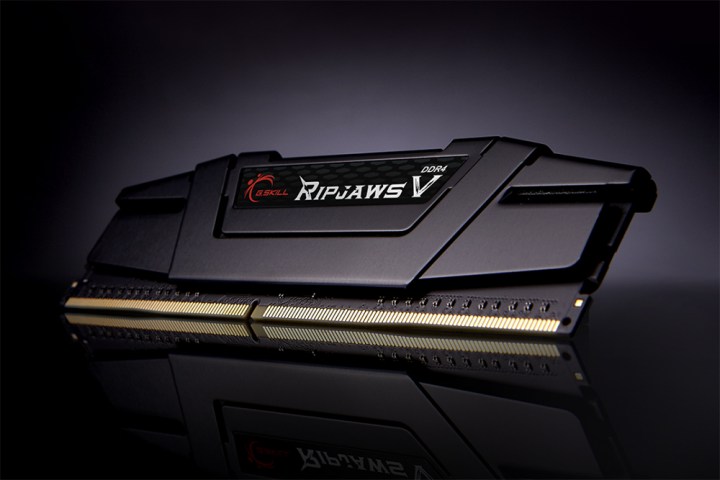
That’s right, memory manufacturer G.Skills is ready to show off a new RAM kit that boasts 128GB of DDR4 memory across a set of eight 16GB DIMMs. That’s the absolute maximum capacity supported by the X99 platform, and that’s not the only reason to be impressed by the new memory kit.

The setup is clocked at 3,200MHz, which is approaching the fastest currently available memory. That jump in speed provides a modest boost, but it’s the low latency that’s really impressive. The memory is rated for CL14-14-14-34 under 1.35V, the lower the better, so it beats out the old DDR3-2133MHz standard of CL15-15-15-35 by a hair.

But all that power and speed doesn’t come cheap. Far from it in fact. The whole kit will cost you $1,070, although you’ll want to make sure your motherboard has the X99 chipset with eight slots before pulling the trigger.

It might seem like a steep price, because it is, but that’s because it’s not intended for gamers or even media editing purposes. RAM like this typically ends up in home or entry-level enterprise server applications, or purpose-built machines running ultra-specific tasks, memory-heavy tasks. Still, its fun to dream about a rig with 128GB of RAM, a total unnecessary amount for everyday use, even for high-end 4K gaming. If you had that much RAM, a ridiculous storage solution like a RAM drive could be feasible.

If you’re the kind of person who always loves to go above and beyond with your rig, or an overclocking fanatic looking to beat a previous record, the G.Skills Ripjaws V 128GB kit will hit shelves in late February. Thankfully, that means you still have some time to brace your wallet for impact.

Brad Bourque
Brad Bourque is a native Portlander, devout nerd, and craft beer enthusiast. He studied creative writing at Willamette…
MIT researchers found a new Spectre attack that can slip past Intel and AMD defenses
AMD Ryzen CPU inside a socket installed on a motherboard

Spectre has been haunting CPU security since 2018, and MIT researchers have now found another way to make it misbehave. The new TONTOU attack can bypass some of the defenses Intel and AMD have added over the years by exploiting a tiny gap in how those protections work. The research comes from Daniël Trujillo and Mengjia Yan at MIT's Computer Science and Artificial Intelligence Laboratory (CSAIL). Their findings show that even after a processor wipes or isolates information used by its branch predictor, there can be a brief window before that information is actually used. TONTOU, short for Time-of-Neutralization to Time-of-Use, attacks precisely that gap.

The tiny gap that TONTOU exploits

Read more
Microsoft accidentally gave Windows 11 users another OneDrive app, and you can’t easily remove it
Microsoft says the wider-than-intended rollout was an accident, but removing the app currently means removing OneDrive too.
Microsoft OneDrive Featured Graphic

Windows 11 users have been getting a new OneDrive app whether they asked for it or not. The problem? Microsoft says it wasn't supposed to happen. Microsoft has confirmed that its OneDrive Photos app was rolled out to Windows 11 PCs more broadly than intended, including enterprise machines where the app isn't even designed to work. The company says it is now working on a fix, but there's an awkward catch: users currently can't uninstall OneDrive Photos without removing the main OneDrive app too.

So, what exactly got installed?

Read more
Apple Reminders sucked for project management until I learned this feature
Your checklist deserves better. Here's how to turn Reminders into a proper Kanban board.
Apple reminders on Mac

For the longest time, I used Apple Reminders only for capturing quick tasks. Thanks to its Siri integration, Reminders let me add tasks quickly so nothing would fall through the cracks. However, when it came to managing big projects, I always moved to a more powerful task manager like OmniFocus or Things 3. 

That changed the day I stumbled onto the Column view. Apple added this feature with the iOS 17 and macOS Sonoma updates, and somehow I completely missed it. But once I discovered and got the hang of it, Reminders finally started to feel like a real project management tool instead of a glorified sticky note.

Read more