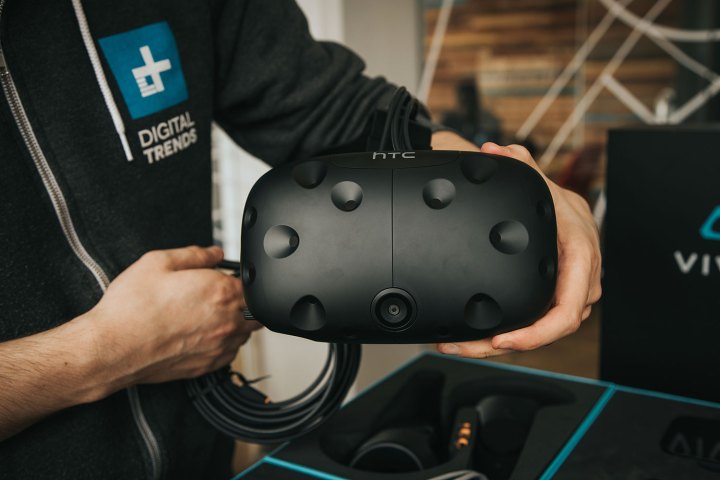
If you’re not sure where the HTC Vive is sold in your neighborhood, the company provides an online “locator” tool right here. The headset should also be available in Microsoft’s brick-and-mortar stores, GameStop stores, and at 34 Fry’s locations across the nation. They can even be ordered from Fry’s online storefront too as well as Amazon, Newegg, and Microcenter.
But wait, there’s more! HTC Vive owners will be able to load up the Viveport app and get huge discounts on software too throughout the weekend. The sale will kick off at 11:59 p.m. (PT) on Thursday and will shut down at 11:59 p.m. on November 28.
For starters, the Vive-based Viveport store only serves up non-gaming apps. However, during the sale, it will give back the equivalent of $10 when customers spend $30 inside the app. Customers will also be able to grab a $5 bundle containing SoundStage, Arcade Artist, and Lumen. If that’s not enough to fire up your wallet this weekend, HTC will even knock 50 percent off the current price of 18 apps.
That said, here is the list:
- A Chair in a Room: Greenwater
- Adventurous Life VR
- C O S M Worlds Within Worlds
- Cineveo
- Cloudlands: VR Minigolf
- Cmoar VR Cinema
- Daylight’s End (U.S. only)
- Emily Wants to Play
- Grand Canyon
- Heaven Island Life
- Konrad the Kitten
- La Peri
- Oneiric Sculptures – Rodin
- Potioneer: The VR Gardening Simulator
- Ricerca
- Star Chart
- Stars
- The Night the Carsons Disappeared
- Think Space
- Toon Ocean
- VV player
- World of Diving
If you’re on the hunt for a VR headset during the Black Friday/Cyber Monday marathon, the HTC Vive is originally a whopping $800 whereas the Oculus Rift is $600. However, HTC’s headset is backed by Valve Software’s SteamVR, the same company that runs the Steam digital distribution platform and previously developed popular PC games like Half-Life, the Counter-Strike, Left 4 Dead, Team Fortress, and Portal. Valve even has its own game controller.
HTC’s headset, launched earlier in 2016, features a 110-degree field of view, 32 headset sensors for tracking 360 degrees of head motion, a combined resolution of 2,160 x 1,200, and a barf-free 90Hz refresh rate to keep motion sickness at bay. Thrown into the box are two motion-tracked controllers with 24 sensors each, and two base stations that track 360-degrees of movement. These two tracking stations are wireless, requiring only a single power cord connection.
While the HTC Vive is rather expensive to begin with, HTC’s Black Friday and Cyber Monday sale will help make it more affordable. By comparison, the Oculus Rift plus the upcoming Touch controllers will cost $800 combined, so one is not exactly cheaper than the other outside the turkey-eating holidays. So far there is no sign that Oculus VR will provide a similar discount for Rift, but that could change in the next day or two.
Editors' Recommendations
- HTC just fixed a major shortcoming of standalone VR headsets
- Which Chromebook should you buy on Cyber Monday 2021?
- Which laptop should you buy on Cyber Monday 2021?
- Which prebuilt gaming PC should you buy on Cyber Monday 2021?
- Why I passed on $500 off the MacBook Pro for a MacBook Air on Black Friday