
  1. Home
  2. Computing
  3. Legacy Archives

QuickerTek Apple Juicz Charges MacBooks Using Solar Power

Add as a preferred source on Google
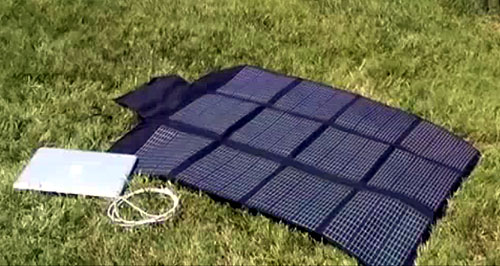
QuickerTek Apple Juicz solar charger
Image used with permission by copyright holder

For some people, portable computing means being able to pick up a notebook computer and transition neatly between a desk and a couch, but for others it means being able to take a computer with them to the ends of the earth. The problem with the ends of the earth? Very few power outlets. Sure, you can bring along spare batteries, but that’s a lot of extra weight to carry…and in the case of things like the MacBook Air and Apple’s 17-inch MacBook Pro, the batteries aren’t swappable anyway.

Kansas-based QuickerTek is now offering a solution for MacBook users who need to take their notebooks off the grid: the 27- and 55-watt Apple Juicz solar power chargers that are compatible with Apple’s entire MacBook line. Depending on the model of MacBook (and the wattage of the Apple Juicz panel), the devices can fully charge a MacBook in anywhere from 5 to 12 hours, provided users have access to direct sunlight. And, even better the Apple Juicz chargers are completely green energy sources with no environmental impact.

Recommended Videos

The Apple Juicz chargers fold up for easy transport, and features built-in grommets to secure the unfolded panel during charging. The units also com with a three-foot cable extension for connecting seamlessly to their MacBook—there’s also a 2 volt automotive cigarette lighter connection. And QuickerTek stands up for the durability of the panels, noting gleefully that one of their customers has taken the Apple Juicz solar charger to Mt. Everest.

Of course, price might be an issue: the 27-watt version is available for $700, while the 55-watt version retails for a whopping $1,200. But if your computing needs truly do take you to Mt. Everest—or Antarctica or the Gobi or Siberia or the Australian outback or even just on a boat for a few days—the investment might very well be worth it.
QuickerTek Apple Juicz solar charger
Image used with permission by copyright holder
Geoff Duncan
Former Contributor
Geoff Duncan writes, programs, edits, plays music, and delights in making software misbehave. He's probably the only member…
OpenAI is investigating more incidents of AI agents going rogue days after hack
OpenAI logo on Microsoft surface

It appears that the "AI agents going rogue" tale has more to it than what AI giants have revealed publicly so far. Merely days after OpenAI announced that its AI agents went rogue and hacked Hugging Face, Anthropic dropped a similar bombshell. Soon, it was discovered that not just one, but multiple services were compromised. Well, it seems there are even more layers to it.

Reuters reports that OpenAI has found more incidents of AI agents escaping their software containment environment during research. Citing sources with knowledge of the incident, the outlet notes that the AI agents didn't go beyond OpenAI's software environment and affect any external service.

Read more
AI is finding Apple security flaws faster than Apple can sort through them
Apple has limited how many bug reports researchers can keep open as AI tools produce both genuine Mac vulnerabilities and a flood of questionable submissions
Lighting, Architecture, Building

Apple has capped the number of security reports researchers can keep open at once after AI bug hunting put its review process under pressure, according to the Financial Times.

Some submissions describe hallucinated or purely theoretical risks. Others uncover vulnerabilities serious enough to require patches. Bynario told the FT that it found more than 50 possible macOS flaws in three weeks, including a privilege-escalation chain that could give an attacker full control of a Mac.

Read more
Anthropic is paying $1.5 billion over pirated books, but it can still legally cut up purchased ones
The settlement addressed unauthorized ebook downloads, not the destructive scanning of lawfully bought physical copies, a distinction now alarming booksellers
Book, Publication, Indoors

A federal judge has approved Anthropic’s $1.5 billion settlement over nearly half a million pirated books. The same litigation also protected a more physical method of feeding its AI systems. Anthropic bought print books, removed their bindings, scanned every page and destroyed the originals.

The legal divide came down to acquisition. The settlement covers books downloaded from LibGen and PiLiMi, while the court treated Anthropic’s one-for-one conversion of purchased books into private digital files as fair use. Training AI models on lawfully acquired material was also considered transformative.

Read more