

Inspired by Star Trek’s “replicator,” a machine capable of synthesizing objects on demand, researchers from Lawrence Livermore National Laboratory (LLNL) and the University of California, Berkeley, have developed a new, potentially game-changing type of 3D printer. Instead of building objects layer by layer, as conventional 3D printing methods do, this new printer is able to print entire objects at once — using projected light to transform gooey resin into solid finished pieces.
“We’ve invented a new category of 3D printing process inspired by the principles of computed tomography (CT),” Hayden Taylor, an electrical engineer at UC Berkeley, told Digital Trends. “CT is widely used in 3D medical and industrial imaging, but hasn’t previously been applied to fabrication. Our new process is called Computed Axial Lithography (CAL), and prints entire 3D objects into light-sensitive materials all at once. The process involves rotating a container of light-sensitive material, while projecting into it a sequence of computed light intensity patterns that are synchronized with the rotation. Over time, a 3D pattern of light energy is delivered to the material by more than a thousand different projections. Where the energy delivered exceeds a critical threshold, the material undergoes a chemical reaction and the part is formed.”
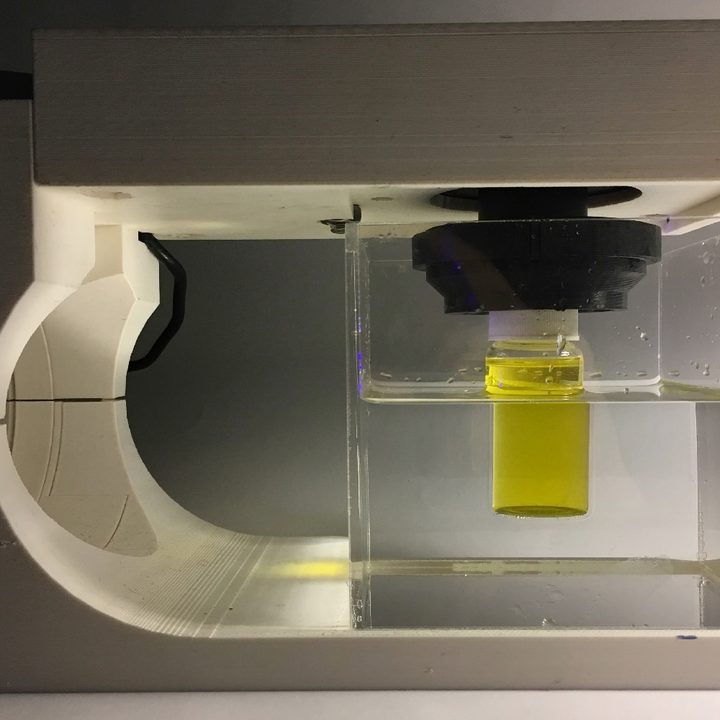
The CT machines regularly used in hospitals involve rotating an X-ray tube around patients, taking multiple images of their insides in the process, from which a computer can then reconstruct a 3D model. As Taylor described, in this new printing method that idea is reversed: meaning that it starts with a 3D object and then works out what it would look like from each angle to create such a finished shape. This data, comprised of 2D images, is then fed into a slide projector, which projects the images into a container filled with the synthetic resin. During the projection process, the container is rotated, resulting in a solid printed model.
To print an object several centimeters across takes just a couple of minutes. As a proof of concept, the team re-created a version of Auguste Rodin’s famous sculpture “The Thinker.”
“Almost all existing 3D printing processes build up components layer by layer, which limits printing speed and can introduce mechanical defects that may limit strength or make strength strongly directional,” Taylor continued. “CAL does away with the use of layers, and patterns all points of a polymeric 3D object simultaneously. This different approach opens up a range of new process capabilities.”


