  1. Home
  2. Emerging Tech
  3. Health & Fitness
  4. News

A battery-free pacemaker harvests and stores energy from heartbeats

Add as a preferred source on Google
Image used with permission by copyright holder
Promotional image for Tech For Change. Person standing on solar panel looking at sunset.
This story is part of Tech for Change: an ongoing series in which we shine a spotlight on positive uses of technology, and showcase how they're helping to make the world a better place.

Pacemakers have a problem — and that’s not something you want to hear about a medical device which literally helps a person’s heart to continue to beat normally. The problem, simply, is that they rely on bulky batteries, which have to be swapped out at regular intervals due to their short lifespans.

Fortunately, researchers from China and the U.S. may have come up with a solution. They have developed an alternative battery-free pacemaker which gathers its required electricity from the energy of heartbeats. While not yet ready to be implanted into humans, it was recently tested successfully in pigs. This is significant because the pig hearts used in the study are approximately the same size as human hearts.

Recommended Videos

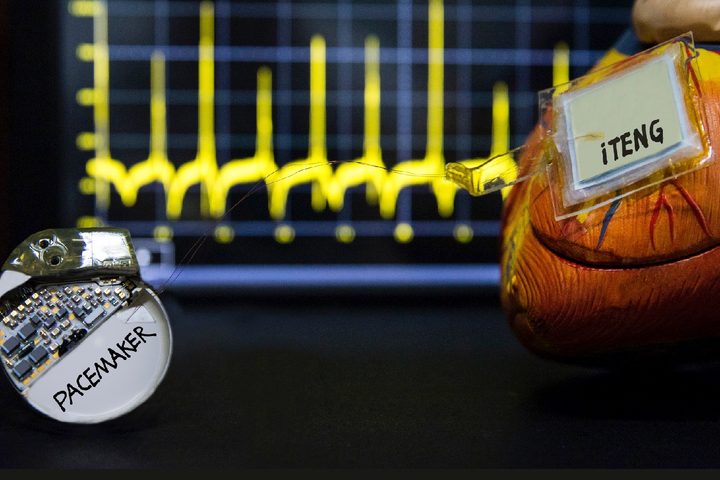
“Our symbiotic cardiac pacemaker (SPM), powered by an iTENG (implantable triboelectric nanogenerator), is the first self-powered battery-free pacemaker [to be] fully implanted in adult pigs,” Zhou Li, a professor in the School of Nanoscience and Technology at the University of Chinese Academy of Sciences, told Digital Trends. “SPM is inspired by the biological symbiosis phenomenon involving interaction between different organisms living in close physical association — such as nitrogen-fixing bacteria with leguminous plants — which is a fancy and interesting idea. The SPM converts biomechanical energy from the heart beating to electricity for powering the pacing module [as it sends] pulses. The abnormal heart can be corrected by these pulses, and the recovered heart will provide more energy for SPM.”

The recent demonstration was significant because it showed that the energy output from the iTENG is enough to reach (and exceed) the threshold needed for a commercial medical human pacemaker. This makes the idea of a self-powering “implant for life” not only exciting but also feasible.

“There is still a long way to go [before this can be] used in humans,” Li said. “Some technical challenges are needed to be solved. To meet the minimally invasive implantation process and better comfort long-term operation in vivo, it is necessary to develop an iTENG [that is] small in size, high energy density, [has] efficient fixation with bio-tissue, and long-term biosafety. It depends on developments of material science, micro and nano-fabrication technologies, and electronic techniques.”

The work isn’t just promising for cardiac pacemakers, however. Li suggested that similar self-powering tech could also be used for alternatives to other battery-powered implant medical devices. These could include neural stimulators, muscle stimulators, devices for tissue repair and engineering, drug delivery systems, and more.

It could additionally be used for consumer devices such as wearables, which currently require charging. “I think that electronic equipment is entering a self-powered era,” he said.

A paper describing the work was recently published in the journal Nature Communications.

Luke Dormehl
I'm a UK-based tech writer covering Cool Tech at Digital Trends. I've also written for Fast Company, Wired, the Guardian…
A new AI model wants self-driving cars to think before they swerve
Forget guessing games, this self-driving AI actually shows its work.
Self driving car

Self-driving cars have gotten pretty good at driving. The harder problem is teaching them to drive safely in situations nobody planned for. We have heard horror stories of self-driving cars, behaving erratically in emergency situations, often times delaying first responders from reaching the scene.

A team at Seoul National University, led by professor Jun Won Choi from the Department of Electrical and Computer Engineering, thinks they have cracked part of that puzzle with a new AI model called SafeDrive. The research was recently selected as a highlight paper at CVPR 2026, a distinction that goes only to roughly 3% of all submissions.

Read more
An AirPods-sized mini lab could help catch disease markers in minutes
Meet VPodDuo, an AirPods-sized molecular testing gadget
VPodDuo Mini Medical Device

Home testing could eventually become a lot more convenient. Researchs at the at the University of Illinois Urbana-Champaign has developed the VPodDuo, a pocket-sized fluorescence reader designed to measure sensitive molecular tests outside a conventional laboratory.

Its housing is roughly comparable in size and shape to an AirPods charging case, while Bluetooth connectivity sends results directly to a smartphone. Meaning, you might not have to wait in line anymore.

Read more
Your future AR glasses might finally stop making the real world look weird
Researchers have developed a new display technique that keeps virtual objects realistic without dimming the real world.
Samsung AR Glasses

One of the biggest promises of augmented reality is blending digital objects seamlessly into the real world. Ironically, today's AR glasses often make the real world harder to see. Researchers at the Shibaura Institute of Technology (SIT) in Japan, led by Assistant Professor Xiaodan Hu in collaboration with Dr. Yan Zhang and Professor Xubo Yang from Shanghai Jiao Tong University in China, and Professor Kiyoshi Kiyokawa from Japan's Nara Institute of Science and Technology, have developed a new AR display technique that aims to make virtual objects look realistic without reducing visibility of the real world. The study was published in IEEE Transactions on Visualization and Computer Graphics.

The biggest AR problem isn't virtual objects; it's everything around them

Read more