1. Home
  2. Emerging Tech
  3. News

DARPA tests drones that can be dropped from planes and collected in midair

Add as a preferred source on Google
Gremlins X-61A Maiden Test Flight

Whether it’s drones that can be “grown” using chemistry in large-scale labs or dissolving drones designed to fly over enemy lines, there’s no shortage of unmanned aerial vehicle (UAV) innovation in military research. An ongoing project involving the U.S. Defense Advanced Research Projects Agency (DARPA) adds one more item to the list. DARPA has been testing a new drone that can be launched from a plane, then later recovered in midair once it’s completed a mission. This is done by having the drone return to the plane and winched back on board via a special line, similar to a midair refueling.

Recommended Videos

The X-61A Gremlins Air Vehicle (GAV) drone, developed by U.S.-based company Dynetics, looks more like a winged missile than the kind of quadcopter most of us picture when we think of a drone. However, one of the abilities this gives it is an impressive flight time. In a test carried out in Utah in November 2019 (although only announced recently), the drone was deployed from a military transport in midair, and flew for 1 hour, 41 minutes. The dry run showed off the drone’s impressive capabilities, including its cold engine start and rapid wing deployment, alongside data link performance and the deployment of a special docking arm.
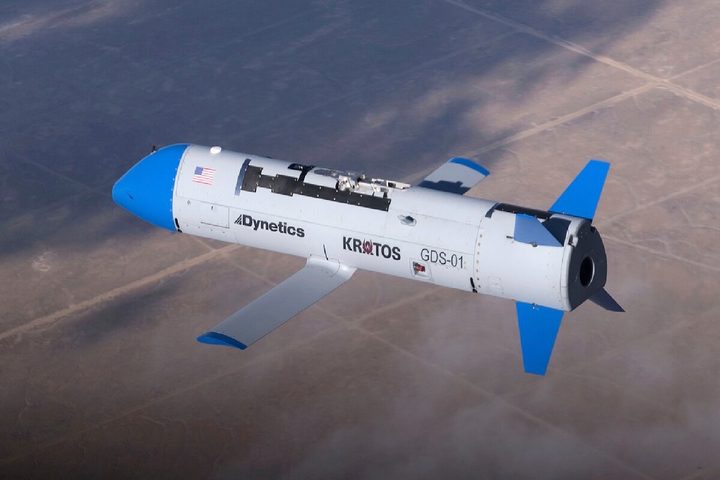
DARPA Gremlin drone 1
DARPA

Not everything went according to plan, however. “Mechanical issues” at the end of the test stopped its parachute from deploying correctly, causing it to crash-land.

Nonetheless, DARPA’s enthusiasm seems to be far from dimmed. It will test out a deployment of four drones sometime this spring. If that goes according to plan, it could suggest how these drones might be used. They may be deployed in a group from a bomber, then sent into action — either working together to pursue one mission or pursuing separate targets. Because they are dropped from a plane, it gives them a wider range than they would ordinarily have if they had to be launched from an air base. The fact that they are reusable would also reduces the cost of deployment.

“This flight marks a historic milestone for Dynetics and the Gremlins program,” Tim Keeter, Gremlins program manager for Dynetics, said in a statement. “The GAV flew beautifully, and our command and control system kept us in total control of the GAV for the entire flight. The loss of our vehicle validates our decision to build five GAVs [for testing]; we still have four remaining.”

Luke Dormehl
I'm a UK-based tech writer covering Cool Tech at Digital Trends. I've also written for Fast Company, Wired, the Guardian…
Samsung’s humanoid robot ambitions are real, but factories come first
Samsung’s new robotics division has humanoids in its sights, although its immediate business is far more practical factory automation
Robot Touch Human Finger

Samsung wants a place in the humanoid race, but its new robotics push begins with machines built for factories rather than homes.

The CEO-led RX robotics division will initially focus on manufacturing robots. Samsung has separately identified humanoids as a priority, although it hasn’t announced a commercial model or explained where one fits into the division’s immediate plans.

Read more
The future of AI may depend on this one behind-the-scenes change
Running Claude on Android.

Whenever a new AI model arrives, it's easy to get caught up in the bells and whistles. We talk about how much smarter it is, how quickly it answers questions, or how realistic its images have become. But here's the thing: none of that matters much if the AI can't reliably work with the apps and services people use every day.

That's why an upcoming update to the Model Context Protocol (MCP) caught my attention. It isn't a new chatbot or a fancy AI model. In fact, most people will never even know it's happening. But it could quietly make the AI ecosystem a lot healthier. If you've never heard of MCP before, don't worry. Think of it as a shared language that lets AI assistants safely talk to apps like Gmail, Slack, calendars, databases, and countless other services. Instead of every company inventing its own way to make those connections, MCP gives everyone a common rulebook.

Read more
The AI game-dev boom has a dark side: fewer jobs for the people starting out
Solo creators are thriving with tools like Claude Code and Copilot, but entry-level game roles are disappearing.
Man playing a video game on a desktop with glowing red and blue lights

AI is making it easier than ever for a single person to build a game. That sounds like a win for creativity, and in many ways, it absolutely is. But there is a catch. As generative AI tools help solo developers and small studios do more with fewer people, the same shift is making life tougher for writers, artists, concept creators, and junior programmers trying to break into the gaming industry.

AI is giving solo developers superpowers

Read more