
  1. Home
  2. Emerging Tech
  3. Web
  4. Legacy Archives

Only the Flashed Face Distortion illusion can make celebrities look hideous

Add as a preferred source on Google
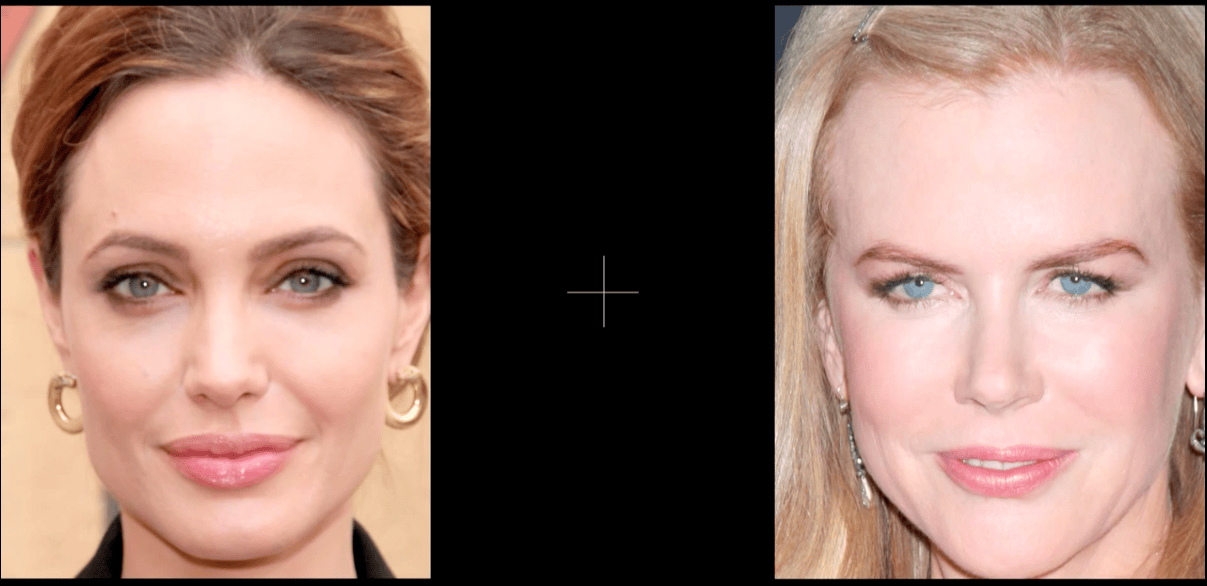
Flashed Face Distortion Effect illusion
Image used with permission by copyright holder

Celebrities are supposed to be those glorified beauties that seem hardly attainable for everyday humans like you and me. Just accept it. Now that you have, perhaps you can have a little fun with this optical illusion that can give ordinary photos (celebrity pictures included!) a wild facial distortion. Take that, Mila Kunis.

The Flashed Face Distortion Effect works by aligning two front-facing photos at the eyes and forcing viewers to focus at a middle point between the two photos. As the portraits flash through, the eyes begin to compare the features, making them look distorted and out of place. Reverting the eyes back to the photos on either side turns the pictures back to normal, but focusing at the plus sign in the middle continues to destroy any evidence of beauty (or even normality).

Recommended Videos

The phenomenon was accidentally discovered by a researcher at the University of Queensland when he was browsing through a series of images.

“After a few seconds, he noticed that some of the faces began to appear highly deformed and grotesque,” Matthew Thompson writes of Sean Murphy, the student who discovered the illusion. “He looked at the especially ugly faces individually, but each of them appeared normal or even attractive.”

In the video flashing through celebrities, after a few rounds of photos, Halle Berry’s face seems to stretch at the middle while Jim Carrey doesn’t even look human anymore. “If someone has a large jaw, it looks almost ogre-like. If they have an especially large forehead, then it looks particularly bulbous,” Thompson explains on his website.

The Flashed Face Distortion Effect recently won an award for Best Illusion of the Year Contest 2012 and cites the illusion as a “useful tool for investigating contrastive distortion effects and face adaption.”

While it doesn’t change that some celebrities are naturally pretty gorgeous and photogenic (at least with the help of professional hair and makeup), the video does add a little humor and validation that celebrities are just like us: No technological illusion can save them either! Of course, if you prefer to think of Ms. Kunis or Angelina Jolie as beauty goddesses who can do no wrong, stop now before the video gives you nightmares for days.

Meanwhile, here’s the first version of the Flashed Face Distortion Effect illusion using photos of the everyday woman.

Natt Garun
An avid gadgets and Internet culture enthusiast, Natt Garun spends her days bringing you the funniest, coolest, and strangest…
Google is making Gemini and Search work better with the apps you love
Gemini's guest list is growing, and your favorite apps are invited.
Gemini AI on a phone.

Google has been finding more ways to make Gemini a part of your daily routine, from putting together playlists to ordering groceries through your favorite apps. Now it's expanding those capabilities to more services, with Google Search joining in, too.

The company has announced a new Connected Apps Platform that makes it easier for developers to bring their services to both Gemini and Search. Alongside this, Google is adding new partners to its growing lineup, bringing more of the apps people already use into its AI ecosystem.

Read more
AI bots are now trying to sabotage public health policies, like banning disposable vapes
Thousands of AI bots voted in a public health poll to block sales restriction on disposable vapes. It's like Big Tobacco is back from the dead.
Woman smoking a vape.

In the broad context of AI and its perceived harms, health and medical risks often pop up in the conversation. The warnings even come from frontier AI labs, such as ChatGPT-maker OpenAI and Anthropic, both of which have warned about misusing AI to cook up bioweapons. Security experts have already spotted a few such incidents in the wild, especially with the usage of AI models without any solid guardrails. 

Well, it appears that the risks run deeper. As per an analysis appearing in the British Medical Journal (BMJ), AI bots are now being deployed to influence public policies governing health risks to citizens. In this instance, an attempt was made using AI bots to thwart regulations that aim to restrict the sale of disposable vapes, all while disguising the manipulation efforts as a response from real humans. 

Read more
A tiny smartphone gadget can detect some of the nastiest chemicals in your water
Scientists built a tiny smartphone gadget that can spot toxic 'forever chemicals'
Smartphone-connected drinking water safety sensor Featured

What if checking your drinking water for dangerous chemicals were as simple as plugging a tiny gadget into your smartphone? Researchers in Japan have developed a compact sensor that could make that possible, potentially bringing sophisticated water contamination testing out of expensive laboratories and into people's hands.

Scientists at the Okinawa Institute of Science and Technology (OIST) have created a portable device capable of detecting extremely low concentrations of PFAS, commonly known as "forever chemicals." The findings were published in the journal Biosensors and Bioelectronics, which demonstrate how an inexpensive sensor and a smartphone could make identifying potentially harmful chemicals in water a lot easier.

Read more